Total Pageviews

Monday, June 5, 2017

John Ono Lennon - "Instant Karma" b/w Yoko Ono Lennon with the Plastic Ono Band's ""Who Has Seen the Wind" 45 rpm vinyl, 1970 (Apple)


One of my favorite, if not 'the' John Lennon fave.  Hearing "Instant Karma" for the first time was a shock to the system.  Incredibly aggressive, and often thought that this recording was the birth of glam rock, with respect to the drumming, and vocal sounds.   In 1969/1970 Lennon couldn't do wrong for me.  I love his songs on "Abbey Road," and of course the singles "Cold Turkey," and  then the following year, "Instant Karma."   What's puzzling is the billing.  For "Cold Turkey" it was under the Plastic Ono Band, and "Instant Karma" is under his full (new) legal name "John Ono Lennon.  Yoko on the b-side (or is it a double-A side) is under Yoko Ono Lennon.  Perhaps just to acknowledge their recent marriage.  Lennon I don't think put too much thought on whose name on the label, but more important was that individual song.  "Instant Karma" works as a 45 rpm single, because it's forecful and makes a statement.  There is no way that this song could be placed on the first Lennon solo album "Plastic Ono Band."   To me and my ears this is a very unique Lennon record. 

Yoko's "Who Has Seen the Wind?" is a tender beauty of a record.   It's the flip of Lennon's dynamism on the other side of that record.  A reflection compared to "Instant Karma's" warning that you better get it together.    At the time of its release, this record made me yearn for change which came later in the punk years.  So this song is almost a nod or a hint of better things to come.  Ironically not from the Lennon camp, but through The Sex Pistols.  Lennon I felt channeled the anger of punk, before Punk (in the British sense) existed.  A fascinating single. 


Saturday, June 3, 2017

Buzzcocks (with Howard Devoto) "Spiral Scratch" Vinyl, 7" EP 45rpm Single, 1979 (New Hormones)


I first purchased this 7" EP at Bomp Records, and I believed in 1976.   It may have been the same shopping trip where I bought the Sneakers EP as well as the Devo single "Jacko Homo/"Mongoloid." History will tell that this was a great shopping day for me.   When I went to the record store, I don't think I have heard of the Buzzcocks.  Maybe in passing in a Brtish publication.  But I was struck by their image on the front of the sleeve, as well as reading the song titles on the back.  "Boredom," "Time's Up," "Breakdown," and "Friends of Mine."  At that time (and still) I'm attracted to the titles of songs.  I was reading a lot of poetry at the time, so the lyrics and even its title had meant a great deal to me.    The Punk Era, including what was happening in New York City as well as within the U.K., was a very literate time for me.  Not only in reading, but myself trying to write lyrics as well as getting into the songwriting and craft of Cole Porter and Noël Coward.  Which sounds odd, but I put Howard Devoto and Richard Hell into the same framework as these classic lyricists. 

This 7" is a perfect moment of its time, but even now, listening to it this morning, it's fresh air being pumped into a stale environment or room.  The sound of the instruments seemed simple, but almost bordering on an avant-garde level.  Minimalists who rock!  Howard Devoto's lyrics strike me as being very literary, profound, and smart.  This wasn't angry music against a system, but a reflection of what was happening around them.  Aggressive yes, but with wit and intelligence.  The Pete Shelley/Howard Devoto team couldn't possibly go wrong.  But then Devoto left the band.  For sure, I thought that would be the end of the Buzzcocks.  Boy, was I ever wrong! 


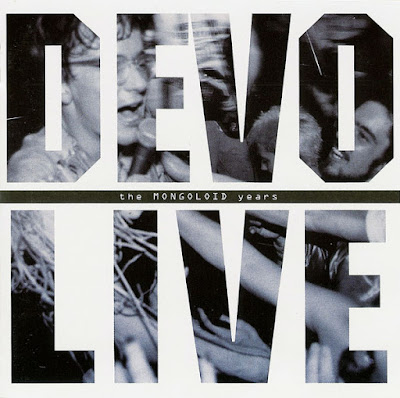
DEVO - "Live" The Mongoloid Years" CD, Album, U.S., 1992 (Rykodisc)


Dealing with my father's death in 1976 was a huge cloud over me.  As for my musical taste at the time, I was looking for a new beginning to get out of the old narrative that was my life.   Not a teenager anymore but barely an adult, I embraced the Punk ethics with a degree of conviction on my part.   Especially for those bands/artists who wanted to start over again and work from ground zero and on up.  I can quickly forget my past music heroes such as The Beatles, The Stones and everyone else (except Bowie, I was and am a devoted fan). So something like Sex Pistols appealed to my sense of new, although in truth, there was nothing that new, after all, it's rock n' roll.  As for myself, I was drowning with my past, and I needed something new to feel alive again.  DEVO came to Los Angeles in 1976, and I discovered their music when I purchased an independent 45 rpm single that they put out on their Booji Boy Records.  I remember buying the recording at Bomp Records in the Valley.   The music was harsh, yet dynamic and with an incredible machine-like rhythm.  The sound I was looking for! 

When my friend and I saw them at the Starwood, which I believe was their first appearance in Los Angeles, there was a very small audience.  I saw a few faces that I knew, but I have heard that Iggy Pop was there as well.  Nevertheless, it was and still is, the most incredible concert I have ever been to.  Their intensity and stagecraft were superb.  It was like that they were attached to some electrical force of some sort, and someone turned the switch on.   Throughout 1976 and 1977, I must have seen this band live at least a dozen times. 

The one outstanding musician was their drummer Alan Myers.  He played like a machine, but one with a heart.  Truly he was one of the great drummers on this planet.  You can hear his genius on this album "DEVO LIVE."  When they made their record with Brian Eno, which in theory, is a perfect combination, I was deeply disappointed.  The songs were great, but what went missing was the intensity of their performance.    It seemed like the air in the recording studio was vacuumed out and replaced with a sleeping drug-like ingredient of some sort.   If I weren't so familiar with their live show, I would probably love this album.  But alas, I knew both worlds of DEVO, and this Warner Brothers album is not a good representation of their work.  On the other hand, "DEVO LIVE" recorded between the years 1975 and 1977 is a remarkable document of the band's work but also captures their magnetic intensity.  For me, it is probably one of the great live rock recordings.  And the only great record from DEVO. 

DEVO I feel is a live presentation.  Them in the studio I feel they are in constraints by perhaps technology (which is ironic)  or too much interference from their various producers.  I hear the songs but not the sweat or heart of the band.  I also love their concept of the world to a certain point.  I never felt that they were fair to the female side of the world.  They seemed to be very male orientated, which I found troubling.   On the other hand, I loved their independence.  If I were there manager or advisor, I would have told them never sign to Warner Brothers.  Keep your own record label and just do live recordings.   Make and publish your own books, and make your films without any interference from the outside world.  This, of course, would cause financial ruin, but alas, that is just me. 

Rykodisc put out this magnificent live album on CD, and it serves as a document, but again, it's the dynamic of their music at the time and the way they performed it.  Their sense of theater were both disturbing and seductive.   To be in their audience at the Starwood and other nightclubs was really a fantastic once-in-a-lifetime experience.  The live recording is the real deal.  


Friday, June 2, 2017

Erik Satie/Alan Marks - "Vexations" CD Album, 1990 (Decca)


This piece of music by Erik Satie is one of keen interest.  To quote the liner note:  "It consists of a single page of music, only three lines long, and its full duration is calculated to be a whole day and night."   This, of course, is a masterpiece.  Satie wrote "Vexations" in 1893, yet it took John Cage to give the music its world premiere in 1963.  Cage did an 18-hour performance of the piece using various pianists throughout the day and night.   Which in theory, the piece should last for 24-hours, but alas economics and intensity of the promoters of such a work would be a great challenge.  "Vexations" is made for the CD format.  A regular 12" vinyl usually lasts for 40 minutes, but a CD can last for 80 minutes, and you don't have to change sides, like what you have to do with vinyl.  Still, to be true to Satie's vision, it would take 21 CDs to complete the official work.  Us Avant-Garde fans are waiting for the boxset.  

The late pianist Alan Marks did a 70-minute version, and as far as I know, this 1990 release is the first recording that lasts that long.  There was a vinyl edition made by another artist, and recently there is a recent CD by Stephane Ginsburgh which is one hour and nine minues long.  Nevertheless, all the versions I have heard (Ginsburgh and Marks) are exquisite.  

Whatever Satie meant this piece to be a joke or a serious statement on an aesthetic and the philosophy, we may never know.  The truth is this piece of music is one of the great ambient works on disc/CD.  I play Marks/Vexations to stamp out the world outside my head.  It's a perfect time length to focus on either the music or if you are doing some writing or creative work.  I can imagine just playing the music while you're mopping the floor would be OK as well.  Yet, the piece due to its length is a very demanding work.  For the musician, it must be either a sense of hell or enlightenment. For the listener, it is music that draws you into its world.  There are pieces like "Discreet Music" by Eno that is furniture or wallpaper music, but there is something more demanding in "Vexations."  Perhaps the live aspect that the work lasts so long with a living musician actually following the instructions of the pace, which is slow, or just how one can take so much repetition in a work of aural art.   For me, it's music that makes me both focus on the music lines, but also clears my head to focus on my writing.  It's crucial work.   Joke or art, or both, Satie's "Vexations" is one of the great wonders on this planet. 

Françoise Hardy - "J'Suis D'Accord"/"Tous Les Garçons et les Filles" Vinyl, 7" EP 45RPM (Disques Vogue)


A very early 1962 recording by Fançoise Hardy.  With that voice, her looks and songwriting talent, how can she possibly go wrong, except the one route to Icon Artist.   I love these recordings because, in their way, they're very raw.   "Oh Oh Cheri" is based on a song by a rockabilly singer Bobby Lee Trammell, which is interesting, because it shows how the French music industry takes something so American and somehow can find French aesthetic or taste in that material.  

For me, "Tous Les Garçons et Les Filles" is classic Hardy.  A beautiful melody but with some sort of pathos involved.   What is unique about Hardy is that she can distance herself from the songs, and in a sense, it's like repeating a joke you hear, but maybe you add your own twist to that narrative.  When Hardy sings her own writing or cover, it is always a Françoise Hardy record.   There is nothing cookie-cutter factory about her.  One of the chief reasons why she stands out among the other Yé-Yé singers of her time and country.   A superb E.P.  I also love the cover of this 7" because it's very toned down and in one's face.  A lack of graphics that makes it more real.  In fact, her portrait here reminds me of an official high school photo of a student.  

Tracklist Hide Credits

A1Oh Oh Chéri
Written-By – Trammel*, Jil Et Jan
2:20
A2Il Est Parti Un Jour
Written-By – Hardy*, Samyn*
1:47
B1J'Suis D'Accord
Written-By – Hardy*, Samyn*
2:00
B2Tous Les Garçons Et Les Filles
Written-By – Hardy*, Samyn*


Thursday, June 1, 2017

Marcel Duchamp - "The Entire Musical Work of Marcel Duchamp" Vinyl, LP, UK (Song Cycle Records)


To call Marcel Duchamp the most important or greatest artist of the 20th century seems too small of a credit.  Perhaps one of the great philosophers?  Nevertheless, his stamp on culture and thinking is a remarkable aspect of Duchamp's genius.  For sure, he thought conceptually, where work is important as a visual, but also the thinking of such artwork.  Duchamp approached music the way he approached his art - he thought it out like it was a game.  Everyone knows that chess was just as important (if not more than) as art.  The music he "wrote" are based on the individual who follows his score.  Of course, Duchamp was Fluxus before there was Fluxus.  But those artists basically took the Duchamp method and used it for their own works.  And that's a good thing that happened!

Side one is (hold on to your breath) "LA MARIEE MISE A NU PAR SES ELIBATAIRES, MEME. ERRATUM MUSICAL" (1913) is 25 minutes long and very ambient.  To me, it's a dialogue between the alto flute, trombone, celeste, and glockenspiel.  The intensity of the piece is each instrument either acknowledges the other one, or it sounds like a gentle chase among them.  A chase where the results don't happen in an obvious way.  There is another version of this music piece that is done by a player piano realized by Duchamp.  Not surprisingly the work reminds me of Erik Satie's "Vexations." The Satie piece is made for the background of a room, literally furniture music, but Duchamp's piece is more urgent and demanding.  

"Erratum Musical" (1913) is a vocal piece where each note is picked out of a hat.  The voices are Duchamp and his two sisters. Not on this record mind you, but in the original conception.  "Musical Sculpture" is mysterious.  The liner notes state that this is an "undated, unspecified piece." The sounds here are a toy music box, a horn, and a hum, but that maybe caused by my stereo system.  It's a sweet ending to a very wonderful album. 

The music on this album is played by Petr Kotik and S.E.M. Ensemble in 1976.  Limited edition of 500 copies.  

Frank Sinatra - "Perfectly Frank" CD, Album, 1991 (Bravura)


Excellent collection of Sinatra's performances from his radio show "Perfectly Frank" from the years 1953 to 1955.  In other words, the classic Frank years where he just made one masterpiece album after another.  "Perfectly Frank" is my favorite Sinatra collection, and I suspect that it's a bootleg, but thank god for that.   What makes these recordings so unique are the musicians backing Sinatra on these classic American tunes.  All of them are exceptional, but it's the combination of instruments, especially the electric guitar that makes these recordings unique and extraordinary.  Intimate, as radio should be - because it's voice to a listener and the selection of songs are excellent.  No strings, no brass, just the magic that is Sinatra with his small combo, doing these fantastic broadcasts.  Such a perfect setting.  Probably not the easiest recordings to find, but very much worth the hunt. 


racklist Hide Credits

Opening Theme And Introduction
1.1This Can´t Be Love
Written-By – Rodgers-Hart*
2Nevertheless
Written-By – Kalmar*, Harry Ruby
3What Can I Say After I Say I'm Sorry 
Written-By – Lyman*, Donaldson*
4Hello Young Lovers
Written-By – Rodgers-Hammerstein II*
5Love Me Or Leave Me
Written-By – Kahn*, Donaldson*
6I'll String Along With You
Written-By – Dubin*, Warren*
7You Took Advantage Of Me
Written-By – Rodgers-Hart*
8Just You, Just Me
Written-By – Greer*, Klages*
9Let´s Fall In Love
Written-By – Arlen*, Koehler*
10Them There Eyes
Written-By – Tauber*, Pinkard*, Tracey*
11Come Rain Or Come Shine
Written-By – Arlen-Mercer*
12Somebody Loves Me
Written-By – MacDonald*, DeSylva*, Gershwin*
13I´m In The Mood For Love
Written-By – Fields*, McHugh*
14On The Sunnyside Of The Street
Written-By – Fields*, McHugh*
15S'Wonderful
Written-By – Gershwin-I.Gershwin*
16Under A Blanket Of Blue
Written-By – Neiburg*, Symes*
17I Don't Know Why (I Love You Like I Do)
Written-By – Ahlert*, Turk*
18Sometimes I'm Happy
Written-By – Caesar*, Youmans*
19Don't Blame Me
Written-By – Fields*, McHugh*
20Thou Swell
Written-By – Rodgers-Hart*
21I'm Confessin'
Written-By – Daugherty*, Reynolds*
22Out Of Nowhere
Written-By – Heyman*, Green*
23One Hundred Years From Today
Written-By – Washington*, Young*
24Between The Devil And The Deep Blue Sea
Written-By – Arlen*, Koehler*
25Tenderly
Written-By – Lawrence*, Gross*
26You Must Have Been A Beautiful Baby
Written-By – Warren*, Mercer*
27Taking A Chance On Love
Written-By – Latouche*, Fetter*, Duke*
28Hands Across The Table
Written-By – Delettre*, Parish*
29What Is This Thing Called Love?
Written-By – Porter*
30If I Could Be With You (One Hour Tonight)
Written By – Creamer, Johnson
31Night And Day
Written-By – Porter*