Total Pageviews

Showing posts with label Mick Karn. Show all posts

Wednesday, November 20, 2019

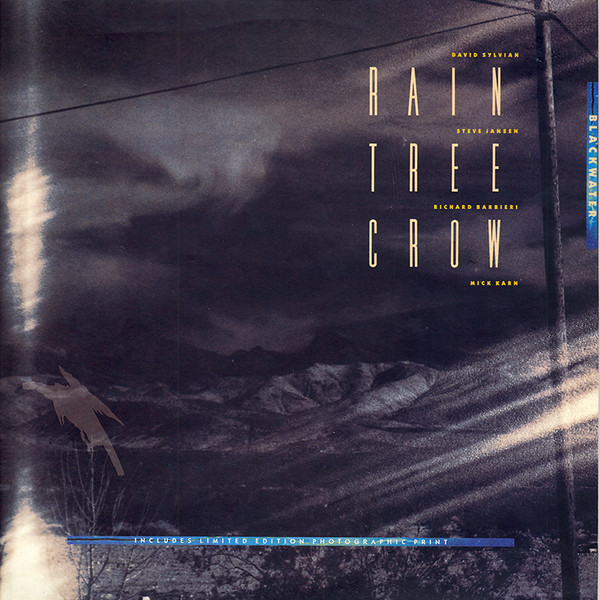
Rain Tree Crow - "Rain Tree Crow" Vinyl, LP, Album, Reissue, 1991/2019 (Virgin)


Rain Tree Crow is the band Japan, with all four original members (David Sylvian, Mick Karn, Steve Jansen, & Richard Barbieri). This album is a reunion after Japan broke up. Why they didn't keep the name, Japan, is a mystery to me. When the record was released in 1991, it didn't make significant noise in the music press nor anywhere else for that matter, which is a shame, because this is a beautiful record.

The first cut "Big Wheels in Shanty Town" is very similar sounding to the David Byrne/Brian Eno's album, in that it has a groove that's "World" music like, but then David Sylvian's croon makes it their music. Sylvian and company, which I suspect were under the influence of Can while making this album, is a series of improvisions done in the studio. What was perhaps a 'jam' album becomes tight compositions. The appeal of Rain Tree Crow is that what they do is not original, but that they can take the concept or riff and make it their own.

Their sound (as in Japan as well) is very distinctive of their collaborations. Barbieri has that unique ambient electronic sound that gives the material a foundation. Then you add Karn's distinctive brass arrangements and fretless bass, with the creative percussion by Jansen. Then Sylvian adds effects, and importantly, his Bryan Ferry-like croon. What once was an inspiration, now is very much part of the Sylvian aesthetic. The great song is "Blackwater," which is a stunning ballad. It builds to a certain level and then floats like a cloud seen from a distance. The album, in whole, works in that fashion.  

Sunday, July 8, 2018

Rain Tree Crow - "Blackwater" b/w "Red Earth" & "I Drink To Forget" 12" Vinyl, 45 rpm, Limited Edition, 1991 (Virgin)


In reality, Rain Tree Crow is the band Japan.  Why they changed their name when they decided to get back together to make an album is a mystery to me.  Still, this 12" single is one of their best songs.  "Blackwater" is a beautiful moody melody that expresses not exactly a romance, but the essence of looking back, and the need to move on.   Mick Karn, Steve Jansen, Richard Barbieri, and of course David Sylvian, with assistance from guitarist and Cocteau fan Bill Nelson.  Mellow, with the ultimate Sylvian croon, "Blackwater" is a dream existence or location that one can feel, but maybe never touch or be in that location again.  It's a sad song.  It's melancholy with traces of wistfulness.   

Side two of this 12" single are two instrumentals.  "Red Earth" is on the Rain Tree Crow album, and it's very cinematic I think due to Brian Gascoigne's orchestration, and he also worked with Scott Walker's later recordings.  "I Drink To Forget" (don't we all) is prepared piano played by Sylvian with the rest of the band doing electronics is very slight, and it's almost an afterthought, but it is also very beautiful in its nature.  

Friday, April 27, 2018

Rain Tree Crow (Japan) - "Blackwater" b/w "Red Earth" & "I Drink to Forget" Vinyl 12" 45 rpm, Limited Edition, 1991 (Virgin)


For whatever reasons, the band Japan decided to regroup to make an album under the name of Rain Tree Crow.   David Sylvian, Mick Karn, Steven Jansen, and Richard Barbieri co-wrote all the music, but Sylvian dominated the lyrics.   I have the album on CD, but I just recently found a copy of a limited edition 12" of one of the songs that are on the album, "Blackwater." 

Without a doubt, it is one of the most beautiful recordings from Sylvian and company with an elegant melody played with great sensitivity by all above, including guest guitarist Bill Nelson.  It's ironic that this song is hidden in the Rain Tree Crow project, even though it is on a Sylvian compilation, it really needs full attention from Japan fans and elsewhere.  Whatever it is tensioned between Sylvian and Karn that caused the unit to break up, they clearly work well together, with respect to the results of their recordings.   Both have an interest in Eastern music or melodies, and it's borderline tragic that they didn't stick it out to make further albums.  The Sylvian and Karn solo recordings are good, but I often listen to a Sylvian solo release and think "where's Karn's fretless bass?"  Still, perhaps it wasn't meant to be.  At least Japan has made three excellent albums and Rain Tree Crow is very good as well.  Although it's a mystery to me why they didn't go under the name of Japan. Legal reasons?   It's a stupid name for a band, and maybe they wanted a fresh start.  Nevertheless, "Blackwater" is a great record.  

Monday, March 12, 2018

Japan - "Quiet Life" Vinyl, LP, Album, Japan, 1979 (Hansa)


As I mentioned in an earlier review of a Japan album, I would never buy one of their albums due to their name.   It's a general rule that any band that names themselves after a country, a state in the United States, or even a city, are usually terrible.  The two exceptions are the bands the United States of America and of course, Japan.   I first discovered Japan from their album "Tin Drum," which was also their last studio release before splitting up.  "Quiet Life" is an important album for the group.  Their third album and the one that broke off their previous two albums in sound and vision. 

David Sylvian gets his crooning voice in order and the band plays with textures that at first reminds me of Roxy Music, and obviously influenced by Bryan Ferry and company, but took that sound to another place.  I was going to say another level, but Roxy Music and Japan are very different from each other.  Ferry is very much focused on the ideal female - not even a woman, but a presence that is almost ghost-like in his imagination.  Sylvian is more spiritually inclined and in many ways more sensual than Roxy, but also quieter.  I think Eno's "Another Green World" is another influence on the band, in that it is making music for reflection than action.  Mick Karn's presence is felt strongly, and it's interesting to note that Sylvian on the Japan releases is always the cover figure and Karn lurks in the back cover, the placement for a writer or arranger.  Still, this is a fantastic band that blends the sounds in a natural manner, that is suitable for Japan.  

The songs on "Quiet Life" is uptempo in parts, but the future sound is clearly marked.  The song "Quiet Life" is a quiet anthem, and it has a glam overture with the phrase 'Boys..' - and the beautiful string arrangement by Ann O'Dell on "The Other Side of Life" is exquisite.   There is also a cover of The Velvet Underground's "All Tomorrow's Parties," which is suited to the Sylvian croon.  Simon Naiper-Bell managed Japan, and the early Sylvian career, which strikes me as an odd relationship. Only considering that the great Napier-Bell (I'm a fan) went on to manage Wham! and George Michaels, as well as The Yardbirds, and early Marc Bolan.  He co-produced this track, but most of the production work is from John Punter, who worked on the solo Bryan Ferry recordings.  

Ironically I bought this album in Tokyo and this version of "Quiet Life" is the Japanese vinyl edition. It comes with a poster, liner notes (in Japanese) as well as the lyrics both in Japanese and English. 


Wednesday, February 7, 2018

Midge Ure & Mick Karn - "After A Fashion" b/w "Textures" 12" Vinyl, 45 rpm, 1983 (Chrysalis)


One of the things I love about the New Romantics period in pop is artists embracing the foreign and at the time, very exotic landscapes on this planet.  In a sense, they take the idea from Paul Bowles, not only as a writer, but his iconic personality as the Westerner in the exotic Middle East, or North Africa.   Bands like Duran Duran, Japan, and Ultravox liked to present themselves as an international artist(s) in a very adventurous world.   Very much of an exploitation in theory, because when you get down to it, we're all tourists.  Which I think is the most honest aspect of The New Romantics era.  Once in awhile great music comes from the juxtaposition of British pop (once part of the grand occupation) and the world that is out there.  We can almost taste it, but at the time we could only admire the tourist postcards, or in this case, album covers or publicity photographs.  Mick Karn is very much the exotic musician who started from one place and ended up embracing the world.  "After A Fashion"a one-off recording by two musicians who were prominent in British pop during the early 1980s.  Midge Ure I suspect was the more successful pop star due to his musical history with other bands, but especially with Ultravox.  

Karn was the brilliant fretless bassist, and who added exotic color to David Sylvian's Japan.  The sounds he made from his bass was like liquid being poured into a glass, or on the sand.   His textural playing and compositions (especially on his early solo albums) reflect on a world that was exciting, and sexual.  Midge Ure in his fashion (no pun intended) also explored the same landscape but through a more pop format than Karn and Japan.  What makes this 12" single fascinating is the combination of Ure's pop awareness with Karn's outer world sounds.  

The 7" single is very different than the 12", in that the song is expanded in a textural manner that flirts with the main chorus.   Almost a dub version, but not quite.  I have to imagine that it's only Karn and Ure on this recording, doing all the instruments.  It has that 'studio' feel and truly the image on the cover of this long single, is quite accurate.  The picture of Ure and Karn in Egypt is both a postcard as well as a visual interpretation of the sounds with on the record.  Paul Bowles had taken numerous photos of himself among the desert of North Africa, and for the literate or aware, this is clearly the influence of Ure and Karn's "After A Fashion."  The b-side is an instrumental that is a sound piece that reflects the aesthetic of travel and being aware of one's limits.  

Tuesday, November 28, 2017

Dalis Car - "The Waking Hours" Vinyl, LP, Album, 1984 (Paradox Records)


Dalis Car is truth in advertising.  Mick Karn from Japan and Peter Murphy from Bauhaus.  Both talented musicians from bands with the worse names.  Dalis Car is just as bad as a name for a band, but if we ignore that little fact, the music is quite awarding.   Both Murphy and Karn have/had an aesthetic that is very much based on East European or Asian sounds.  Listening to their album "The Waking Hours" is very much like going to a great metaphysical bookstore that covers spiritual practices not only in the West but also other parts of the world.  Murphy as the vocalist moved from the goth/Bowie world into a figure that's exploring other worlds.  I think of the relationship between Karn and Murphy such as Jean Cocteau's two main characters in his film "Orpheus."   Murphy playing the Orphée role and Karn as Heurtebise.  Leading one to another world.

The Waking Hours" (very Cocteau like) is very much Mick Karn playing all the instruments, including the magnificent fretless bass, that he mastered with sparse instrumentation to give Murphy a lot of room for his vocals.  It's interesting to note, as a Japan fan, to notice the differences between the David Sylvian (Japan's main writer and vocalist) and the Karn solo/project works.  Sylvian opens up his recording where there's a lot of space, but Karn sounds like he's working in a very small room which contains the sound.  It's not Mono, but the sound comes from one direction. Like in Japan, the bass is the lead instrument, and Karn had the knack to make his instrumental skills very punk-like (although not in sound) in that there is a DIY mentality in his recordings.  Dalis Car is not a band, but Mick Karn doing all the music and Murphy adding the vocals. 

I don't know if Dalis Car was meant to go on after this album, but for me, I don't think there was a need for another album from the Karn/Murphy duo.   This is very much a great listening experience and I miss the late Mick Karn greatly. 


Saturday, October 28, 2017

Japan - "Oil On Canvas" 2 X Vinyl, LP, Album, Live, 1983 (Virgin)


David Sylvian, Mick Karn, Richard Barbieri and Steve Jansen and on this album, guest guitarist from the country Japan is Masami Tsuchiya.  Not to be confused with the name of the band, which is Japan.  I loathe groups that name themselves after countries, cities or even states, but Japan is a different type of category.   As mentioned before in other of my writings, I have always felt Japan were influenced by Roxy Music, if not in style, in the music adventuresome of the Eno era of that band.   What I first thought was imitation, it eventually turns into originality.   I can't think of another group at the moment that had that odd journey to me.    I fell in love with Japan because of Mick Karn's darkened eyes and David Sylvian's mixture of preppy clothing and makeup.  Japan physically and musically changed in a rapid process from glam rock guys after that movement to a more spiritual and at times, border on a New Age aesthetic.  Sylvian and company have the good taste to go to the root of their obsessions.  Joseph Beuys, Jean Cocteau, Erik Satie, and a Westerner's fascination with the Asian East.  That, in a nutshell, is Japan. 

One thing Japan never was, is an overnight sensation.  With the assistance from their (brilliant memoirist) Simon Napier-Bell, he engineered their changes and a darker melancholy into a salable hit in England and oddly enough, in Japan.   The band at the end of their career as a group worked out a sound that was minimal and ambient but still had a funk rhythm, with Sylvian sad sounding vocalizing.  The combination was hard for me to avoid, and I ended up purchasing not only their original albums but also all the 12" remixes and the very few b-sides.   "Oil On Canvas" was the last official release from Japan, and it's a live album.  

For the tour, they brought in Masami Tsuchiya, who was at the time, in a band called Ippu-do.   At the time that band sounded like a combination of Bill Nelson and Japan, so his guitar work, as well as his aesthetic (makeup), fitted perfectly in the Japan format and sound.  It's a shame that he never became a permanent band member for recordings.   Still, this is a live album that is not a museum nor a document of a live show.   Among the live recordings are three studio pieces.  "Oil on Canvas" (composed and performed by Sylvian, and very Satie sounding), "Voices Raised In Welcome, Hands Held in Prayer" (composed and performed by Sylvian and Jansen) and to finish off the album "Temple of Dawn" composed and performed by Barbieri.    It's interesting that these instrumentals are placed in the beginning, the end of side two, and the last is the finishing track on side 4.   All of them frame the live material in the sense that these pieces expose the musicians' interest and future, while the rest of the album is very much like the studio recordings.  The riffs are longer, and the songs are stretched out, but not that far from the studio work.   So like "Oil on Canvas" as you mix paint, it becomes something new or an added texture.  I think Japan was of that opinion in that line of thought as well.   I don't feel this album is a product but in actuality a statement of sorts.  The great painter, Frank Auerbach's work, is on the cover, and he's known for his portraits that merge from massive paint strokes.  

The classic Japan sound is really two instruments up front.  That is David Sylvian's voice and Mick Karn's fretless bass.  The rest of the instrumentation backs up those two sounds, and this is what makes Japan so unique and wonderful.  


Tuesday, September 12, 2017

Japan - "Quiet Life" CD, Album, Reissue, 2001/1979 (BMG)


When the most unfashionable band in existence became the most fashionable band in the era of the new romantic.   How they made that work is a total mystery to me.  Japan's first two albums I have heard bits and pieces but never could take them seriously due to their appearance and worse, the name of their band.  It's common knowledge that bands that name themselves after places, especially countries, in theory, suck.   Yet somehow, David Sylvian, Mick Karn, Steve Jansen (David's brother), Richard Barbieri and guitarist Rob Dean managed to turn themselves into sophisticated sonic artists. 
It's like they made a deal with Satan at the crossroads.  Nevertheless, it must have been an 'ah-ha' moment for all those involved. 

What's interesting, and who I think is an essential person in their change of tactics is their producer John Punter.  Punter worked with Bryan Ferry and Roxy Music on their/his early solo recordings  The first thing I think of when listening to Japan is Roxy Music.  Sylvian took on the Bryan Ferry voice mannerisms, and the instruments became more Roxy like, but with additional sonic textures that were their own making.  The interesting thing about Sylvian is that he truly transform himself into a different type of singer/performer/writer.  Sylvian's songs reflected his mood, but with a European icy aesthetic that pretty much removed them from their London roots.  Also in future recordings, they worked with Steve Nye, another long-term Roxy/Eno associate.  The results of these relationships and in the band's artistry is remarkable. 

"Quiet Life" is the first 'new' version of Japan.  The original vinyl album had eight songs, but the CD reissue has 12 altogether, with two being remixes for the 12" market, and the additional "Life in Tokyo" produced and co-written by the great Giorgio Moroder.   Sylvian is not a man of action, but a figure who reflects on his surroundings, and contemplates on the nature of his world.  With his deep ballad (Ferry like) croon, his voice floats over the instrumentation, which has one very particular instrument - and that's Mick Karn's fretless bass.  Karn is the secret ingredient to Japan's success. Sylvian looked like a cross-dressing fashion model out of Vogue, but Karn had a Mediterranian good looking vibe, but also his distinctive playing of the bass is a huge part of their overall sound.  In a sense, it is like there are two singers in Japan.  Sylvian with his voice and the other voice is the bass.  Also noted is that the front cover is Sylvian by himself, but the back cover is Karn. Which suggests that the band is Sylvan on one side, and the other is Karn, with the rest of the group being in the middle of those two, as they are displayed in the inner sleeve. The keyboard work from  Barbieri (as well as Sylvian) is never based on chords, but more with sound. It's very organized musiques concréte, with jazz-like drumming from Jansen.  

The weird juxtaposition of them being pin-up teen idols, but with a very sophisticated sound must have been an odd experience for both the fan and musicians.   Although the music is loose, it is still very contained in an airless box, which makes listening to a "Quiet Life" an exciting experience.  The songs are all beautiful.  The pacing is quite slow, but it's the textures that keep one's interest throughout the album.  Their cover of the Velvet Underground's "All Tomorrow's Parties" is a perfect vehicle of a song for them to do.  On the surface captures the sense of dread within a social world, and Japan, at this point, is out of that world, and in a much-confined inner-world.  

"Quiet Life" is by no means an ambient album, but I think a listener can tell that the group was heading toward a place that is 'furniture music' (Satie), but here they still explore the boundaries of the pop music format.  If the new listener can get past their silly name, one will be awarded an impressive landscape that is Japan's music. 


Thursday, August 31, 2017

Mick Karn - "Titles" CD, Album, Reissue, 1990/1982 (Caroline)


Bass playing in my listening experience is not always, but usually distinctive to a specific player.  Mick Karn, I can identify within a few seconds of his playing. For one, he plays a fretless bass, and the way he treats melodies is like containing water by cupping your hand. It will slowly leak out, but the essence of the taste of the cool water will stay with you.  Karn's playing works in the same fashion.   It throbs with sexuality, and it is almost like hearing someone crying.   Karn was a member of the band Japan.   His bass playing for that band was essential to their overall sound.  David Sylvian the lead singer and writer for Japan never really changed that much in his solo recordings, except maybe be more experimental in its overall sound.  Still, when I hear the Sylvian solo release, I think, where is Mick?    And when I listen to Karn's solo recordings, I think "where's David."  In truth, or whatever their problem was, they needed each other.  The original band should have never broken up, even though I do enjoy the solo recordings by both artists. 

"Titles" is the first solo Mick Karn album.   One would not expect that much because he's not known as a composer or songwriter, but still, the bass playing is the essence of everything he did.  The truth is "Titles" is a very good album.  Ambient in parts, and totally exotic sounding throughout the record.  It reminds me of David Bowie's "Low," in that Karn gives in to the instrumental side of the world.  The album features members of Japan (except David of course), but it's mostly Karn doing all the overdubs and it's great noise.  Spiritual in a pop sensibility way, the album is Karn stretching out his muscles and brain.  His death from Cancer was a terrible tragedy.  As I mention, the bass playing is very individual practice, and with him out of the picture, we lost a unique and brilliant musician. 

Monday, May 8, 2017

Japan - "Tin Drum" CD Album, Reissue, 1994 original release 1981 (Virgin)


This was my first introduction to the band Japan, and the voice of David Sylvian.  My first hearing experience was "a Roxy Music rip-off."  And on top of that, what a horrible name for a band.  It's common knowledge that any band that names itself after a city, a state, a country or continent, sucks.  But I do have to admit, it's a great album cover.   The second listening experience brought me pleasures that are still with me.   Japan was a very original band.  

Sylvian's voice is very mannered in the Bryan Ferry mode, but he uses it in a different method with respect to his music.  As for the band, the strongest presence on "Tin Drum is Mick Karn's fretless bass playing.  A remarkable musician.  To me, he's the Brian Jones of the band.  The rest of the instrumentation the drums or percussion is sparse (by Sylvian's brother Steve Jansen) but in a very jazzy complexed manner.  The keyboards (Richard Barbieri) add electronic effects that are mood more than melody.  Sylvian carries the melody in his vocals.  The band and recording (by the great Steve Nye) are tight.  Almost if the air has been sucked out of the room.  

On the surface, it's Asian sounding, but why?  It's almost like a Wittgenstein response in that you know what's in front of you, but one can't define the experience.  There are song titles that bring the image for instance "Cantonese Boy," "Visions of China," and "Canton."  But it's a very romantic, yet at the same time, dry look at a culture or country.  This is not negative criticism.  I think Japan is exploring worlds that are known, but to them at the time, perhaps not that well known.  

The band is eye-candy as well.  You can't go wrong with a group of young guys in make-up.  But their style at this time was sort of like Asian minimal chic, with a touch of Brooks Brothers button collar shirts, but of course, with make-up.   Fans take them seriously, but I think if there was no Japan there would be no Radiohead.