Total Pageviews

Showing posts with label Steve Reich. Show all posts

Monday, February 26, 2018

Philip Glass - "Solo Music" Vinyl, LP, Album, 1975 (Shandar)


There are two different periods in Philip Glass's work or recordings.  The early works were truly minimal, and the later operas, orchestrations, are very much driven by melody.  Both periods have driven rhythms, but there is something special about the early works that I like a lot.  There is a zen quality to the work, that I don't want to say puts me in a spiritual place, but more aware of my mind going to other worlds.  Steve Reich hits me differently, because I'm aware of a system taking place, but Glass strikes me as being more emotional and riff-driven in that making a fist and hitting the air stance. 

"Contrary Motion" on side one is just Glass and his electric organ.  It's not a peaceful existence, but it is one that makes me sit down and listen to the work.  I never want to read the liner notes of a Glass album while I'm playing the record, on the other hand, I tend to read Reich's album notes, because of the structure of that piece being put together.   Reich is conceptual that focuses on the practice as well as the sound and Glass I think is just music.   Both do have a strong visual sensibility, but looking at the back cover of "Solo Music" it does truly look like a Brice Marden work of art.  A great album. 


Sunday, September 24, 2017

Steve Reich - "Drumming/Music for Mallet Instruments, Voices & Organ/Six Pianos" 3XVinyl Box Set, 1974 (Deutsche Grammophon)


The ultimate recording from Steve Reich.  Three albums of minimal persuasion and keyboard work that is maximum in scope and sound.   Reich's work is not meditative music, but one where the listener has to sit in front of the speakers and let this aural wash come and take you over. I have to presume that these three albums were released separately, but due to some marketing genius on the label has decided to make it into a Box-Set.  Going through all three albums in one sitting may be tough, not because of the work itself, but each piece is a demanding presence in one's life. For me, it has an exotic appeal, because I think of mallets coming from a foreign island in the Pacific.  Again, what do I know, but that is the visual image I get while listening to "Music for Mallet Instruments, Voices & Organ." 

All pieces by Reich strike me as a pattern.  When I hear this music, I see structures or things being attached to each other.  There is an architectural quality to Reich's compositions.  There's a foundation built, and then he adds textures on top of that landscape, and I feel he's building from the ground and then up to the sky.   I'm sure there is a spiritual aspect to Reich, but for me, it is more about the mechanics of life, as if it was a cycle.  The Four Seasons, Sunday through Saturday, the 24-hour day, I feel all of that is very much part of Reich's aesthetic.  So when you go into Reich's world, you have to surrender 'your' sense of time and be merged into the Reich world. 


Tuesday, September 5, 2017

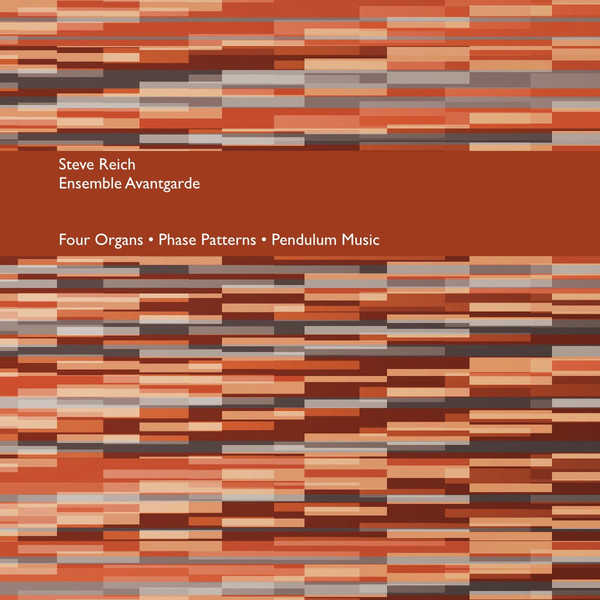
Steve Reich, Ensemble Avantgarde - "Four Organs" / "Phase Patterns" / "Pendulum Music" Limited Edition, Vinyl, LP, 2014 (Karlrecords)


"Four Organs" is actually more than four organs, it also features the maracas, which is a big part of the piece.  Four electric organs that play in short bursts of a note, but as the piece goes on, the notes become longer, yet the crazy maracas stay in place and in the beat. What makes this work listenable to me at the very least, is the dynamic relationship between the organs and maracas.   It's a remarkable piece of music, and when played loud, it brings a new meaning to a sense of bliss. 

"Pendulum Music" is an early work (1968) that consist of microphones, amplifiers, and loudspeakers.   It sounds like a sea creature in a mating call.  The key element here is the rhythm, which is prominent in all three pieces here by Steve Reich.  "Phase Patterns" is another work with four organs, and it's more frantic, but oddly enough a meditative piece of work. Reich always seemed to me to be a composer who is inspired by the sounds of life - traffic noise, electricity running through a fridge or speakers - he makes these sounds into a strong rhythmic melody.  I have to imagine that it's a high of sorts for the musician who plays these music pieces.  It's about discipline.  A lot of modern works, such as John Cage, is about noise being organized.  I think Cage and Reich do have a relationship through their music.  Different sounds, techniques, yet there is a rigid way of looking at the world.  Open, yet see the world in a frame.  

Tuesday, April 25, 2017

Sonic Youth - "Goodbye 20th Century" 2 x Vinyl, LP, Album, U.S. (Sonic Youth Records - SYR4)


For the past few years, I have been interested in purchasing 20th-century experimental/classical music on vinyl.   The medium of vinyl is important to me because I listen to music differently on vinyl than say through my computer.   For me, I like to jump into the aural landscape without being interrupted by words, things, or anything else around me.  So, yesterday I purchased an album that I have wanted to hear for awhile now.  "Goodbye 20th Century" (a great title by the way, especially since this album was recorded in 1999) is Sonic Youth performing avant-garde classical music by legendary composers.  Christian Wolff, Pauline Oliveros, James Tenney, John Cage, Takehisa Kosugi, Yoko Ono, Nicolas Slonimsky, Cornelius Cardew (a composer I want to be more familiar with), George Maciunas, and Steve Reich.  

I have the John Cage/Christian Wolff album, which I love.  I think that specific album was recorded in the early 1960s, and it's an amazing document.  Wolff actually worked with Sonic Youth in the studio for his two recordings on this album.   Of all the composers I find him to be the most Cage-like, but that is my take on the sound of his work.  I never read an essay on or by him, so I'm very much an amateur listener at this point.  "Burdocks" for me is great.   Having Christian Marclay on turntables on this track really adds an intensity to the piece.   But beyond that, I don't find any weaknesses on this album.  The other composer who is on this album, and covered by Sonic Youth is Takehisa Kosugi.   It's very much a collaborative work.   Besides the fab four, there is Jim O'Rourke (before he officially joined the band), and William Winant among others.

What impresses me is that this is very much of a Sonic Youth album.  With guest stars of course.  It's interesting to hear a rock band (in theory) covering the territory of the avant-garde.  They do so with a large respect for the material but also don't give up the core sound of Sonic Youth.  When Kim Gordon gives a vocal, it immediately reminds me of Ennio Morricone's film scores -especially when he scored horror/sexy films from the 1970s.  Come to think of it, Morricone would fit like a hand in a glove on this album.   An excellent album. 


Tuesday, October 25, 2016

John Cage/Steve Reich/Michael Tilson/Ralph Gierson - "Three Dances & "Four Organs) Vinyl LP (Angel Records)


I had this vinyl album when it first came out in 1976.  I lost it over the ages, but recently found it at my local record store 'Rockaway' on Glendale Blvd.  It's a fascinating to hear these two very different pieces on one album. "Four Organs" is what it is - four electric organs playing the same notes over and over again, with maracas keeping the beat.   Written in 1970, the cords get longer, as the beat stays consistent.  It's meditative, but also really captures the listener's attention.  For me, I love the sound of the electric organ and having four of them going on the same time, is my vision of aural bliss.  This is the original recording of this work, played by Michael Tilson Thomas (a big figure in Los Angeles classical world), Ralph Gierson, Roger Kellaway and the composer himself, Steve Reich.  There is a much more recent version of this work, and when I have time, I will compare the two. 

Side one belongs to John Cage. Thomas and Gierson on two amplified prepared pianos, and it's intense.  Cage wrote this piece, "Three Dances" in 1944, and it is punk like in its attack on the altered pianos. It's beautiful, yet very foreign sounding.  The interesting point here is that Cage looked beyond the piano keyboard to find or make new sounds out of the standard instrument.   Very rhythmic, with layers of sound on top of it.   To meditate and reflect.  The duo that never gets old.