Total Pageviews

Wednesday, August 9, 2017

Egisto Macchi - "Città Notte" (Vinyl, LP, Album, Reissue, Remastered, 2015/1972 (The Omni Recording Corporation)


"città notte," (Night City) the album by Egisto Macchi is a masterpiece.  A pal of Ennio Morricone, as well as both of them being part of the experimental and free-flowing Gruppo di Improvvisazione Nuova Consonanza.  This is a very focused album of compositional music, but using the instrumentation in startling aural textures.  Macchi's approach is to express an urban area (a city) as a subject matter for this album.  It's abstract space, but no doubt Italian.  

From moment to moment "città notte" can change from lush strings to snarling electric guitar.  Or both.   When you have the beauty of the strings mixed in with harsh sounds of a guitar, or organ, it brings out the grandeur of the piece.  Pain and pleasure equal bliss.  Sparseness yet the aural canvas will eventually be full.  There are no specific credits in who plays what on this album, recorded in 1972, but it's more of a hunch that Morricone plays trumpet, and it's almost like the sound of someone spitting against the wind. 

On a financial level, I think this album was made for film production houses which need a certain type of music - mood pieces, or something romantic at times. Listening to it as an album project, which I suspect Macchi was playing both ends of the spectrum, is superb.  It is truly a mix of the experimental, the gorgeous melodies, and an exploration of sound, and how it can transform a space.  Playing this album in a room that is great for sound, it can't help but impress the listener. 


Tuesday, August 8, 2017

Ennio Morricone - "Comandamenti per un Gangster" (OST) Vinyl, LP, Album, Limited Edition, 2015 (Dagored)


The album as perfection.   From the graphics of the cover to the vinyl design to the aural delights within the package, it's a must to obtain and enjoy.  For me, Ennio Morricone is one of the greatest composers of the 20th century.  The mixture of instruments, the haunting melodies, and the imagination that goes through his compositions is magnificence at work.   "Comandamenti per un Gangster" is basically two songs, but totally re-arranged to give it a new listening experience. It never grows old, and one is amazed at the arrangements by Bruno Nicolai.  

The music on this album is very much in one's face.  Some original soundtrack music is very ambient and there to serve the images on the screen, but Morricone is listenable without the specific images coming from the projected light.  One can tell that this is not a romantic score but tied in with elements of suspense and violence.  Beyond that, it's a landscape of sound that is one moment soothing, and then gripping in its intensity.  This album should be played loud with all the windows in the house closed. Don't have mercy for your neighbors down below or next door.  


Monday, August 7, 2017

Richard Strauss/Elisabeth Schwarzkopf, George Szell, Berlin Radio Symphony Orchestra - "Four Last Songs" LP, Vinyl (Angel Records)


Not a bad find for $1.99 at Amoeba Music in Hollywood.  At this point in my life, I know very little about classical music.  My main gateway to that world is Glenn Gould.  Which I suspect is a perverse entrance to 'long-hair' music.  This year, and due to classical music selections in various used record stores, I'm finding a lot of great sounds.   Richard Strauss "Four Last Songs" was totally unknown to me, except for David Bowie's love for this music.   If Bowie loved it, then I'm going to listen to it.  I don't have the actual recording that he had, but the Elisabeth Schwarzkopf / George Szell version is a wow. 

Strauss wrote the "Four Last Songs" as a parting gift or a reflexion on approaching death.  Goth classical?  No, not exactly.  Three of the songs have text by Hermann Hesse.  They're simple, but with stark imagery of time passing, and the moment when peace arrives.  It's not a downer but emotionally charged, with a profound sense of soul.  Which comes to Schwarzkopf's voice which is amazing.  A stunning looking woman, with a beautiful voice, what can go wrong?  Well, she does have a murky relationship with Hitler and company, that is similar to the relationship between Leni Riefenstahl and the Nazis. Nevertheless, a fascinating biography that needs to be read by me (and you).  Still, her singing is a perfect element in the cocktail of Strauss's music with the addition of Szell's orchestration.  

The flip side is five additional songs that are just as great as "The Last Four Songs."  Strauss was one of Glenn Gould's favorite composers, and now hearing this album, I need to explore this composer's music.  And oddly enough, Gould recorded some of Strauss's songs with Schwarzkopf, that apparently didn't go well.   It makes my head explode thinking of those two in the same room.   Sony put out a CD of those recordings, but I haven't had the chance to locate the CD, but it is on YouTube. Also, I suspect that I'm going to purchase more versions of Strauss's "Four Last Songs" in the very near future.   Any recommendations?


Sunday, August 6, 2017

Manfred Mann - "This Is... Manfred Mann" Vinyl, LP, Compilation, 1970 (Philips)


The Paul Jones era of Manfred Mann is what I know best of this band.  When Mike D'Abo took over as the lead vocalist, I either lost my attention to them, or more to the fact, that they became very European orientated with respect to marketing and didn't follow them just due to that fact. Although they had a massive hit here in the States with Bob Dylan's "Mighty Quinn" it was a one-shot deal for me and my ears.  Alas, there are hidden treasures in the later Mandred Mann world.  

At heart, and what makes Manfred Mann the band interesting is that they are basically blues players with a healthy appreciation for jazz. Mann was always a jazz keyboard player who happened dip his toes into the world of pop.   Paul Jones (to this day) had an organic appreciation of the blues and was once considered to be the lead singer for the Rolling Stones, due to his friendship with Brian Jones.  When D'Abo took over vocal duties, this led the band to a more pop format.   And here on this compilation album is the highlights of the D'Abo years with Manfred Mann.  I, for one, is a huge fan of the song "Ha Ha! Said the Clown."   The Yardbirds (with Jimmy Page) also recorded this song around the same time that Manfred and crew recorded it.  There is not a huge mega difference between the two recordings, except Manfred does have a jazz feel for his material, even if it's a straight ahead pop song. 

Side two is the real deal for me.  For the sole reason, there are three Manfred Mann instrumentals.  I suspect that these were recorded between lead singers, and they had to release something in the meantime.   They do "Sweet Pea" (by Tommy Roe), "Wild Thing" (the Troggs legendary song), and the French classic "Autumn Leaves."  Here we get the hardcore Soho London jazz version of the band, which I suspect is the real Manfred at work and play.  I wrote about their EP that they released in 1968, that was all instrumental.  "Wild Thing" was part of that package, but the other two were not on the EP.   Their version of "Sweet Pea" is essential Manfred listening experience.  Mann is an excellent organist, and the band is having a great time exploring this song up, and then putting it back in its proper pop mode.    The British Invasion Manfred Mann was a great band.  They also had inside track into Bob Dylan songs, and I think that when they handle a Bob piece, it's the best version of that song.    Not the easiest album to find, but worth while, if only for their jazz instrumentals.  And yes, of course, "Ha Ha!, Said The Clown." 


Saturday, August 5, 2017

Robert Wyatt - "68'" Blue Vinyl, LP, Limited Edition, Album, 2013 (Cuneiform Records)


Robert Wyatt is one of the wonders of the music planet.  Is there even a bad record with Wyatt's connection in existence?  I don't think so.   When you're going through his catalog of recordings, you're choosing from pretty good to exceptionally perfect.  So you can't lose with Wyatt.  "68'" is an album or is it a set of demos?   Recorded after his American tour with Soft Machine on the same bill with The Jimi Hendrix Experience, Wyatt stayed in America to record this album and hang out with Jimi and gang.   Very much a self-recording with some assistance from Hendrix playing bass on "Slow Walkin' Talk" and fellow Soft Machine pals Hugh Hopper and Mike Ratledge on "Moon in June," this is very much Wyatt on all vocals and instruments.  

The essential jazzy touch and "Rock Bottom" aesthetic is very much part of this early recording by Wyatt.   The standout tracks (out of four) are "Moon in June" which is both free-form as well as a tight 'pop' melody and an amazing song "Chelsea" which was either co-written by Kevin Ayers or perhaps with the help of very early Soft Machine member Daevid Allen.  "Chelsea" is a Wyatt beauty with a prominent organ playing throughout the song.  The album is very much the bridge between the first Soft Machine album and Wyatt's "Rock Bottom."  Essential for the Wyatt fan, and if you're not, you should be one.  

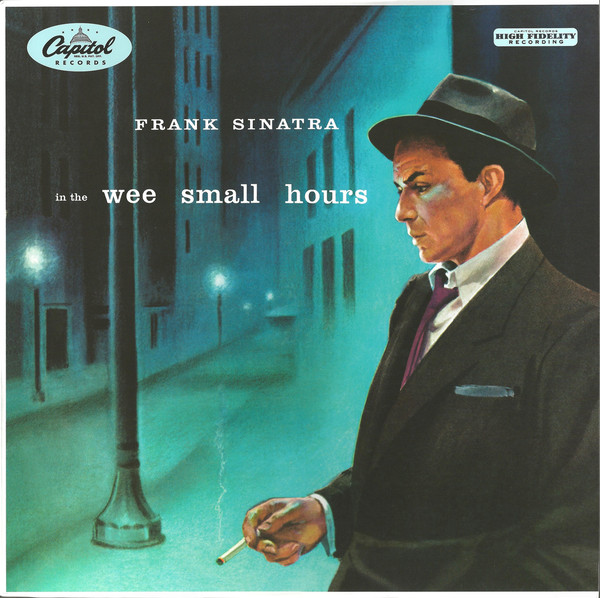
Frank Sinatra - "In The Wee Small Hours" Vinyl, Album, LP, 1955/2009 (Capital)


This, I believe, is the first full-length Frank Sinatra album that I purchased in 1986. As a man who was in his 30's, it seems liked the right moment or time to get into the blue funk of Sinatra at the time. Sinatra, I believe, or at the very least, one of the first artists to use the album format as a theme piece or dare I say it, the concept album. Being a sad boy/man, I was immediately drawn to Sinatra's skills as a ballad singer. In other words, these recordings, especially this album "In The Wee Small Hours" is my version of the goth album. 

I re-lived my entire romantic life at that point and time with this album. The disappointments of love have never been expressed in such highly poetic and brutal terms before my ears. The album cover fully reveals what's inside the packaging, which is 16 songs of begging and acknowledging being on the losing side of a sexual/romantic relationship. "Can't We Be Friends" is the ultimate song of a partner just grasping any straws of hope that somehow you can still be part of someone's life. We can gather that this is not going to be the case. Failure lurks on this album like a cheap after-shave lotion. 

Sinatra had the knack of getting right into the emotion or the physical pleasure of being in love or with a loved one. Through his vocals, he was a sonic poet, and here he had his brilliant arranger Nelson Riddle adding spices and elements of Wagner like heights to Sinatra's series of pleadings and reporting of love gone wrong or gone. There are no bad cuts on this album. Sinatra took the great American Songbook and cherry-picked the brilliant songs that make this album. The one song I play over and over again is the great Duke Ellington song "Mood Indigo." Perfection was never so painful to hear. Yet, it pleases the troubled soul.


Tracklist Hide Credits

A1In The Wee Small Hours Of The Morning
Composed By – David Mann (3)Written-By – Bob Hilliard
3:00
A2Mood Indigo
Composed By – Barney BigardDuke EllingtonWritten-By – Irving Mills
3:30
A3Glad To Be Unhappy
Written-By – Rodgers & Hart
2:35
A4I Get Along Without You Very Well
Composed By – Hoagy CarmichaelWritten-By – Jane Brown Thompson
3:42
A5Deep In A Dream
Composed By – Jimmy Van HeusenWritten-By – Eddie DeLange
2:49
A6I See Your Face Before Me
Composed By – Arthur SchwartzWritten-By – Howard Dietz
3:24
A7Can't We Be Friends?
Composed By – Kay SwiftWritten-By – Paul James (4)
2:48
A8When Your Lover Has Gone
Songwriter – E. A. Swan*
3:10
B1What Is This Thing Called Love?
Songwriter – Cole Porter
2:35
B2Last Night When We Were Young
Composed By – Harold ArlenWritten-By – E.Y. Harburg
3:17
B3I'll Be Around
Songwriter – Alec Wilder
2:59
B4Ill Wind
Composed By – Harold ArlenWritten-By – Ted Koehler
3:46
B5It Never Entered My Mind
Written-By – Rodgers & Hart
2:42
B6Dancing On The Ceiling
Written-By – Rodgers & Hart
2:57
B7I'll Never Be The Same
Songwriter – Frank SignorelliGus KahnMatty Malneck
3:05
B8This Love Of Mine
Songwriter – Frank SinatraHenry SanicolaSol Parker
3:35

Friday, August 4, 2017

Portsmouth Sinfonia - "Plays the Popular Classics" Vinyl, LP, Album, 1974 (Columbia)


I pity the poor vinyl seeker who picks up this album in the hopes that it's a typical collection of classical music pieces by some obscure Symphony.  On the other hand, it is a wonderful re-discovery of the classical pop hits, done by an orchestra that is not entirely sufficient in their instrumentation. Nevertheless part of the enjoyment of the journey I think is the motif of the Portsmouth Sinfonia.  It's not entirely off-kilter because one can recognize the works here.  

British composer Gavin Bryars started the orchestra, and not sure if it was done so for the purpose of going back to his roots, but I suspect to explore the music in a different light.  There is a Fluxus flavor to the concept of having an orchestra who can't play their instruments (properly) and performing classics by composers like Beethoven, Bach, Bizet, Holst, and others.   At first hearing, I took it as a joke, but I don't think that's the purpose here.  The selection of pieces they do on the album is very popular.  The average listener who may not know classical music, I would have imagined heard the compositions in their home or on the TV or some other medium.  The arrangements are close to the music sheet (as far as I know), but it's the skills of each musician that makes this album unique. 

In ways, an orchestra is a study of civilization at work where everyone has a role to play for the betterment of the composed work as well as the overall orchestrational sound.  The Portsmouth Sinfonia is chaos working as a group. It's a society that is struggling to make sounds that are actual music.  This is not an eccentric's work, but more of a statement on politics and culture and how one sees their role in the "orchestra."   Brian Eno produced this album and is one of the musicians in the orchestra.  He plays Clarinet, and Byars play the cello.  His original instrument I think is stand-up bass.