Total Pageviews

Saturday, April 27, 2019

Giles, Giles and Fripp - "The Cheerful Insanity of Giles, Giles and Fripp" Vinyl, LP, Album, Reissue, 1968/2013 (Cherry Red Records)


My strange obsession this year (so far) is my appreciation for King Crimson.  The love of this band came out of the blue, and I suspect that I was just bored as well.   I bought the first five albums by King Crimson, and although some I like more than others, it is an exciting era of music making by Robert Fripp and company.  I have always heard of Fripp's first recording but thought it might be a tad weird for my taste.  Alas, I was wrong, and again, it took me decades to finally own and listen to this album.  I have heard about it since the early 1970s.  

Peter Giles and his brother Michael, along with Robert Fripp were a trio band but sounded nothing like a power trio.   What they were was jazzy, British music hall, and in certain degrees baroque pop. They are supported by strings as well as keyboards by Nicky Hopkins and organist Mike Hill.  Giles, Giles, & Fripp were also tuneful songwriters, and even at this moment, I have some of their melodies going through my head.   The album also has running humorous narratives that are very twee, kind of funny, and reminds me a bit of The Small Faces' side two of Odgens' Nut Gone Flake."  

Listening to the album, one does not think the next project would be "In The Court of The Crimson King."  It is similar to listening to Bowie's early recordings that lead up to Ziggy and noticing the huge leaps of musical changes.  However, on the surface, it seems Fripp and company made a huge giant step into another world with King Crimson.  Although I do admire and like Crimson, I think I prefer Giles, Giles, & Fripp.  Fripp's guitar playing is exceptional throughout the album, and all three songwriters in the group have a similar aesthetic that they share.  A good balance.  For those who like the slightly obscure sounds coming out of music in 1968 will like this, as well as fans of The Kinks "Village Green," and the eccentric aspects of the Bonzo Dog Band.  

Monday, April 22, 2019

British Electric Foundation - "Music of Quality & Distinction, Volume 1" Vinyl, LP, 1982 (Virgin)


In the late 70s and early 80s, there was this procedure where bands like Public Image LTD and Heaven 17's British Electric Foundation (B.E.F.) were into the corporate identity.  Not only a group but also a company.  I imagine in those days that there were no band meetings, but instead, and in its place, a board meeting took place.   I'm a massive fan of Heaven 17's first album "Penthouse and Pavement," which at its heart is a synth-pop soul sound, but also mixing in real instruments as well. When Ian Craig Marsh and Martyn Ware left Human League to form Heaven 17/B.E.F., it was an ambitious move on their part.  Through Virgin Records, they clearly wanted to have their separate identity as a production house, songwriting group, as well as having a radical approach to corporation life, which I suspect was in itself a critique of that world. 

With that in mind, and also playing the game of marketing an image/music for the consumer, B.E.F. put together "Music of Quality & Distinction, Volume 1" which is a collection of 1960's Motown soul music with 70's Glam era rock.   Each song had a guest singer, and it was usually an iconic figure in the music world.  You have Tina Turner covering the Temptations' "Ball of Confusion," Sandie Shaw doing "Anyone Had a Heart," and Gary Glitter doing a pretty great glam version of Elvis' "Suspicious Minds."  The brilliant aspect of this project is having singers who were fading out in the mainstream music world at the time, and giving them a decent song, as well as a commentary on their era of music making.   The great Paul Jones of Manfred Mann fame does a remarkable version of Northern Soul "There's a Ghost in My House." 

In 1982, the pop singers on the album that were happening at the moment like the excellent Billy MacKenzie (Associates), Heaven 17's Glenn Gregory, and TV announcer Paula Yates (tragic life that one) making mostly classic music from the 60s.  Gregory does the Jimmy Webb song "Witchita Lineman" as well as Lou Reed's "Perfect Day," which is from the 70s.  Ware and Marsh attempt to freeze an era through music, but the brilliant part is their choice of artists doing the material, yet working in the B.E.F. mode of production and vision. 

For me, MacKenzie never fails.  His version of Bowie's "The Secret Life of Arabia" and Roy Orbison's "It's Over" are magnificent due to Billy's voice and approach to these songs.  Having the Shadows' Hank Marvin on the Orbison song is a nice touch as well.  Again, it's the mixture of electronics with real instrumentation, as well as choosing the right iconic singer doing the material makes this album a real joy. 


Saturday, March 23, 2019

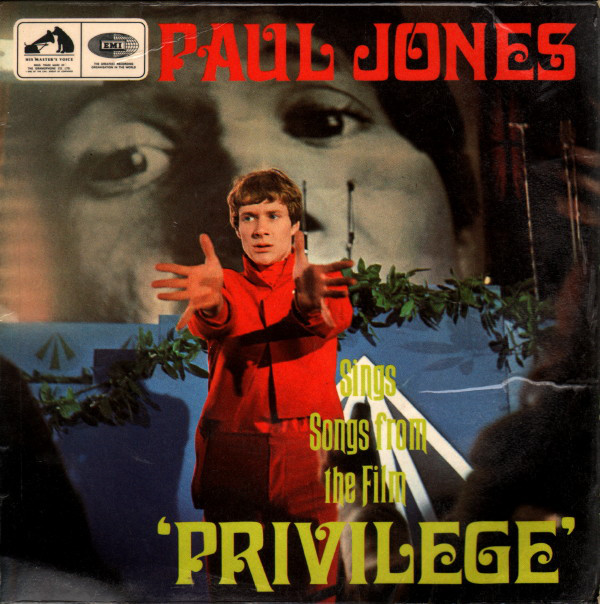
Paul Jones - "Sings Songs From The Film 'Privilege'" Vinyl, 45 rpm, 7", EP, UK, 1967 (His Master's Voice)


One of my favorite music that came out of 1967 for new pop was "Paul Jones Sings Songs From the Film 'Privilege.'"  My dad took me to see this film I have to presume sometime in 1968, and it played in a small 'art' movie theater in a building on the Sunset Strip.  One had to know about this theater because there was no advertisement or even acknowledgment that this place existed outside of the theater space.  Overall the film is not that hot, but I was glued to the screen due to Paul Jones performance, both acting and singing, and of course the beauty of Jean Shrimpton.  The story takes place in England when the church decided to match-up with the pop world, circa Paul Jones.  A new form of Fascism takes place where the teenager is influenced by the combination of the Church and pop music.   The film opens up with a great performance by Paul Jones, doing "Free Me," which has a haunted organ and strings arrangement.   A few years later, Alice Cooper would use theatrics that is very similar to the performance in "Privilege." 

Beyond that this EP has four songs, including my beloved "Free Me" as well as the theme "Privilege" and 'I've Been a Bad, Bad Boy, and I think the other song "(My Poor Heart is Surely) Breaking" is not in the film, but alas, memory plays tricks.  Nevertheless, one can get the full original soundtrack album with no problem, and I see it often online or sold in used record stores around Los Angeles and Tokyo.  Still, I prefer the format of the 7" 45 rpm EP, because of the focus on the four songs, which overall is pretty magnificent.  

Paul Jones is known to be the lead vocalist for Manfred Mann in the early and mid-1960s, but he took a strange solo career that was equally pop and his natural love for rhythm n' blues.  A great voice, and presence, I feel Jones is overlooked these days, and he is a great vocalist.   The solo career is spotty, but his work with the band Manfred Mann is brilliant.  And his other highlight is "Privilege." 


Thursday, March 21, 2019

Talk Talk - "Laughing Stock" Vinyl, LP, Album, Reissue, 2016/1991 (Polydor)


Friends of mine who have taste always recommended Talk Talk to me.  For years I have avoided hearing their music, not due to being put-off by the band, but just totally absorb into the music of my choice at the time.  It wasn't until Mark Hollis passed away this past month that I decided to make the leap and I purchased "Laughing Stock," which is I think was the last Talk Talk album.  

I was first introduced to Talk Talk in Reseda California when I worked at Licorice Pizza.  We got free tickets to see Talk Talk at a nightclub in the San Fernando Valley.  At the time, they had a hit song "Talk Talk" which I thought was strange that it was the name of the band as well.  At the time, it bothered me that they both had a song and a band name that was the same.  In my psyche, I felt that this wasn't right.  I have a faint memory of seeing them, and I think it was Holley singing lead, and then there was a bass player, keyboard, and drums.  Very minimal in that fashion.  They didn't leave a strong impression on me at the time.  What impressed me later is that they abandoned the new wave world into the moody jazz planet. Or I was told that by numerous acquaintances.

I like "Laughing Stock." I like it a lot.  My first impression is always to make a comparison of what you hear, and try to match it with another artist. In this case, it reminds me of a bit of  Steve Winwood / Traffic meeting David Sylvian solo recordings.  Talk Talk is more abstract than those two. It's hard to define their sound, which is dreamy and also free of electronics but use the recording studio in a manner that is like an additional musician in the band.  Which sounds like Eno, but Talk Talk work on a different type of canvas than Brian Eno.   

Six songs but it are easy to drift from one track to the next.  The appearance of the songs seems laid back, but there is actually bits of noise or extreme electric guitar sounds which for sure, does not make this music ambient by any means.  There's an electric Miles Davis vibe attached to the aural landscape as well.  The beauty of the music is that it's not easy to put into words, but as music, as one listens to it, the album makes excellent sense. 


The Kinks - "The Kinks Are The Village Green Preservation Society" Vinyl, LP, Album, Reissue, Mono, 2014/1968 (Sanctuary Records)


It took me a while, but I finally purchased a new or mint copy of the Mono edition of The Kinks Are The Village Green Preservation Society." The sound of the record is brilliant, but what's more important is the music itself.  Clearly a masterpiece, and I think it is at that status due to its powerful images of a world that is a combination of William Makepeace Thackeray, Henry James, and a touch of Oscar Wilde. In other words, it's British, but not the lad England of Oasis but the world of English gentlemen, quiet pubs, and great inner depression.  Perhaps there is a touch of the Angry Young Men movement as well.  It's a shame that this album was never turned into a musical in London's West End.  There is no narrative, but one can quickly write the 'book' and make this an instant classic, just due to the excellence of the songs.  

I originally bought this album in the time of its original release in 1968.  I have been a somewhat consistent Kinks fan, but life in Los Angeles didn't always allow an easy route to purchase a Kinks album, even though they were on Reprise Records in America.   For one, they dropped out of the press or TV appearances, and for about six months, I totally forgot that they even existed.  I came upon this album when I lived in Topanga Canyon, and I felt like a prisoner in that area of the world.  "Village Green" unknown to me at the point of purchase, exposed me to another prison, but one in Merryland England.   My sense of alienation perfectly fitted the mood of this Kinks' album.  When I got home with the record and put it on my turntable, I think I felt tears from my eyes.  I never had a record that encouraged such an emotional response before.  It wasn't sadness exactly, but more of the fact that I too felt I lived in a village, and there is something rotten in that neighborhood.  

Also, this is very much music made by and for Dandies.  I like the cover, but I feel that it should have been a painting portrait of The Kinks, perhaps in oil, or even an image of Francis Bacon at the very least.  Still, over the years I have purchased this album in every format possible, and it was until very recently I bought the Mono mix of "Village Green."   For my ears, it sounds more punchy and forceful, and therefore I prefer the Mono to the stereo mix.  Not one wrong musical moment on this record, it's perfection as an art form, with the band performing this delicate music as an oil painting or perhaps building the village as a sculpture.  One of the remarkable albums from the 20th-century.


Monday, March 18, 2019

The Lemon Pipers - "Green Tambourine" b/w "No Help From Me" 45 rpm single, 1967 (Pye International)


Is it even possible to loathe "Green Tambourine?" Which by the way, is a superb song/recording released in the latter half of 1967.  Sometimes considered to be 'bubble-gum rock' record, but to me, it's 2 minutes and 23 seconds of magic.  The group is The Lemon Pipers from Ohio, and the songwriters of the song are hardcore Brill Building culture.  Paul Leka wrote the song with Shelley Pinz but based on Pinz observing a musician playing and asking for money in front of the Brill Building.  It seems his main instrumentation was a tambourine.  With the help of Leka, he came up with the song, and it's a record that is very much tattooed on my soul.  I'm also fond of Leka's "Na Na Hey Hey Kiss Him Goodbye recorded by a fake band called Steam, but that's another tale. 

The beauty of 'Green Tambourine is the psychedelic touches that are totally commercial, due to the echo delay of some of the lyrics, as well as the use of the electric sitar.  The narrative of sorts is a musician who wants to play his 'green tambourine' which has a Piped Piper, almost gypsy touch to its melody.  It's sad, but the production and arrangement (by Leka) convey pathos as a concept.  A projection of inner-misery, which naturally is organic in the process of pop music.  I also recommend The Associates version as well, if one can find it.  


Sunday, March 17, 2019

Shirley Bassey - "The Fabulous Shirley Bassey" Vinyl, LP, Album, Mono, UK, 1959 (Columbia)


Shirley Bassey, famous in the United States for her recording of "Goldfinger" is an exceptional British singer.  Born in Wales, "The Fabulous Shirley Bassey, released in 1959, was her second album.  Always a big voice, she strikes me as a powerful wind machine, and even the orchestration around her has to go from 8 to 10 in volume control.  Which sounds a bit much, but the fact is her voice has a lot of warmth, and on the "Fabulous" album there are classic songs.   "The Man Who Got Away," "Cry Me A River,"  "I've Got You Under My Skin," and others on this disc are superb pieces of contemporary music. 

As part of my obsession with British pop music before the Fab Four, Bassey is a key showbiz figure that expressed the grit and soiled nature of pop music at the time.  Hearing the recordings of that period it sounds light and fluffy, but I suspect it's aural candy to disguise the roughness of the post-war U.K. years.   Bassey is not a light singer, but a performer of great attitude and brings magnificence to the main meal.  When one digs up the beautiful landscape of a part of the world that suffered greatly, one can find great art.  Shirley Bassey is such a fine, and the "Fabulous Shirley Bassey" is an album full of polished gems, but there is a lot of grit within its textures.