Total Pageviews

Showing posts with label 1960s British Pop. Show all posts

Monday, March 23, 2020

V.A. -"History of British Rock" Compilation, 2 x Vinyl, 1974 (Sire)


Music became a force for me during my childhood. I was nine or 10-years old when The Beatles made their appearance on the Ed Sullivan Show, and the impact of that event or spectacle had made a great impression for me. I wasn't aware that there was British English in the landscape until I heard them speak Liverpool English. The Beatles, for me, besides being a great band, also were the heavenly gate to the entrance of British music culture for yours truly. The Stones came upon me at the same time as the Fab Four. However, it was the Honeycombs that made an impression on me in a very insightful manner that still gives me goosebumps when I hear their recording "Have I The Right." In 1974 when I turned 20, I purchased "History of British Rock," due that they have The Honeycombs' hit song on this compilation.

Alas, this collection brought memories back to me in the same manner as Marcel Proust's character taking a bite of the French cookie. Billy J. Kramer, The Mindbenders (great name for a band by the way), Troggs, and so forth had a magnificent presence in my childhood. Therefore even in my 20's and thinking of the present, I was taken to my childhood in a pleasant manner. The album also introduced me to new music that wasn't popular in Los Angeles in the early 60s, such as Cliff Richard's "Blue Turns To Grey," a remarkable song by Jagger/Richards and an excellent recording. Also, Status Quo's "Pictures of Matchstick Men," Dusty Springfield's "I Only Want To Be With You," and The Pretty Things "Don't Bring Me Down." Those were new songs for me. I have read about these artists in teenage magazines, but never had the opportunity to hear the songs, until I purchased "History of British Rock."

Over the years, I lost this compilation but recently purchased a copy at Rockaway Records, which was under $5. Now, the album not only takes me back to the early 60s but also 1974, when I originally bought the album. A record is not only a listening experience but also an entranceway to one's past.

Wednesday, January 1, 2020

Graham Gouldman - "The Graham Gouldman Thing (Vinyl, Album, Stereo, 1968 (RCA)


My interest in figures who somehow made pop music culture, yet remain in its shadows is an obsession of mine. For instance, songwriters who wrote numerous hit songs for various artists, and yet, they made their album. Does one wonder if they had hopes of being successful without fronting other music artists? Graham Gouldman wrote hit songs for The Yardbirds and Herman's Hermits, among others. He eventually formed and became a member of 10cc. Eric Stewart, his co-band member, was also from the British Invasion era. He was a member and songwriter for The Mindbenders (with and without "Wayne").

I'm an admirer of these 'pop' songwriter albums such as "The Graham Gouldman Thing" as well as Tony Hazzard (wrote songs for The Yardbirds as well as Manfred Mann) and Boyce and Hart (they wrote classic hits for The Monkees). All albums are of great importance, mostly due that they have their 'hit songs' on them, and it's interesting to compare the recordings between their recorded version and others by the bands who did their songs.

Gouldman's album was co-produced by Peter Noone (Herman of Herman's Hermits) and himself, as well as John Paul Jones handling the arrangements. It is released in 1968, a tad later than The Yardbirds's "For Your Love" this is very much a showcase of Gouldman's songs and his ability to carry these tunes under his name. The hits (made famous by others) are "For Your Love" (The Yardbirds), "Bus Stop" (The Hollies), "No Milk Today and "Upstairs and Downstairs" both by Herman's Hermits. If there is a Gouldman aesthetic, it seems his songs relay sort of mid-20th-century British culture, that is a snapshot of life as it happens, with a touch of the Harold Pinter/John Osbourne observation of British everyday life. When he started working with 10cc, his songs, as well as the others in the band, became still, observational, but with a savage sense of humor. Here in his early works, it's more of a reflection that has traces of sadness and romantic disappointment. Gouldman wrote the hits, but I feel he left an enormous amount of DNA of his personality and thoughts in these commercial works.

Thursday, October 31, 2019

Manfred Mann - "Radio Days Vol. 1: Live At The BBC 64-66" 2XVinyl, LP, Compilation (Creature Music)


A fascinating compilation of the band, Manfred Mann, from the years 1964 to 1966.  These are the years that featured the amazing Paul Jones on vocals and some compositions. What I find interesting about Manfred Mann is that they are basically jazz and blues musicians who also did pop.  Yet, there is no tension between the music categories with this band.  Perhaps because they could always expose their roots as well as recording the perfect pop hit, such as "Pretty Flamingo." 

The BBC recordings are all live, and it shows how the band expanded within the two years of their existence with Jones.   Everything from "Parchman Farm" (Paul going solo here) to an amazing jazz arrangement of The Yardbirds' "Still I'm Sad."  There is also a series of interviews with the band that are amusing but also compared to other bands of that era, Manfred Mann is solidly grounded in their roots.  Pop, jazz, and the occasional Dylan song all seems natural in the band's hands. 


Tuesday, July 23, 2019

Manfred Mann - "Soul of Mann (Instrumentals)" Vinyl, LP, Compilation, Reissue (Umbrella)


This past year I have been going through an ongoing appreciation for the band Manfred Mann.  Both Paul Jones and Mike D'Abo years.  During the Paul Jones era and in between the two lead singers, the band recorded a series of instrumentals as b-sides and album cuts.  What I find fascinating about the group is that they are jazz players playing pop as well as blues or rhythm n' blues, but I get their very essence is jazz.   Manfred Mann recorded pop music, but it is the tension between the commercial music and their jazz leanings, which gives them an intensity.

"Soul of Mann" is a fantastic compilation of their instrumentals, which are mostly based on pop songs.  Done with excellent jazz arrangements, as well as some originals and their take on jazz artists/composers as Milt Jackson and Nat Adderley.   The album is very "Mod" orientated, and the cool here is essential.   The album fits very much into Milt Jackson world as well as the Mod planet of The Who, The Small Faces, and Graham Bond Organization.  

Saturday, June 1, 2019

Twinkle - "Golden Lights" Vinyl, LP, Compilation, 1996, UK (RPM Records)


Twinkle is the ultimate 1960s British teenager, who is also a songwriter and pop singer.  Born wealthy, and had a sister who wrote for the British music fan magazines of that time, knew and went out with a lot of rock n' roll people.  Never released an album, but a series of 45 rpm singles, Twinkle's music is remarkable.  An excellent lyricist, one of her great songs is "Golden Lights," which is a fantastic groupie-like view of a loved one whose name is in the neon lights of a theater. It's visual power, and beautiful melody is pop-divine. 

"Terry" is about a boy who dies on a motorcycle.  It is just as great as any The Shangri-Las' recording, and the difference is that it's quiet in a British manner compared to the Shadow Morton world of East Coast cinematic sounds. There is even a version of Serge Gainsbourg/France Gall's "A Lonely Singing Doll."  This 17-song compilation doesn't have a weak link. 

If a comparison is to be made, I think of Gillian Hills, who also wrote her songs, as well as being an iconic figure both in the UK as well as in France.  A remarkable collection of pop music.  


Saturday, March 23, 2019

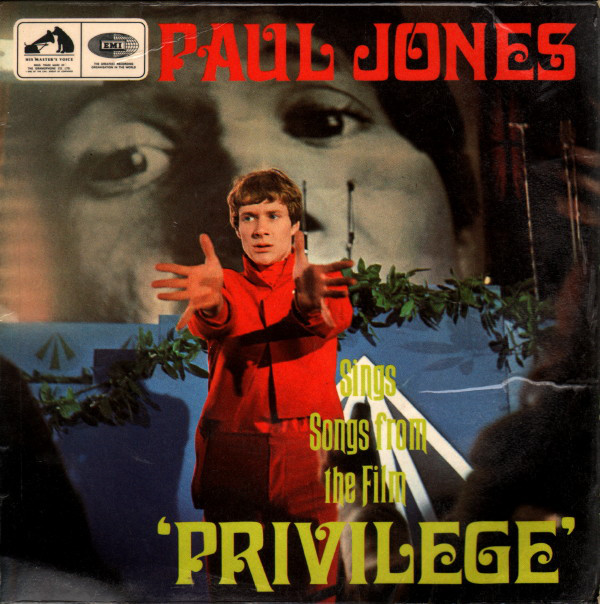
Paul Jones - "Sings Songs From The Film 'Privilege'" Vinyl, 45 rpm, 7", EP, UK, 1967 (His Master's Voice)


One of my favorite music that came out of 1967 for new pop was "Paul Jones Sings Songs From the Film 'Privilege.'"  My dad took me to see this film I have to presume sometime in 1968, and it played in a small 'art' movie theater in a building on the Sunset Strip.  One had to know about this theater because there was no advertisement or even acknowledgment that this place existed outside of the theater space.  Overall the film is not that hot, but I was glued to the screen due to Paul Jones performance, both acting and singing, and of course the beauty of Jean Shrimpton.  The story takes place in England when the church decided to match-up with the pop world, circa Paul Jones.  A new form of Fascism takes place where the teenager is influenced by the combination of the Church and pop music.   The film opens up with a great performance by Paul Jones, doing "Free Me," which has a haunted organ and strings arrangement.   A few years later, Alice Cooper would use theatrics that is very similar to the performance in "Privilege." 

Beyond that this EP has four songs, including my beloved "Free Me" as well as the theme "Privilege" and 'I've Been a Bad, Bad Boy, and I think the other song "(My Poor Heart is Surely) Breaking" is not in the film, but alas, memory plays tricks.  Nevertheless, one can get the full original soundtrack album with no problem, and I see it often online or sold in used record stores around Los Angeles and Tokyo.  Still, I prefer the format of the 7" 45 rpm EP, because of the focus on the four songs, which overall is pretty magnificent.  

Paul Jones is known to be the lead vocalist for Manfred Mann in the early and mid-1960s, but he took a strange solo career that was equally pop and his natural love for rhythm n' blues.  A great voice, and presence, I feel Jones is overlooked these days, and he is a great vocalist.   The solo career is spotty, but his work with the band Manfred Mann is brilliant.  And his other highlight is "Privilege." 


Monday, March 4, 2019

The Ron Grainer Orchestra - "The Prisoner: Original Soundtrack Music From The TV Series" Vinyl, LP, Album, 1986 (Bam-Caruso)


I never heard of Ron Grainer before, but clearly, I know his music due to my obsession with the TV series "The Prisoner."  I can spend hours just watching the opening credits to the show, where secret agent No. 6 (Patrick McGoohan) resigns in anger and is seen being kidnapped and taken to the island, which resembles a retirement home for lunatics.  Within two minutes one has the flavor as well as the narrative of the show.  Equally exciting is the soundtrack theme to "The Prisoner."

Ron Grainer wrote the central theme, and the rest of the music that was on the show is a combination of his work, and various British composers who worked in the Film Library world.  At times, playful, sinister, and classic Spy theme music all rolled in one package.  British sounding to the core, and not that different from the aesthetics of various English shows of the time:  "The Avengers," "Saint," and even McGoohan's old show "Secret Agent Man" (or in the UK "Danger Man").  Still, this is a spy TV show that hints of the avant-garde, or the theater of the absurd.  A limited run show that had a beginning, a middle, and an end.   In that format, it is like a structured version of "Twin Peaks," but with the intensity of McGoohan's participation.  It's odd that I have at least three albums that are based on Parick McGoohan's film/TV works.  Perhaps it's not the music itself, but the presence of this great actor/producer/director. 


Sunday, August 26, 2018

Chris Andrews - "Yesterday Man" b/w "Too Bad You Don't Want Me" 45 rpm 7" Single, 1965 (Atco)


Chris Andrews is a bit of a mystery to me.  I first came upon his name when I look at the credits for Sandie Shaw songs during the early 1960s.  He wrote all her major hits, and I'm a fan of her work.  The second time I became aware of this songwriter's talent was when I heard Robert Wyatt's 1973 version of "Yesterday Man," which is one of my favorite Wyatt recordings.   Chris Andrews wrote that song as well, and I think it's the best I have heard of his songwriting.  

Wyatt's version is slow, mournful, with a touch of regret and of course, romantic angst.  Chris Andrews recorded his own version of the song in 1965 and of course, it's upbeat with a strong Ska rhythm going through it, but the chorus has that Sandie Shaw sound.  It's particular talent of Andrews to add a clatter of vocals that are busy and frantic at the same time.  I like his approach to his song.  If I have to choose between the two, it would be the Wyatt version, just because he can milk the pathos deeply and profoundly.  Yet there is something sinister in the happy-go-lucky Andrews conveying the fact that he is genuinely a Yesterday Man in some woman's life.  In other words, a great tune. 

Sunday, July 15, 2018

Johnny Kidd & The Pirates - "The Best of Johnny Kidd and The Pirates" Vinyl, LP, Compilation, Reissue, Mono (EMI)


Frederick Heath, better known as Johnny Kidd, is one of the first rock n' roll figures in England.  Him and his band of various players throughout the early years of the 1960s, The Pirates, were RnR authentic, but still British to the very core of their existence.  "Please Don't Touch" is the ultimate horny theme song, that to describe in one word,  is marvelous.    Although their one major hit is obviously "Shakin' All Over."  Canadian band 'Guess Who?' had a hit recording in America, and it was a song covered by The Who, and Pete Townshend is/was without a doubt a huge Peter Green of The Pirates fan.  Like another British rocker of the same period, one can trace the British accent of Johnny Kidd, which to my ears, makes the recordings unusual. 

As far as I know, Johnny Kidd never made an album.  All his recordings were 45 rpm singles, so this compilation is those singles, plus the b-sides.  A lot of the songs were written by Kidd, but also by a Gordon Mills, who became a powerhouse manager of Tom Jones, Engelbert Humperdinck, and Gilbert O'Sullivan.  Johnny & The Pirates were half show-biz of the Music Hall world and one foot in the prototype of early rock.   Kidd/Heath was very much a product of his time and place.  Of course, we now think of Adam Ant and His Ants as being the sons of Johnny Kidd, due to the Pirate motif in his stage shows and publicity photos.   

There are many compilations of Johnny's hits or non-hits, but I think this "Best of..."  is an incredible collection of music by Kidd, and it is like peeking into a keyhole of the British world at the time of the early 60s before the Fab Four hit the scene.   In a field of teenage pop stars, Kidd and Billy Fury were the real deals.   It's rock n' roll, but clearly, it's BRITISH rock n' roll.  


Monday, June 4, 2018

Scott Walker - "Scott" Vinyl, LP, Album, Reissue, 2008 (4 Men With Beards)


Probably one of the most unique artists that appeared in the 20th century.   Scott Walker is a remarkable singer of course, but what is even more interesting is that he's a singer that was placed in the teenage world of England and Europe, and as an American who has a strong taste in European culture, that goes beyond being a mere fan.  If one can transform oneself into another being or spirit, Scott Walker succeeds greatly.  

"Scott" is the first of many albums, and although he only wrote three songs out of the 12 cuts, each one has his stamp or personality tattoed on the grooves.  For one, it is a mature work done by a young man.  While Mick & Keith were concerned about getting a "Connection" or the Fab Four reflecting on Lovely Rita, Scott was meditating on "My Death."   For a pop album of that period, 1967, it must have stood out like a diseased object, swelling with strings and orchestration, and then Scott's voice cutting through the arrangements like a hot knife cutting bread.    One can compare his work at the time with the Sinatra world of the 1950s, specifically his ballad albums, but the truth is Scott's take is more internal, private, and of course, angst.  

None of the covers on this album are obvious.  Even though they are written by classic songwriters like Mann/Weil, Wayne Shanklin, and Andre Previn, it's mostly unknown material, at least to my knowledge and ears.  The big discovery here is both his Jacques Brel obsession, and one of the first singers to dwell into his work in English, and his songwriting.  "Montague Terrace (In Blue)," "Such a Small Love," and "Always Coming Back to You" sound like classic songwriting from an earlier era.  He has nothing in common with his age group of fellow writers.  Scott comes from an alternative universe, and listening to "Scott" is still a discovery of something new that seems to come from an imagined past. 

Wednesday, May 30, 2018

Small Faces - "Ogdens' Nut Gone Flake" Vinyl, LP, Album, Reissue, Limited Edition, 1996/1968 (Castle Communications)


Small Faces may or may not be geniuses, but they strike me as moments of perfection.  To this day, I'm confused what makes a Small Faces album.  I think most of their records are a collection of 45 rpm singles and their b-sides.  Their aesthetic is the 45 single, and therefore most of their albums are greatest hits collections.  Yet, in 1968, after Sgt. Pepper (1967), and before "Tommy" (1969), The Small Faces made their conceptual or narrative album.   "Ogdens' Nut Gone Flake" is not only that but also a highly designed album package, that is tricky to fold up or put the disc away in its packaging.   I have to imagine it made a significant hit on the present and future graphic artists.  And in fashion, just as important as the music inside the designed package. 

Usually, when a recording artist decides to make a concept album, it has a huge theme of some sort.  Sgt. Pepper is a made-up group, and the album's theme follows that method of narration, and of course, "Tommy" is a major statement from Pete Townshend with respect to his spirituality and perhaps a severe sexual relationship/abuse.   On the other hand, Small Faces made a concept album about a fellow following or trying to locate a disappearing moon.   And this is only on side two with a narrative spoken by British comedian who invented his own humorous language, "Unwinese."  A language that has a few words in standard English, but the listener picks up or imagines that there is a consistency in what he's saying.  Totally eccentric, and that is also the appeal of the Small Faces.   A band that was driven by its love for Rhythm n' Blues, but on the other hand, they do have this secure connection to British music halls and the Cockney culture.  It is this relationship between the two worlds that makes the Small Faces a great band.  

"Ogdens' Nut Gone Flake" is not really a masterpiece, but it's an enjoyable and unique album from 1968.  I don't think the album could have been made outside of that era or year.   It captures a certain innocence as well as the enjoyment of getting high and letting your mind wander into a recording studio.  It is also interesting to note that this album was the work from the Small Faces.  Steve Marriott left the band to form Humble Pie, with fellow pop star Peter Frampton of The Herd, who both wanted to investigate a heavier sound in their music and approach to that aesthetic.  Still, "Ogden's" is an incredible combination of charm and classic Small Faces pop.  "Afterglow," "Song of a Baker," "Lazy Sunday," (a song that Small Faces had mixed feelings about when it was released as a single by Immediate Records, but to me a classic work), and the more obscure "Happy Days Toy Town."  One often thinks of the Small Faces being the flip of the coin with The Who on the other side.  On some days, I think the Small Faces were a better band, but the truth is, both on a very street, but smart level, took their music to another platform or level.   I only know a few people who "like" the Small Faces, but I know a lot more who "love" the Small Faces.  It's a love that is richly accepted.


Tuesday, May 22, 2018

The Move - "Something Else From The Move" Vinyl, LP, Compilation, France, 1979 (Cube Records)


Has there ever been a band such as The Move, who moved from psych-pop to heavy, and then at times, something operatic and more significant than big?   Never on my top ten list of loves, because I keep forgetting that they exist, and that is apparently a shortsighted position on my part.  Roy Wood is not only an incredible songwriter, but the eccentricity of his stance in the pop music world is one to admire. He's an artist who accepts the abscess of too much, and often I think how is this even possible?  

The Move has two lead singers Carl Wayne and Wood.  Wood writes the material, and Carl Wayne, in a Roger Daltrey manner, takes the material like a grand actor.  If one has to compare the band with another, I have to imagine it will be The Who.  Both groups are melodic as well as thrashing, and there is a sophistication in the mix that makes it a couple of notches better than the standard pop of its era.  It's not surprising that The Move influenced Sparks because they both share the density of the overall sound, as well as songs that are double-edged in imagery and presence. 

"Something Else From The Move" is a compilation album from France.  Side one is their early singles, but including "Brontosaurus" a song when The Move was a trio featuring Jeff Lynne.  Still, this collection is Roy Wood orientated, and side two is a live set from the Marquee Club in 1968.  The reason I purchased this album is that of the live side. One can find this material in various formats, including an EP, but it's pricey to locate.  Here The Move covers Eddie Cochran ("Something Else"), as well as Spooky Tooth, The Byrds, and surprisingly Love.  Besides Cochran, which is music from the past, the other artists they covered were contemporary and very much in force still in 1968. 

The secret of The Move is that they were very baroque orientated in their arrangements, but played the material in a heavy manner.  So there are layers of sound and textures within the three-minute pop single, but also they were able to stretch out in more extended material as well.  As a compilation, it didn't take that much imagination in putting this collection together; still, it is such an enjoyable listening experience. 

Tuesday, April 24, 2018

Robert Wyatt - "Different Every Time Volume 1 - Ex Machina" 2 x Vinyl, Compilation, 2014 (Domino)


There are artists who one can follow, and it opens up to other artists and worlds.  It's similar to eating an artichoke, and as you strip each leaf, you can put different flavorings on it, which alters the taste significantly.  Then you reach the artichoke heart, and that itself is a different taste, but if you marinated it with a sauce, another element for the taste buds.  Robert Wyatt is like that as well.  "Different Every Time" is a two-volume set of double vinyl albums, where one is focusing on Wyatt as a contributor or collaborator, and the other is a selected greatest hits package, both curated by Wyatt.  Now, we focus on "Ex-Machina" which is his 'hits' package. 

 If you are a long time fan of Wyatt, there is never a perfect compilation.  Wyatt is not all over the map, but his landscape where he makes his music is physically small, but branches out in Left politics, jazz and pop standards, and his original compositions.  Some written by himself and other times with his wife and graphic artist, Alfreda Benge.   Wyatt made choices here that are superb, but there will always be that obvious song left out.  For me, it's his version of Neil Diamond's (The Monkees) "I'm a Believer."  On the other hand, we do have his version of "Yesterday Man," which is an exceptional composition by Chris Andrews, who wrote hit material for Sandie Shaw.   I do recommend a listener to track down Andrews version, which is very much a ska-pop arrangement.  Wyatt's version is soulful and a feeling of regret.  A beautiful melody and in the voice of Wyatt it becomes an emotional reflection on a lost romance.   Only Wyatt can sing a song with political overtures and make it sound like a lost soul reflecting on a grand disappointment.   His voice is unique, and there is nothing out there like a Wyatt vocal.

The album covers a great deal of Wyatt's solo work but also touches on his first two well-known bands, Soft Machine and Matching Mole.   Side one is taken up with Soft Machine's "Moon in June" which is 20 minutes long, and not a boring second is allowed.  The Wyatt humor takes place. Still, there is an English attitude of expressing oneself that's very restrained and in order.   Wyatt also made his incredible masterpiece album "Rock Bottom," but there is only one song to represent that record, and it's a live recording of the song "A Last Straw."   There is a focus at least material wise, on recordings made in the 80s, 90s and up to a few years ago.  More of exposure to Wyatt's brain working which is not nostalgic, but expressing his desires for current work.   If one has all the Wyatt recordings, including the 45 rpm single "Yesterday Man" (which to me if you don't have the song, it's worth buying the double-album set), then you don't need it. Still, if you are new in the Wyatt world, this is an excellent introduction and entrance way to a magnificent artist. 

Monday, March 26, 2018

Tony Hazzard - "Tony Hazzard Sings Tony Hazzard Vinyl, LP, Reissue, 1969/2016 (You Are The Cosmos)


I have favorite songs that I can't get enough of:  "Goodnight Sweet Josephine" and "Ha! Ha! Said the Clown."   Both were recorded by the Jimmy Page era of The Yardbirds, as well as Manfred Mann who actually had the hit with "Ha! Ha! Said the Clown."   My life goal is to get every recorded version of "Ha! Ha! Said the Clown." It's interesting to note that two blues related bands of that time recorded the most pop of the pop song possible at that time.  And I know there are Yardbirds fans who must that song and "Goodnight Sweet Josephine," but I love them to bits because they are provocative in the sense that its throw-a-way pop song, but brilliant at the same time.  The author of those two songs is Tony Hazzard, a songwriter from Liverpool.  

"Tony Hazzard Sings Tony Hazzard" is an interesting album, not only due that he wrote two perfect pop songs, but also he was one of the last songwriters whose existence is to write songs for other artists.  1969 is pretty late in the game for the pure pop songwriter when artists like Manfred Mann and Yardbirds were also writing their own material, and one presumes that the producer or record company made these bands take on Hazzard's professional material.  Also, The Yardbirds and Manfred Mann were slowly fading to of course change to Led Zeppelin and Manfred Mann Chapter Three.  Still, it was the last dying grasp that these bands recorded the Tony Hazzard songs. 

If one needs to compare Hazzard with another singer-songwriter it would have to be Graham Gouldman of 10cc fame, but also a very prominent commercial songwriter for a lot of beat bands during the early 60s, including The Yardbirds, The Hollies, and Herman's Hermits.  I don't know Hazzard's history, but I feel that he was the last 'echo' of that type of British songwriter such as Gouldman. 

Listening to Hazzard's record is odd, and it must have been odder to hear it when the album was originally released in 1969 when things got heavy, yet, this is an album of consistent pop songwriting techniques.  Clearly an album by a man who knows how to put a song together.  One thing that stands out in the recording is the 12-string acoustic guitar which is very strong in the mix.  There is psychedelic phrasing of the electric guitar - which may be a nod to the Jimmy Page touch, and in fact, maybe Page is on this album?   My obsession with British music is very much my interest, and Tony Hazzard fascinates me within that's context.   For those who love British pop, I do suggest checking this album out.  

Thursday, March 22, 2018

Cream - "Fresh Cream" Vinyl, LP, Album, Reissue, 1966/2008 (Vinyl Lovers)


The greatest contribution Eric Clapton made to Cream, is not his guitar work, but vocally backing up the magnificent Jack Bruce.  Clapton's voice comes almost as an inner-thought to Bruce's narration or words.   in an odd way, Cream was a band that had two separate identities or approaches.  One is live on stage, and number 2, is the studio.  Ginger Baker, Bruce, and Clapton made magnificent music in the studio, their live performances is another matter altogether.  There is confusion instead of clarity in Cream.  For one they are for sure a blues-based band, but what makes their work interesting is the experimental side or their occasional approach to pop.  Their blues material is OK, but it's the pop side that I find interesting and that's mostly due to Bruce's (and Pete Brown the lyricist) approach to the song.   "Fresh Cream" is their first album, which has many charms, but for me, it's all Jack Bruce. 

The other star in the trio is Ginger Baker.  He plays drums with character and personality.  In no fashion is his work session-like.   Heavy on the cymbals, but with a jazz feeling, him and Bruce are unique rhythm section that sounds different, but in theory close to the Entwistle and Moon combo in The Who.   The outstanding song here is Bruce's "Dreaming" which is a beautiful ballad, with Clapton's voice following Bruce, like chasing a faint dream.  It's the song that made me re-buy this album.  That song, plus "The Coffee Song," "I Feel Free," and the magnificent "Wrapping Paper" are almost forgotten works of songwriting craft and vision. 

Cream is important, I think due to their approach of being a trio power band, but again, it's the soft moments that I think are their strength.  As Cream went on (not that long, I think the band lasted just a bit over two years), it's Bruce being the multi-instrumentalist, with Clapton backing him in a conservative manner musically speaking.   Also, another trio was making the rounds around the same time as Cream, which was The Jimi Hendrix Experience, where I think making comparisons between the guitarists, made Clapton re-think his career.   Still, Clapton served Cream well.  Jack Bruce/Ginger Baker was the entrance and Clapton closed doors. 

Sunday, February 25, 2018

Dave Dee, Dozy, Beaky, Mick & Tich : "Time To Take Off" Vinyl, LP, Album, U.S., 1968 (Imperial)


Dave Dee, Dozy, Beaky, Mick & Tich is the worst name for a band ever made.  Beyond that, I have a fondness for DDDBM&T.  As one can gather, if you read this blog on a regular basis, I have an odd collection of their recordings.  Why I collect them I can't possibly give you an answer.  The truth is I have an obsession with Joe Meeks' The Honeycombs, whose first album I adore to bits. All their songs on that album are written by Ken Howard and Alan Blaikley, who go by their name "Howard Blaikley."  The material they wrote for DDDBM&T is very different from The Honeycombs' songs.  For one, the scope of their subject matter is huge for DDDBM&T.

"Time To Take Off" is DDDBM&T's 1968 album, which means for a British pop band they had to get serious or make a statement of some sort on their album.  In other words, the sound on this album is huge and clearly advanced to another level, compared to their early works.  Of course, the early recordings are superior to anything on this album.  Still, they had two hit singles off this album, the wacky "The Legend Of Xanadu" and the bizarre "Zabadak."  The rest of the album is crap, but it's 1968 type of crap, and that makes this album listenable, even enjoyable in a bad taste manner.  Their version of "If I Were a Carpenter" written by Tim Hardin is probably the strangest version of that classic song yet.   It sounds out with respect to the rest of the songs on "Time To Take Off."   Also, note that this album in the U.K. is called "If No-One Sang."


Wednesday, February 21, 2018

The Outlaws (Joe Meek) - "Dream of the West" LP, Vinyl, Album, 1961 (His Masters Voice)


The Outlaws is an instrumental band and worked with Joe Meek being their producer and songwriter.  Meek wrote all the songs on this album under the name of Robert Duke, as well as writing the liner notes.  The two guitars, bass and drums on a Meek recording can sound like it was recorded somewhere on the other side of the moon, yet pretend to be human.  Which is ironic, because this is an album that has a theme of the wild west.  "Dream of the West" is a concept album, but not one with a narrative, but with a place, a time, and of course, since it's British, more about the cinematic Western than the real west. 

If one compares The Outlaws to another band, it will have to be The Shadows.  Twangy guitars that are more British sounding than say surf, yet it's almost like scientists studying the surf guitar sound, and somehow getting it wonderfully wrong.   There is not one authentic western song on this album. All of the material, written by Meek (Duke) is a western that is imagined than real.  It's a beautiful album in the sense that fantasy plays a great role in Meek's world.  Yet, I sense he feels that all of it is 'real,' at least to him.   

Monday, February 12, 2018

The Beatles "Rubber Soul" Vinyl, LP, Album, Reissued, Remastered, Mono, 2014/1965


As a gentleman (if I may call myself that) born in 1954, The Beatles were truly a band that I grew up with, as the albums were released.   It's so odd for me to hear such a sophisticated album "Rubber Soul" when I was 11 years old.  How could I possibly understood "Norwegian Wood" at that age, yet, on its original release I played that song over and over again.  Even as a young child I like songs that sounded sad, that somehow I felt was a reflection of my being at the time.   Of all the Beatle albums, "Rubber Soul" is an album that I can listen to in my head by just reading the songs off the back cover.  They're etched not in color, but in black and white, just like the photos on the back cover of the album.  A very contrast black & white, compared to high definition images replaced by "Revolver" their next album. After that, it was all bright technicolor photos of The Beatles from "Sgt. Pepper" to "Abbey Road."

The sound I hear on "Rubber Soul" is four men, who seemed to be older (of course) and perhaps wiser, yet, in reality, it's a record of reflection of men still young.  Almost like a soldier who came from the front lines of a war, young, but bitter from the experience.   In reality, there is not one bad song on this album, yet, it's not my favorite Beatles album anymore.  I recently purchased the album in mono (all the Beatle records I own are in mono, except "Abbey Road") and as I played it, I didn't feel any emotional attachment to "Rubber Soul" whatsoever.  Yet, as a child, it had a huge impact on me by how it brought a sense of sophistication into my world.  If you think of the pop music (almost all great) being made in 1965, especially by the British Invasion bands of the time, "Rubber Soul" in comparison is a rainy day with thick clouds in the sky type of record.  "Michelle" is probably the first time I heard a song that is sung in partly French.   How could I possibly relate to that, except I loved how the language was sung by Paul in that song.  Not exotica in the sense of an American tourist in a foreign part of France, but conveyed a sense of bitter romanticism just by Paul's voice and instrumentation.  

"Rubber Soul" is an important album, and when you think of it as being released in 1965, the Fab Four were somewhat distanced from all the others in the music market at the time.  It reminds me image-wise of Fellini's early film "I, Vitelloni" (1953) when one of the characters at the end of the film moves on from his childhood/teenage friends to a new world, but traveling alone.  In a sense, The Beatles were waving goodbye to their contemporary fellow musicians and some fans, that they are moving on, to territory that is not yet formed or idealized at the time. 


Sunday, February 11, 2018

Dave Berry - "The Crying Game...The Best Of Dave Berry


The beauty of pop music for me is the strangeness and eccentricity that sneaks into the format.  I used to watch "Shindig!" every week because it was my window to the rock n' roll world of the 1964/1965 years.   Once in awhile, the British singer Dave Barry would make an appearance, and it was a total foreign object in front of my eyes.  As he sang, he would use his hand microphone as a visual tool and use the long cord as an extension to another world.   He would move slow-motion as he used the cord to slowly swing the microphone from one hand to the other.   I was amazed how he could fit his songs into that extra slow movement of his body.  I never have seen anyone like that on stage or screen that can move in that fashion.   His biggest hit in the United States was this beautifully haunting song "The Crying Game" which reeks of sadness and regret.  Perhaps the first "Emo" song in teenage pop that wasn't about a car or motorcycle crash, but about sadness itself.  It's either Jimmy Page or Jim Sullivan on electric guitar, but the echo is not one of rockabilly, but more likely from within the echo walls of one's brain or heart. 

Berry as far as I know never wrote his own songs.  The material is very much the songs that a lot of British Rn'B artists were doing at the time.  For example Chuck Berry's "Memphis, Tennessee," and so forth.  Again what is unique is that Berry used this song not sounding like a bluesman from the American South, but almost like an alien who discovered the joys of such songs.   His version of "Memphis, Tennessee" is very different from Johnny Rivers or Chuck Berry or even the Rolling Stones.   The other great song he recorded was a Ray Davies' (The Kinks) "This Strange Effect."  Which like "The Crying Game" has an oddness that is appealing but also profoundly moving in tone and gesture.   Written in the height of the Ray Davies great songbook, this like his other songs deal with feeling in such an intimate nature.

Decades later I went to a Shinto ceremony in Japan, and there was a parade which featured women from the court that goes down a walk away but moves in a very stylized manner.  It was at that moment when I saw this, that I was immediately reminded of Dave Berry's stylized movements on stage.   These women would move in a very slow manner, and when the music stopped or changed, they would freeze frame.   It was to me at the time a mixture of old Japanese culture (of course), voguing done in gay clubs of the 1970s and 1980s, and Dave Berry.  On top of that, Berry had the wonderful taste in doing a version of Barbara Lewis' "Baby, It's You" and "Little Things."  "The Best of Dave Berry" is very much music that is tattooed on my brain and DNA. 

Friday, February 2, 2018

Gary Glitter - "Glitter and Gold" Vinyl, 10", Mini-Album, Compilation, U.S., 1980 (Epic)


Gary Glitter is a by-product of the British pop industry.   "Gary Glitter" was invented by record producer  Mike Leander and Paul Francis Gadd, who first entered into the pop market as Paul Raven in 1960.   Leander is that rare combination of a visionary - both as a manager and as a songwriter.  The fact that he made the film soundtrack "Privilege" with Paul Jones, is the first step to his most brilliant creation, Gary Glitter, with incredible input by Gadd, who transformed himself into Glitter. 

A formula was made, that not only made money (all the gold in glitter) but also gave the world a sound - Glitter Rock.   Stripped down sound with a super heavy drum sound, mixed in with what sounds like a distorted electric guitar or maybe even a synthesizer of some sort.   For me, it is one of the great sounding rock n' roll records since Sun recordings.  It's all echo, compressed sound that sounds like Rockabilly, but from outer space.  There is a touch of Joe Meek in the madness (sound wise)  as well. 

The American side of CBS (on Epic Records) released a six-song 10" compilation that is very much the essential Gary Glitter.   I don't think anyone needs any more than the six-songs here on this mini-album, with respect to the Glitter sound and aesthetic.  It's perfection as practiced.  "Rock n' Roll" Part 1 and 2 was until ten years ago, the sound of sports rallies all around the world.  The call and response approach to rock is essentially important.  Pumping the air with your fist, it has a hyper-macho beat that swaggers and straight-forward.   Rudd and Leander made a character that is truly Ziggy Stardust but without the intellect.   Dumb, and beautiful music that's pure sound, with a mighty beat.  For me, it was a series of perfect moments.  Gary Glitter was not meant to last.  Rudd's character got in the way, and Leander went on to other adventures.