Total Pageviews

Showing posts with label 1985. Show all posts

Sunday, December 8, 2019

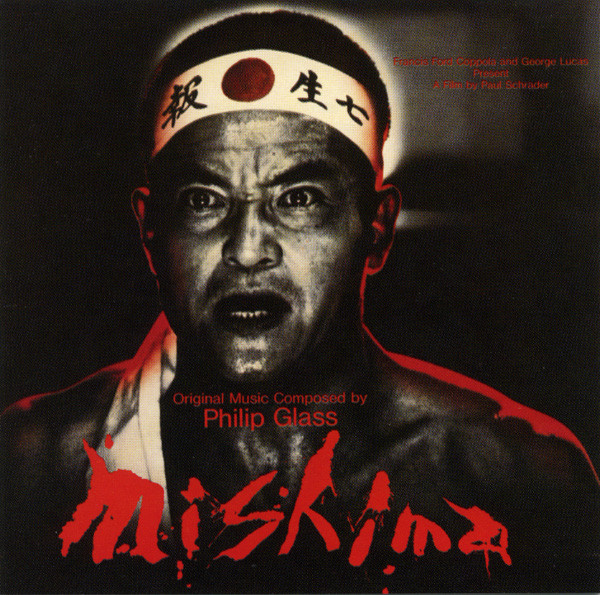
Philip Glass - "Mishima" Vinyl, LP, OST, 1985 (Nonesuch)


One can argue that there are better Philip Glass albums out there, but I'm very fond of his soundtrack to the film "Mishima" directed by Paul Schrader. I think "Einstein on the Beach" is one of the great pieces in classical 20th-century music, but Glass can do different types of music. "Mishima" is full of beautiful melodies, and the way he builds up the tempo as if adding one pick-up stick on to another, you're waiting for it to collapse. Alas, that doesn't happen. 

The film itself is one of my favorites as well. Ever since I was a teenager, I had a fascination with Yukio Mishima, not only for his writing but for his crazed life as well. On the surface, his whole lifestyle devoted to a mixture of literature, politics, gay life, and his need to be a performer — one thing for sure he didn't hold anything back. The film captures his character, but it is also the best work on a writer creating his (or her) world. Most movies about writers are dull. Still, Mishima is unique because, due to family overtures, Schrader had to rely on Mishima's writings, and that made this film a stronger piece of art.  The Glass compositions add a sense of melancholy as well as grandness. There is even a surf guitar part in the score that is a mystery to me — one of the unusual aspects in a Glass composition ever. There are classic OST albums that stay with me beyond the film. "A Clockwork Orange, "8 1/2," and "Mishima" is right up there with my other faves. 

Saturday, April 28, 2018

Michael Nyman - "The Kiss and Other Movements" Vinyl, LP, Album, 1985 (Editions EG)


I discovered Michael Nyman when he made a recording of his composition "Decay Music" for Brian Eno's Obscure Records.  A few years later I really got into his music due to his soundtrack work for British filmmaker Peter Greenaway.   Before I purchased those recordings, "The Kiss and Other Movements" was the first album of his that wasn't part of someone else's series (Eno) or film (Greenaway).  Although I do believe some of the music here was used for Greenaway's short films.  Still, I have heard of speed metal, but Nyman struck me as speed classical.   Which is a stupid observation but without a doubt, his music was so different from anyone else's at the time.  Also to my ears, it was very British sounding.   Eccentric comes to mind, but then there is Nyman's great talent for melodies.  He writes melodies that I can sort of hum in the shower or bath. 

His work is majestic and builds up like one adding one block on top of another, and then there is the fear that the whole structure will topple down.   That's the thrill of hearing his tightly controlled, and performed musical pieces.  "The Kiss" is an album that is a great entrance to the Nyman aesthetic, and the mixture of strings, horns, and a very aggressive electric bass almost gives it a Who type of intensity.   Nyman is a brilliant composer, and over the years, I have purchased many of his albums on CD, mostly in Japan.  For some odd reason or another, at the time, it was easy to find Nyman's work in a big music store in Tokyo.   For those who are fans of "Music of Penguin Cafe" (another Eno Obscure Records release) will find Nyman as a suitable companion.   

Sunday, January 28, 2018

Jun Togawa (戸川純) - 極東慰安唱歌 Vinyl, LP, Album, 45 rpm, Japan, 1985 (Yen Records)


I first discovered Jun Togawa in the small town of Moji-Ku on the big island of Kyushu in Japan.  I was living there for the entire four-seasons, and I came across her albums with the help of my wife Lun*na Menoh.   With a great deal of cultural guilt, I never took on the Japanese pop music scene in Japan in a big way.  I greatly admired Hosono Harumi and other members of YMO (Yellow Magic Orchestra) but a lot of it sounded flat to me due to the production standards of record production of the 1980s. Very digital, and it struck me that Japanese pop music was very much like Kabuki theater where everything is laid out on the stage in an equal manner.   My eyes didn't focus on one character or actor, but I look at the stage as if it was a giant poster.  My eyes kept moving around, and I feel the same with Japanese pop music of the 1980s.   Jun Togawa was different from the rest of the Showa era entertainers or artists.  Listening to her work I got a huge painting, but I can focus on parts of that aural painting due to its clarity and at the same time, it's eccentricity. 

 極東慰安唱歌 is a superb Togawa album or should say, The Jun Togawa Unit, which is the official artist listing for this project.   Here she makes music with Yoichiro Yoshikawa, Takago Higae,  and uses traditional Okinawa music as well as the composer Giacomo Puccini and the great Haruomi Hosono.  The first impression is that this is very much a techno-pop music but with touches of the old (Puccini and Okinawaian music), but the glue that holds all of this is Togawa's magnificent vocal talents.  She's a great singer.   

On one level she reminds me a bit of Kate Bush, but totally not British and very Japanese.  I once read or heard a Togawa quote that she knew nothing of Western music except for classical and Prince.  I believe her.   There are traces of psychedelic pop in her method and sound.  Listening and collecting Togawa is for sure falling into the rabbit's hole, and how one can crawl out of that space is very questionable.  Still, her recordings are consistently being reissued on the CD format, as well as in various compilations.  It's worth the adventure to check her music out.  She's great.   

Monday, December 18, 2017

Robert Wyatt - "Old Rottenhat" Vinyl, LP, Album, Reissue, 1985 (Domino)


My favorite commie pinko singer ever.   There is no such a bad thing as a Robert Wyatt recording.  Still, "Old Rottenhat" is my favorite of his later recordings from the 1980s.  For one, his lyrics are very political and direct.   He also wrote the entire album by himself, so this is very much a personal message (at the time) from artist to listener.  There's a moral outrage, but his anger is very much measured and restrained, and that's the art of Wyatt. 

I also love the minimalism of the recording.  Percussion and various keyboards, it's very much of a man in his studio making art.  Songs like "Alliance," "The United States of Amnesia," and my favorite "The Age of Self" cut through the bullshit and gets to the meat near the bone.  Wyatt's view is very much worldwide and he sees the political implications all connecting together.   It's like playing the game of hitting one gopher in the head, but the other head will pop out somewhere in the game landscape.  Sadly that we now live in the age of Trump, one could use Wyatt's voice.  The truth is not that much has changed since 1985.  Misery is still here, and Wyatt's art and voice will stay with us as long as there is a medium that allows us to play music. 

Tuesday, September 19, 2017

The Associates - "Perhaps" Vinyl, LP, Album, 1985 (WEA)


Billy MacKenzie's passions were in this order:  His dogs,  his family, and then music.  And I suspect he hated the music business. Which explains why he didn't go for the gold when it was evident that his talents were placed above so many others in the music world.  Without a doubt, his greatness was magnified by his work with Alan Rankine.  The first three Associates albums were magnificent in its scope, design and of course, the voice of MacKenzie.  When Rankine left the partnership, MacKenzie lost the driver, yet, he still made gorgeous pop music. 

"Perhaps" is the first album without Rankine, and it's produced by various people on different tracks. Martin Rushent did half, and Martyn Ware of Human League/Heaven 17/B.E.F. did the others, with some self-production by MacKenzie.  As a whole, the album sounds like a bunch of singles with the additional b-sides added to the package.   It doesn't have a consistency as the other Associates' albums.  On the other hand, you're going to get pop perfection in all its glory with songs like the title cut "Perhaps," "Those First Impressions," "Breakfast," "Thirteen Feelings," and others.  For one, the songwriting of Billy MacKenzie doesn't falter.  As a lyricist he's superb, but also he can sing the text off a cereal box and make it magnificent sounding.  For sure, with Rankine, he was pushing boundaries, and here he's singing magnificent pop.  The production makes the record sound very 1985, but if you go beyond that, there are incredible songs on this album.   In fact, over time in 1985, MacKenzie did a live concert with just his voice and a piano player.  Hardcore Billy music.  One of the great figures from the Post-Punk world, this album is essential to the Associates' world.  If for nothing else, for the comparison of the two sides of The Associates and just a reminder how great the Rankine/MacKenzie team were. 

Wednesday, September 13, 2017

The Explorers - "Explorers" Vinyl, LP, Album, 1985


What would Roxy Music sound like without Bryan Ferry?  The Explorers are the answer to that question.  It's a band that made only one album, and it included Phil Manzanera and Andy Mackay from  Roxy Music. James Wraith is the vocalist for this band, and if I'm not mistaken the other musicians on this album also played in the Roxy Music format.  When Bryan Ferry got himself in the recording of "Boys and Girls" after their iconic nod to the smooth pop world of "Avalon," Phil and Andy made their move with The Explorers.  

Listening to the album, I can imagine some of these songs being Roxy Music material.  One can easily imagine Ferry taking over the vocals of Wraith.  In fact, Wraith, here and there, sounds like a Ferry imitator.  Or perhaps he was instructed by Manzanera and Mackay to do so.  In that sense, the songs here sound like demos for a future Roxy Music album.  "Explorers" is not the worse album in the world, but it's a weak record.  On the other hand, it's interesting to hear the Roxy textures that are on these recordings.  As I have stated before, Manzanera and Mackay are very much the sound of Roxy Music, and it's not all Bryan Ferry.  

There are three excellent songs here, that would fit perfectly in a Roxy project.  They are "Lorelei," "Breath of Life," and "Venus De Milo" (and no, it's not the Television song).  These songs are right in the middle of side one, which thinks gives hope for side two.  Alas, that's not the case.  The other disturbing aspect of this album is that Phil and Andy don't leap over the fence like they did with respect to their first solo albums.   One of the things I loved about Mackay's first solo album that it was a crazed mixture of Joe Meek sounds, with a degree of camp thrown in - and Manzanera's "Diamond Head" is a great mix of Latin/pop/prog/avant-garde touches.  "Explorers" unlike that very name, is a band playing it safe in the mid-80s.  It's a shame that they went for a commercial sound than something experimental and wild.  In fact, it's shocking that those two didn't forge ahead in making sounds that maybe similar to Eno or even David Sylvian of that time.   If you're a Roxy Music completest and must fill that missing hole in their history, then, by all means, do get the album.  As mentioned there are some highlights, but it's like a human being looking for water in Death Valley.  

Tuesday, July 4, 2017

Philip Glass - "Mishima" CD, Album, 1985 (Nonsuch)


Now, this is a very nice cocktail.  The subject matter of Yukio Mishima, filmmaker Paul Schrader, and music by Philip Glass all in one package.  Well, the music is here.  This is one of my favorite soundtrack albums, because it serves the purpose of the narrative and images of the film, and stands on its own as an album.   Also, I have heard the melodies on this album on other works by Glass, so I suspect that this is music that he comes back to time-to-time.  

Consistently beautiful, but the dynamic is a subject that is very Japanese (Eastern) made by an American filmmaker and sounds by an American composer.  They didn't exotic it up.  As someone who writes, "Mishima" the film is one of the great movies of a writer's  life.  Usually, cinema fails in the writer biography due that we get scenes of the author behind the typewriter and sweating and drinking in despair.  Due to restrictions made by Mishima's wife, she didn't allow any mention of his homosexuality, his politics, and his suicide.   Which all Mishima fans know those three subject matters are what makes Yukio Mishima a fascinating figure and artist.   At times, he was a performance artist as well as a prose writer. Mishima did make films, both as a filmmaker and an actor.  He was the king of media when alive.   Schrader did a fantastic thing.  Instead of shooting the author's life, he had to go somewhere he wasn't restricted, and that is his books.  Schrader had the film rights so he could mine the material on Mishima through his writing.  This can be dangerous ground, but Schrader picked and chose the right pieces to tell the Mishima narrative.   

The exquisite music is delicate as well as coming like a powerful wave to the listener.   On one cut it sounds like a surf melody with an electric guitar.   So, there are surprises here and there.  A masterful soundtrack for an excellent film on a remarkable writer.