Total Pageviews

Showing posts with label Columbia - Princeton Electronic Music Center. Show all posts

Friday, January 19, 2018

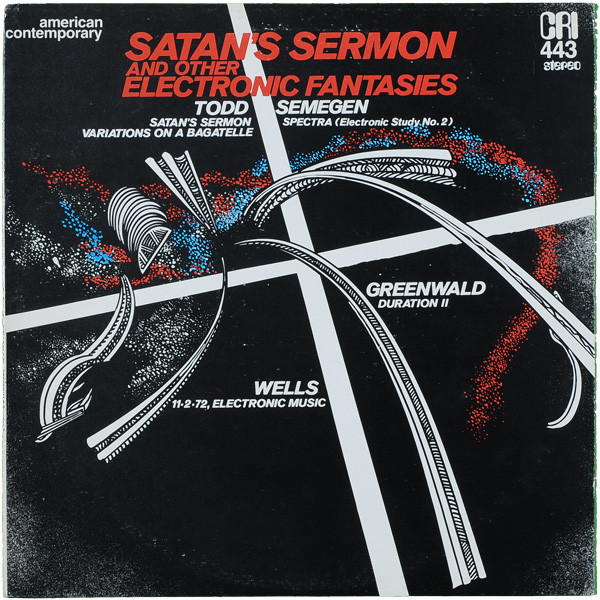
Various - "Satan's Sermon and Other Electronic Fantasies" Vinyl, LP, Album, 1980 (Composers Recording Inc)


I just did a Tosh Talks episode with my friend and translator Paul Knobloch, and he brought this album over to the house as a gift.  He knows that I'm crazy about electronic music from the 1950s to 1970s.    This is an album with music by four composers, who to this day, are unknown to me.  George Todd, Saria Semegen, Thomas Wells, and Jan Greenwald.  Looking up their names on Discogs website I don't find that many other recordings by these composers, which is a shame because the album is a delight. 

"Satan's Sermon" is a work by Todd that is mostly done on a synclavier, invented in 1977-1978.  A lot of bands in the 80s used the synclavier, especially in the recordings produced by Trevor Horn.  Here, its use is totally expansive and driven by an Able 40 computer.  It's digital meets analog.  The music is dark since it is called "Satan's Sermon."  

My favorite work on this compilation is Greenwald's "Duration 2" which was composed on the Nova 1200 Data General computer attached to Buchia 500 digital-to-analog synthesizer.  It's a very slow piece that's meditative but has textures that reflect sinister or even cinematic touches of an Alfred Hitchcock piece of work.  

Monday, March 20, 2017

V.A. - "Electronic Music IV" (Turnabout) Vinyl, LP, U.S., 1968


I have been exposed to Electonic music for my entire life.  It was about two years ago that I started to seriously purchase 'electronic' works from the 1950s and 1960s on vinyl.  On my journey of record buying and music listening, I discovered a name, Vladimir Ussachevsky who consistently turns up incredible music.  Along with Milton Babbitt and George Balch Wilson, all three were judges in a contest devoted to electronic music.  This album "Electronic Music IV" is the results of that competition.  Five winners.

The winner is Olly W. Wilson, a composer I know nothing about, except that he's African American, and known for establishing the TIMARA (Technology in Music and Related Arts) at Oberlin Conservatory, the first program devoted to electronic arts.  His winning piece "Cetus" (1967) opens the album, and it's a beauty.  Pure electric sine wave which slowly evolves into something dramatic. 

William Hellermann's "Ariel (1967) is a work that is a live performance, not a composition.  The source of the sound was a gong, and after that, it is anyone's guess.  This piece was realized in the Columbia-Princeton Electronic Music Center, which is where the great Ussachevsky made his recordings.   To me, this is the Sun Records of Electronic Music.

"Dixi" (1967) composed by Eugeniusz Rudnik is a highly textural work in electronics.   Recorded in Poland, it's an intense listening experience.  The tone changes and I found the music to be very visual.  Not all music is visual to me, in fact, this album is mostly an aural experience - but this particular cut has an additional flavor to it.  Outside of Poland, he seems to be an obscure music figure.  He just passed away last year.  For sure, I'm going to hunt for his music. 

Pril Smiley, a great name, and the only female composer/performer here on this album have a composition "Eclipse" (1967) that is also recorded at Sun Records, I mean at Columbia-Princeton Electronic Music Center.  85% is electronic sounds, but she added pre-recorded percussion to the mix as well.  Moody and very efficient work.  

Bohdan Mazurek, another Polish composer, has "Bozzetti" (1967) is another artist here where I want to check his other works.  This music is four pieces, and of them has a violin that is almost shocking to hear in the context of electronic music.  I like the mixture of real instruments and electronic effects.  One of the reasons why I really love Ussachesky is his ability to use instruments with the dials and switches.  The tension between wooden or metal instruments with the electric is a fabulous cocktail to me.  "Bozzetti" is mostly if not all electric, except for that violin and I think voices. 

Jozef Malovec from Czechoslovakia ends the album with his "Orthogenesis" (1966-1967) is pure hardcore electronic and the tape machine.  The purity of the two is another version of a classic cocktail.  A splendid album.  A good one for my collection. 
Monday, October 24, 2016

James Ostryniec /Contemporary Oboe Three Aspects: Gunther Schuller "Sonata Oboe & Piano, Faye-Ellen Silverman "Oboe-Sthenics" Solo Oboe & Vladiir Ussachevsky "Pentagram" Oboe & Tape (Finnadar Records, 1982)


It is consistently an adventure when one wanders in the 20th century classical music section of a record store.  For the past three or four months, I have been fascinated with early electronic music, and this is the third album I have purchased with regards to Vladmir Ussachevsky.   The co-founder, and for twenty years or so, the director of the Columbia-Princeton Electronic Music Center.  I think of him as sort of the pre-Eno - the fact that he works with real instruments, but alters their sound and pitch by using a tape machine.   The other two composers here are a total mystery to me, but it's nice to see that a female composer here is represented, Faye-Ellen Silverman, who was a student of Ussachevsky.   The oldest piece of music here is Sonata for Oboe & Piano by Gunther Schuller.

The principal subject matter for this specific album is the Oboe, played by James Ostryniec.  To me, the only oboe player I know is Andy MacKay from Roxy Music - but alas, there are others out there - and they seem to be interested in 20th century composition.  This is a gorgeous album, and the oboe sound is one that is very lonely sounding.  Like one who craves the sound of surf guitar, I imagine that there are those out there who obsessed over the sound of the oboe.   Also I want to credit Rüstem Batum for the cool image of an oboe attached to magnetic/recording tape on the front cover.  The 20th century seemed so promising in the early 1980s.

Thursday, October 6, 2016

Otto Luening/Vladimir Ussachevsky - "Tape Recorder Music" (Cacophonic, Vinyl LP)


Slowly and surely, this is becoming my favorite album in my collection of vinyl goodies. I have written about Otto Luening and Vladimir Ussachevsky before, on another album that was released in the early 60s.  "Tape Recorder Music" was recorded in 1952, and it's a remarkable album on so many levels.  Without a doubt, Brian Eno must have had this album during the early Roxy Music years.  Otto and Vladimir did was basically used real instruments - piano, flute, orchestration and put it through the tape machine to manipulate the sounds. Doing loops, echo, etc. Low-tech technique that keeps getting better.

On another level, the music on this album is really beautiful. Funny as well - especially with the voices mixed in one of the works.  It has a lightness, but the sound is fantastic. And again, listening to this album, I 'm reminded of the first two Roxy Music albums.   The Columbia Princeton Electronic Music Center was a sound lab for Luening and Ussachecsky - and they used it wisely.   Historically this is a very important album, but the listening pleasure is also endless.  I really love it.

Friday, September 9, 2016

Columbia–Princeton Electronic Music Center (Recorded in 1961, released in 1964) Columbia


Vladimir Ussachevsky, Otto Luening, Milton Babbitt and Roger Sessions founded the Columbia-Princeton Electronic Music Center in New York City sometime in the early 1950s.   It is the oldest center to focus on composing and making electronic music in the United States.  For me, there is something wonderful and fresh hearing early electronic music in the combined eras 1950s and 1960s.  It was a time of wonderment and exploration of new sounds, done in new ways.  This particular album is a classic, which consisted of pieces and performances by Babbit, Luening, Ussachevsky, Bülent Arel, Halim El-Dabh, and Mario Davidovsky. 

The main discovery for me is El-Dabh's "Leiyla and the Poet." My reference to this piece is David Bowie's "Lodger" album, which was one of the first works I heard that mixes ethnic melodies in an electronic-pop mode.   I don't know if Bowie was aware of El-Dabh's work, but what's marvelous is the mixture of musique concrète with what I think is Egyptian folk or ethnic music.  Based on the Arabic 11th century poem "Layla and Majnun, " the music is a combination of vocals, percussion and high-pitched electronic noise.  Tape manipulation of speed transposition filters the vocals into a unique and highly effective sound. It's a short intense piece of work, that also brings to mind the music that Paul Bowles recorded in Morocco.  To me, it's the perfect hybrid of styles, that is familiar, but in actuality, it's quite new - especially at the time of this recording in 1961.  

Ussachevsky's full chorus piece "Creation - Prologue" is a mixture of heavenly voices but then is joined by jolting electronic effects, including a short section using an early version of a synthesizer.  It's not surprising to know that Arel worked with Edgard Varèse - because the piece here, "Stereo Electronic Music No. 1" is very similar to the great French musique concrète composer's music.   Completely electronic, and controlled feedback, it's a remarkable piece of textures exploring mood and tension.   Rabbit's performance as the title says "Composition for Synthesizer" is an exploration of linear/total rhythms, volume, and pitches.  For me, the weakest piece on this album, but still interesting.  Davidovsky's "Electronic Study No. 1" is from three sources: sinusoidal and square wave generators, and white noise.   Chaos is contained in a box by the composer.  

The last piece on the album is by Luening, and it's a combination of synthesizer, then manipulated by taping techniques, with a live violin, played by Max Pollikoff.  "Gargoyles" is an intense piece of noise/music.   Besides the chorus used in Ussachevsky, and El-Dabh's mixture of vocals/electronics, this is very much more of a real stringed instrument bouncing off the electronics/tape manipulations.  The beauty of all six composers is that they have studied classical composition as well as worked with regular orchestrations, but here they take a huge step forward to a new world.  Yet, if one listens carefully, it is still has traces of the old classical world.  A remarkable anthology of sounds that one can hear later in 20th century pop music.