Total Pageviews

Showing posts with label Electronic Music. Show all posts

Sunday, December 22, 2019

Lucien Goethals - "Lucien Goethals" Vinyl, LP, Compilation, Remastered, 2014 (Cacophonic)


Lucien Goethals (1931-2006) is a composer who had a focus on electronic music.  Or with 'real' instruments such as bass clarinet, which is the focus on side one of this album.  "Difonium" is an 18-minute composition with Harry Sparnaay on bass clarinet, with Goethals's electronic sounds. This 1974 composition is a moody interplay with the wind instrument andmagnétaphone. I think of Edgard Varése's music when listening to this piece.  Not only due to its compositional techniques but for it's the sense of purity in sound and vision. 

Side Two starts off with "Cellotape," and I have to say I love the mixture of electronics and real instrumentation such as piano and violin.   I admire electronic music as it stands by itself, but the tension of having real instruments brings the music a specific type of intensity.  Sometimes this music is instruments treated through an electronic medium (besides the recording studio of course), but here it's on equal ground with Goethals's eternal sounds.  The Piano goes through cluster-sounds, strumming of the piano keys as well as played on the keyboard.  "Studie VII B" is pure electronic composition, and I find it lacking in that it does need the presence of a real instrument in its mix. 

Friday, January 19, 2018

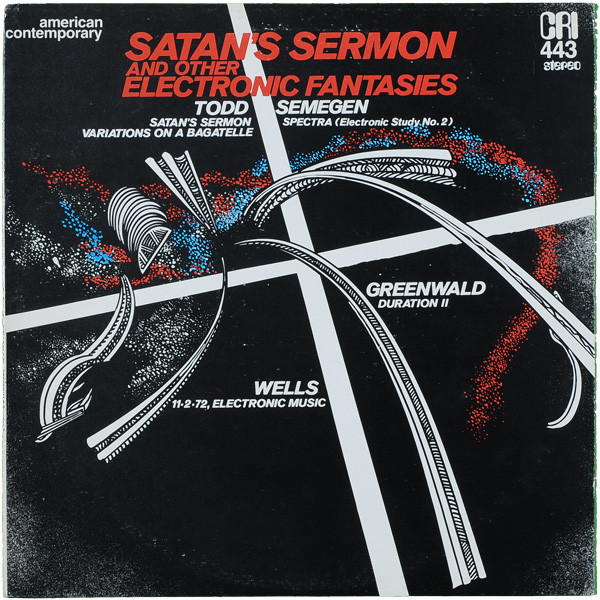
Various - "Satan's Sermon and Other Electronic Fantasies" Vinyl, LP, Album, 1980 (Composers Recording Inc)


I just did a Tosh Talks episode with my friend and translator Paul Knobloch, and he brought this album over to the house as a gift.  He knows that I'm crazy about electronic music from the 1950s to 1970s.    This is an album with music by four composers, who to this day, are unknown to me.  George Todd, Saria Semegen, Thomas Wells, and Jan Greenwald.  Looking up their names on Discogs website I don't find that many other recordings by these composers, which is a shame because the album is a delight. 

"Satan's Sermon" is a work by Todd that is mostly done on a synclavier, invented in 1977-1978.  A lot of bands in the 80s used the synclavier, especially in the recordings produced by Trevor Horn.  Here, its use is totally expansive and driven by an Able 40 computer.  It's digital meets analog.  The music is dark since it is called "Satan's Sermon."  

My favorite work on this compilation is Greenwald's "Duration 2" which was composed on the Nova 1200 Data General computer attached to Buchia 500 digital-to-analog synthesizer.  It's a very slow piece that's meditative but has textures that reflect sinister or even cinematic touches of an Alfred Hitchcock piece of work.  

Friday, September 29, 2017

Alwin Nikolais' "Choreosonic Music of the New Dance Theatre of Alwin Nikolais" LP, Vinyl, Album, 2013/1959, (Cacophonic)


Alwin Nikolais (1910-1993) started out by playing the organ in the silent films. When sound came in, he needed to expand his horizons, and he did so by studying scenic design, costuming, acting, puppetry, and music composition.   These field of interests led him to dance choreography where he could combine all his different mediums in one space.   He founded the Henry Street Playhouse in New York City in the 1950s, where he started to do multi-media presentations.  Nikolais wrote electronic music go with his performances, and here we have the aural results of sounds he made in the 1950s. 

In a similar situation as John Cage/David Tudor (and Eno), Nikolais' partner-in-crime David Berlin, operated and manipulated the sounds from the sound booth that looked over the stage.  Some of the music/noise were played by the dancers with such instruments as drums, bells, wood blocks, gongs, and rattles but all played through Nikolais/Berlin's electronic filters.  The music now is just as fresh as it must have been in 1959.  

When I was in the ARTBOOK store, I played this album, and I sold copies there and then.  By no means is it ambient, due to it being originally used as modern dance music - but a total pleasing listening experience, where the sound brings a sense of rhythm and dynamics.  It's interesting to note that Nikolais was the first person to purchase the first Moog analog synthesizer system.  Another electronic composer of great importance, yet I never heard of him till recently and when I bought this album "Choreosonic Music of the New Dance Theatre of Alwin Nikolais."

Friday, August 11, 2017

Remi Gassmann - "Electronics" Vinyl, LP, Album 10", 2013 (Cacophonic)


The great label out of the United Kingdom, Cacophonic, has released another fascinating album.  "Electronics" is music by composer Remi Gassmann, and this is music for a ballet called "Electronics" choreographed by the legendary George Balanchine in the year 1961.   Gassmann worked with Oskar Sala, another composer, who had access to an early electronic keyboard called the Trautonium.   Eventually, the duo was hired by Hitchcock to add aural effects for his "The Birds."

Never seen the ballet, which had moderate success in 1961, the music on this disc is wide-screen imagery through the ears.  It's not musique concréte or even experimental.  The music to me has orchestrational abilities, but a preference to sound that is electronic.  At the time, many were exploring real live instruments or sounds from the world and then transforming them through electronic or tape manipulations.  "Electronics" is a work that is entirely electronic, but does use tape manipulations with the original sound of machines.  For the listener in the 21st century, these are unusual sounds, but I imagine for the viewer (of the Ballet) and listener it must have been revolutionary.  An interesting document, and essential for those who are interested or collect electronic music.  What I'm slowly finding is that there is a whole world of sound that was made from the 1940s to the early 1960s (and before & beyond of course) that is worth the time and effort to listen and acknowledge its importance. 

Friday, June 23, 2017

Pierre Henry - "Le Voyage" Vinyl, LP, Album, 1962/2013 (Doxy)


For the past two years, I have been picking up albums by Pierre Henry.  I have a fascination with the nature of electronic music or Musique Concréte.  The 'noise' have called out for me, and it's a hard habit to break.  "Le Voyage" is a big Henry project.  I believe it's music with dance choreographed by Maurice Béjart.  I know very little of this piece except that it's based on The Tibetian Book of the Dead, and it represents from birth to death.  Seems like a topical subject matter for a ballet and its score. 
As far as my ear can tell this is music that is entirely electronic.  No organic sounds processed through electronic means, but machines manipulated by Henry making music.   Some parts are almost ambient but with an intensity where you can't really ignore the music.  Toward the end, it becomes a majestic piece of noise that's an incredible ear wash.  I listened to this vinyl in a room with a very high ceiling, and the music just encaptures the landscape that is the room.  I don't know who Doxy is, although I suspect that this record company takes advantage of copyright laws in Europe. Still, they do a great job in curating album titles with great sound. 

Thursday, May 18, 2017

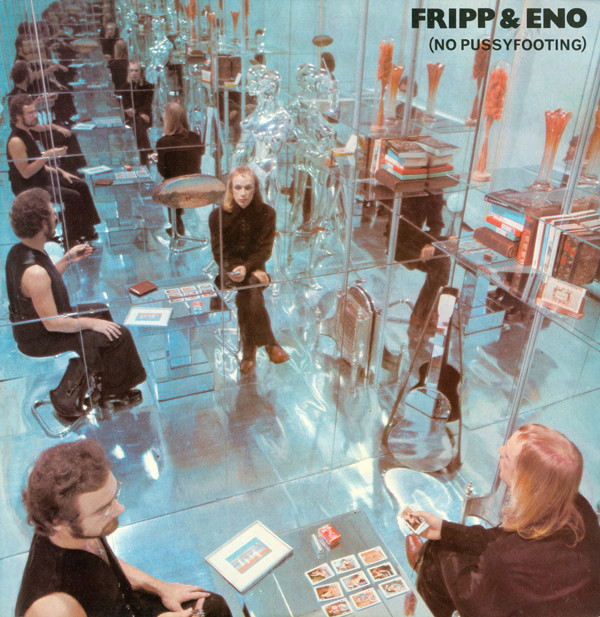
Fripp & Eno - "(No Pussyfooting)" Vinyl, LP, Album, 1973 (Editions EG)


The Roxy Music empire just kept on giving in 1973.  Two brilliant Roxy albums, a fascinating Bryan Ferry solo, and then a Phil Manzanera solo, and then the Eno explosion.  Being a consumer that year was very expensive and incredibly fun.  I remember the feeling that everything was possible, and music will go to explore new avenues and landscapes.  But of course, with make-up!

Robert Fripp, the guitarist, and the brains behind King Crimson, and Eno (before Brian) made the ultimate bedroom music album.  A tape recorder (or two) and guitar with effects.  The music drew the listener into an abstract world of aural pleasure.  No vocals, but a sound that had no beginning or no end.  "The Heavenly Music Corporation" was not a shocking piece of music, because I suspected that Eno will eventually come to this point with his music.  What is fascinating is that the music is not made by spiritualists (well, not Eno) but with the physical world of pleasure and desire.  Eno's later recordings deal with the ambient landscape, but this is more of music that transform your world and to be engaged with it as well. 

At the same time, it's the ultimate guitar album.  Just as important as Jimi Hendrix or surf music.  Also of great interest to me is the album cover and packaging.  The mirrored room is not one of meditation but to follow your glaze to one's inner world.  Which I suspect by the playing cards on the table is a lot of fun. 


Thursday, May 11, 2017

The Human League - "Reproduction" Vinyl, LP, UK, 1979 (Virgin)


If J.G. Ballard had a soundtrack to his novels, it would more likely be the early edition of The Human League.   If Kraftwerk represented a "Germany" that is both realistic and what we think as German, then surely the League is British in that same fashion.  Very electronic and minimal with respect to their arrangements, it is basically synths, and Philip Oakey's always distant, yet heartfelt singing.  It's music that is very much part of the Industrial English cities landscape, but with insight into the future or a sense of dread that things are not that hot.  It does have a relationship with glam rock, but almost a scholarly view of that music from the recent past.   Its roots are Gary Glitter, but as listened to by someone in the future who is looking back to a much more cynical point than their present time.  Which is shit.  But when you have nothing, great things can happen upon you.

"Circus of Death" makes reference to "Hawaii 5-0" and its exotic culture via an American TV show is redefined by Oakey and company.   There is no fear of technology of what the future will bring, because The Human League looks back at old culture junk, and somehow make it all new again.  This is the sound of four guys in a group, or collective, that are commenting and reshaping their world.  Listening to their music you can feel the English damp weather, and their electro-glam sound is hypnotic with catchy beats and sublime melodies.  "Empire State Human" is a masterpiece.  And their version of "You've Lost That Loving Feeling" feels just right in their hands.  Ian Marsh, Martyn Ware (future Heaven 17), Philip Adrian Wright (responsible for their slides & film, and yet, a full-time member of The Human League) and of course, Oakey served a bleak, cold world, but I could live there.


Monday, March 20, 2017

V.A. - "Electronic Music IV" (Turnabout) Vinyl, LP, U.S., 1968


I have been exposed to Electonic music for my entire life.  It was about two years ago that I started to seriously purchase 'electronic' works from the 1950s and 1960s on vinyl.  On my journey of record buying and music listening, I discovered a name, Vladimir Ussachevsky who consistently turns up incredible music.  Along with Milton Babbitt and George Balch Wilson, all three were judges in a contest devoted to electronic music.  This album "Electronic Music IV" is the results of that competition.  Five winners.

The winner is Olly W. Wilson, a composer I know nothing about, except that he's African American, and known for establishing the TIMARA (Technology in Music and Related Arts) at Oberlin Conservatory, the first program devoted to electronic arts.  His winning piece "Cetus" (1967) opens the album, and it's a beauty.  Pure electric sine wave which slowly evolves into something dramatic. 

William Hellermann's "Ariel (1967) is a work that is a live performance, not a composition.  The source of the sound was a gong, and after that, it is anyone's guess.  This piece was realized in the Columbia-Princeton Electronic Music Center, which is where the great Ussachevsky made his recordings.   To me, this is the Sun Records of Electronic Music.

"Dixi" (1967) composed by Eugeniusz Rudnik is a highly textural work in electronics.   Recorded in Poland, it's an intense listening experience.  The tone changes and I found the music to be very visual.  Not all music is visual to me, in fact, this album is mostly an aural experience - but this particular cut has an additional flavor to it.  Outside of Poland, he seems to be an obscure music figure.  He just passed away last year.  For sure, I'm going to hunt for his music. 

Pril Smiley, a great name, and the only female composer/performer here on this album have a composition "Eclipse" (1967) that is also recorded at Sun Records, I mean at Columbia-Princeton Electronic Music Center.  85% is electronic sounds, but she added pre-recorded percussion to the mix as well.  Moody and very efficient work.  

Bohdan Mazurek, another Polish composer, has "Bozzetti" (1967) is another artist here where I want to check his other works.  This music is four pieces, and of them has a violin that is almost shocking to hear in the context of electronic music.  I like the mixture of real instruments and electronic effects.  One of the reasons why I really love Ussachesky is his ability to use instruments with the dials and switches.  The tension between wooden or metal instruments with the electric is a fabulous cocktail to me.  "Bozzetti" is mostly if not all electric, except for that violin and I think voices. 

Jozef Malovec from Czechoslovakia ends the album with his "Orthogenesis" (1966-1967) is pure hardcore electronic and the tape machine.  The purity of the two is another version of a classic cocktail.  A splendid album.  A good one for my collection. 

Thursday, January 12, 2017

Karlheinz Stockhausen - ELECTRONIC MUSIC "Song of the Youths" / "Contact" (Deutsch Gramopon)


Karlheinz Stockhausen's first electronic piece, which he wrote in 1955/56.  What I have read is that it is a personal, even spiritual music for the composer.  "Song of Youths" have children singing in German, with intrusive electronic sounds  - cutting in and out of the children's chorus.  Abstract, and quite remarkable in scope.   The live version was supposed to take place in a church, but due to the electronic/speakers issue, it never happened.  Still, the original set piece is five speakers.  This recording was reconstructed for two speakers.    My first listen to this piece I found it cold, but by the second time around, I find it emotional.  There is a Wagnerian feel, in that it's quite grand.  Still, big sounds can bring deep emotions to the table. 

The score to "Song of the Youths."

"Contact" (Kontakte) was realized 1958-60.  A more meditative piece of music than "Song of the Youths."  Still, there are loud krangs among the hums, so it keeps one's toes in operation.  To me, Stockhausen's music deals very much with space.  The actual space that the music or speakers are placed as well as the sound becoming either a sculpture or architectural model of some sort.  In other words, I don't think this music would be good on YouTube or through your computer speaker.  You need two big speakers, nice room, and a glass of wine (of course).  


The spectacle of Stockhausen's compositions is a big part of the overall experience.  In that sense, I think he shares that quality with Wagner.  The 1950s, which is often thought of as a conservative era, brought electronics into music in a very thoughtful and serious manner.  Stockhausen and others were truly the light coming out of the 20th-century headlights.


Thursday, October 6, 2016

Otto Luening/Vladimir Ussachevsky - "Tape Recorder Music" (Cacophonic, Vinyl LP)


Slowly and surely, this is becoming my favorite album in my collection of vinyl goodies. I have written about Otto Luening and Vladimir Ussachevsky before, on another album that was released in the early 60s.  "Tape Recorder Music" was recorded in 1952, and it's a remarkable album on so many levels.  Without a doubt, Brian Eno must have had this album during the early Roxy Music years.  Otto and Vladimir did was basically used real instruments - piano, flute, orchestration and put it through the tape machine to manipulate the sounds. Doing loops, echo, etc. Low-tech technique that keeps getting better.

On another level, the music on this album is really beautiful. Funny as well - especially with the voices mixed in one of the works.  It has a lightness, but the sound is fantastic. And again, listening to this album, I 'm reminded of the first two Roxy Music albums.   The Columbia Princeton Electronic Music Center was a sound lab for Luening and Ussachecsky - and they used it wisely.   Historically this is a very important album, but the listening pleasure is also endless.  I really love it.

Friday, September 9, 2016

Columbia–Princeton Electronic Music Center (Recorded in 1961, released in 1964) Columbia


Vladimir Ussachevsky, Otto Luening, Milton Babbitt and Roger Sessions founded the Columbia-Princeton Electronic Music Center in New York City sometime in the early 1950s.   It is the oldest center to focus on composing and making electronic music in the United States.  For me, there is something wonderful and fresh hearing early electronic music in the combined eras 1950s and 1960s.  It was a time of wonderment and exploration of new sounds, done in new ways.  This particular album is a classic, which consisted of pieces and performances by Babbit, Luening, Ussachevsky, Bülent Arel, Halim El-Dabh, and Mario Davidovsky. 

The main discovery for me is El-Dabh's "Leiyla and the Poet." My reference to this piece is David Bowie's "Lodger" album, which was one of the first works I heard that mixes ethnic melodies in an electronic-pop mode.   I don't know if Bowie was aware of El-Dabh's work, but what's marvelous is the mixture of musique concrète with what I think is Egyptian folk or ethnic music.  Based on the Arabic 11th century poem "Layla and Majnun, " the music is a combination of vocals, percussion and high-pitched electronic noise.  Tape manipulation of speed transposition filters the vocals into a unique and highly effective sound. It's a short intense piece of work, that also brings to mind the music that Paul Bowles recorded in Morocco.  To me, it's the perfect hybrid of styles, that is familiar, but in actuality, it's quite new - especially at the time of this recording in 1961.  

Ussachevsky's full chorus piece "Creation - Prologue" is a mixture of heavenly voices but then is joined by jolting electronic effects, including a short section using an early version of a synthesizer.  It's not surprising to know that Arel worked with Edgard Varèse - because the piece here, "Stereo Electronic Music No. 1" is very similar to the great French musique concrète composer's music.   Completely electronic, and controlled feedback, it's a remarkable piece of textures exploring mood and tension.   Rabbit's performance as the title says "Composition for Synthesizer" is an exploration of linear/total rhythms, volume, and pitches.  For me, the weakest piece on this album, but still interesting.  Davidovsky's "Electronic Study No. 1" is from three sources: sinusoidal and square wave generators, and white noise.   Chaos is contained in a box by the composer.  

The last piece on the album is by Luening, and it's a combination of synthesizer, then manipulated by taping techniques, with a live violin, played by Max Pollikoff.  "Gargoyles" is an intense piece of noise/music.   Besides the chorus used in Ussachevsky, and El-Dabh's mixture of vocals/electronics, this is very much more of a real stringed instrument bouncing off the electronics/tape manipulations.  The beauty of all six composers is that they have studied classical composition as well as worked with regular orchestrations, but here they take a huge step forward to a new world.  Yet, if one listens carefully, it is still has traces of the old classical world.  A remarkable anthology of sounds that one can hear later in 20th century pop music.