Total Pageviews

Showing posts with label 1973. Show all posts

Sunday, March 3, 2019

Philip Glass - "Music in Similar Motion / Music in Fifths" LP, Album, 1973 (Chatham Square Productions)


The early music of Philip Glass is interesting to me because they are genuinely sculptures made of sound. I feel the music is prepared to take physical space.   His later work is very melodic, but the early works are like classical garage rock.  Made in lofts for people who live in lofts.   "Music in Similar Motion" is three electric organs and two soprano saxophones, plus flute played by Robert Prado, who it seems passed away soon after this recording in 1971.  The music Glass wrote was from another culture, and not necessarily from the New York world.  In fact, the music is transported into that culture.  Still, I think both pieces (the other being "Music in Fifths") are sculptures more than music.

The repetition of the notes played together are a series of riffs, that combined with the other musicians is hypnotic, yet organic in that it has a hefty weight to it all.  The music doesn't roll, but clearly, it rocks.   Best to be played loud.  


Sunday, January 14, 2018

Egisto Macchi - "E.S.P. Vinyl, LP, Album, OST, Limited Edition, 1973/2016 (Cometa Edizioni Musicali)


For those who have read my previous posts as well as my talk on Egisto Macchi https://youtu.be/rqCI97HMQxY know that I'm a huge fan of his work. I'm very passionate about Macchi's music at the moment because it's a new discovery or a new love.  Macchi is known for the music he composed for library music companies.   He was very much a close associate of Ennio Morricone, and like that great composer, they do share a sense of aural adventure.  Morricone did a lot of big budget films, and Macchi did mostly work for grade-z film productions.  Nevertheless, he was a brilliant composer.  E.S.P. is a work of stunning beauty.  

E.S.P. was an Italian TV series, and the music on this album basically plays the one theme but in different arrangements.  When I first heard E.S.P., it reminded me of the soundtrack "Twin Peaks, " in that both pieces capture a wishfulness but a sense of sinister underpinning around the corner.  The main instrument on E.S.P. is the Theremin.  Played not like a science fiction soundtrack, but more of a melodic instrument that fits in the orchestration perfectly.  The score is haunting and it's the perfect late night sound to reflect on one's life.  A superb album. 


Tuesday, December 26, 2017

Lou Reed - "Berlin" Vinyl, LP, Album, Reissue, 2008/1973 (RCA)


Lou Reed's "Berlin" has some of his greatest songs, but as a narrative concept album, it's weak.  Side one is perfect, but the other side's pace is slow, almost an after-thought than anything else.   The beauty of Lou Reed is that he was very much of an artist who wanted to do something new on the next record.  The previous album "Transformer" is a masterpiece, and I think the last of his work that had traces of his years in The Velvet Underground.  "Berlin" is very much 1973 Lou, and what's interesting is that at the time of this recording of the album, he never been to Berlin.  So it's an artist's projection of a city and culture that he only got through second-hand channels. 

Berlin has always been a mythological metropolis to me. I went there in the 1980s when the wall was still up.  I liked the city, but I was disappointed that Sally Bowles wasn't around nor Bertolt Brecht. In other words, I totally had a "Berlin" in my head that no longer exists.   And on top of that, Berlin reminded me in parts, of Los Angeles, my hometown.   So when "Berlin" came out, I totally saw this project as a documentary or something Lou had experienced first-hand.  Then again, the role of the artist is always to do illusionary magic, and the album is very much an illusion as well in parts, a magnificent pop album.  

Besides the iconic Lou Reed vocals and lyrics, the album features the aggressive bass playing of Jack Bruce.  "Berlin" is one of my favorite 'bass' albums.   It's always thrilling to hear Bruce's work, and I think on this album he did a magnificent job.   Like Jah Wobble or Mick Karn, Bruce was a very strong bassist, who was equally unique in his playing or sound.   The other great thing about the album is the overall production by Bob Ezrin.   Overproduced and making the music sound like a huge production with full orchestra, powerful drumming (Procol Harum's B.J. Wilson and Aynsley Dunbar), plus the twin guitars of Steve Hunter and Dick Wagner, this was a group of musicians who played huge on the aural soundtrack.   In a certain style, "Berlin" has an operatic quality of being bigger than life, and that's a plus for this album. 

In theory, it would have been great if the album was just an EP of the first six songs.   Side two is just over emotional and almost a bad taste Christmas card.  Still, it's an important Lou Reed album, in the context with the rest of his recordings. 

Monday, November 27, 2017

Buffalo Springfield - "Buffalo Springfield" 2 x Vinyl, LP, Compilation, 1973 (Atco)


The one word that comes to my mind when I hear the name "Buffalo Springfield" is frustration.  This is a band that should have gone to a higher level of greatness, but I suspect ego got in the way of the direction to go upwards.   Still, they left three albums that are very good, but this compilation of those three records are the best introduction to the Buffalo Springfield world.  

The beauty of the band was the perfect set-up or relationship between the dueling lead guitars of Steve Stills and Neil Young, and Richie Furay's superb vocals and rhythm guitar.  With the soul/Stax drumming of Dewey Martin, and who I suspect is the real star of the group, Bruce Palmer on bass.  Part of the sadness I feel is that this is a band that lost an opportunity of making a permanent presence on the stage.  What I have seen from one clip of them playing live on TV, is incredible.   The tension between the players reminds me of the original set-up of Television with Tom Verlaine and Richard Lloyd.  All play guitars, but at times it seems that they were having a communication between themselves, and us listeners were allowed to listen in.    The fact that Stills/Young tried to do something with the Springfield, and then with the terrible CSNY, and then the Stills/Young album/tour, well, I guess they tried.  The fact is these were two different type of musicians/songwriters, and I think they genuinely needed each other, to make their work more consistent and robust.   I'm not a fan of solo Neil or solo Stills, but when they combine their talents in Buffalo Springfield, it was magnificent.  The sad thing is that there is no film footage of them on stage, and worse, no live recordings.   Just hearing the extended version of Stills' "Bluebird" is fantastic.   One of the great guitar rave-ups in recorded history!

The band playing together was equal, but again, I think their recordings are a hit and miss.  The first album, produced by Greene and Stone, miss the intensity of the songs and their performance.  Still, "Mr. Soul" and "For What's it's Worth" are amazing records.  The other secret weapon is Richie Furay, who is an incredible singer.   Both in harmony and lead vocals.   And there should have been a full-use of the genius Jack Nitzsche, for instance, he should have arranged the entire works of Buffalo Springfield, not only on the Neil stuff but all the other material as well.   After the first album, it became a situation where each band member produced his composition and so forth.   So in a sense, you have a series of solo recordings within the Buffalo Springfield landscape.   

Buffalo Springfield was a super band, but due to its character, it burned itself out before doing something incredible.   This double compilation album is pretty great.  Still, I feel that there was more work to be done.  The story is not over yet. 

Sunday, October 15, 2017

Glenn Gould - "Plays His Own Transcriptions of Wagner Orchestral Showpieces" Vinyl, LP, Album, 1973 (Columbia Masterworks)


I don't know what is more fascinating, Glenn Gould making an arrangement of Wagner's music for the piano, or that he mentions Ferrante and Teicher in the interview that comes with the album.  Still, Wagner has always been a favorite of mine, but to a point.  My problem is that I feel that Wagner's music gets lost in the orchestration, and through his iconic ego.   The beautiful melodies that he wrote are superb, yet they get lost in the Wagner world or mix. 

Glenn Gould transcribed the orchestration to piano music, and doing so, brings Wagner back to planet Earth, where us other humans live as well.   Wagner is very much a genius from the 19th century, and Gould is a brilliant contemporary artist.  The two (well, Wagner's music) meet in a recording studio in 1973, and it's hearing these beautiful melodies in a fresh and new way.  I suspect the actual Viking Wagner lunatic will probably hate this album, but for me, it's a masterpiece. 

Gould keeps the romantic feelings intact, but it's on a smaller scale.  Reading his interview that comes with this vinyl disc, it's interesting that he points out that Liszt, a masterful pianist, did transcriptions of Beethoven's orchestrational music.  Besides the aesthetic flavor of doing something, it is also a proper technique in presenting a composer's music to places that couldn't afford a full orchestra.  Gould's purpose is to re-think Wagner, and I think he also wanted to dominate the music, instead of the music dominating him.  

As far as I know, Gould played and recorded Liszt's transcripts of Beethoven's Fifth Symphony, but the Wagner piece is the only one that he actually wrote an arrangement for piano.  There are three pieces by Wagner on the album:  "Meistersinger Prelude," Dawn and Siegfried's Rhine Journey from "Götterdämmerung," and on side two "Siegfried Idyll." The Gould pace is slow on "Siegfried Idyll."  It's a thoughtful approach to this music, with pauses, almost if someone is meditating on what is being played, as he works through the piece.  A beautiful method with respect to performing Wagner. 

Wednesday, September 20, 2017

Roxy Music - "Pyjamarama b/w "The Pride And The Pain" 45 rpm vinyl, 1973 (Island)


The b-side to "Pyjamarama" the great song by Roxy Music, is"The Pride And The Pain" which sounds like if Bryan Ferry left the band and was replaced by Ennio Morricone.  It took me awhile to find this recording because once I heard it, I loved it.  There is a CD version that is on one of their Roxy Music box sets put out some years ago, but finally, I have the single.  

"The Pride and The Pain" is written by Andy Mackay.  It features his distinctive oboe playing but mixed in with the minimal piano, Phil Manzanera's Italian sounding electric guitar, Eno's (I presume) sound of the wind and off-mike vocals or talking, and like the title, it does bring Morricone's great spaghetti western soundtracks from the 1960s.  This recording is too great to be lost in the heaps of b-sides that never made it onto albums. 

"Pyjamarama" is essential early Roxy.  The great guitar cords in the beginning, but before the melody and Ferry's voice kicks in - it's a natural music high at this point.  One wonders why this song is not on the "For Your Pleasure" album, but at the same time, it does exist quite well as a stand-alone single.  It's a classic Roxy piece, but again, the b-side "The Pride And The Pain" is really amazing.


Thursday, May 18, 2017

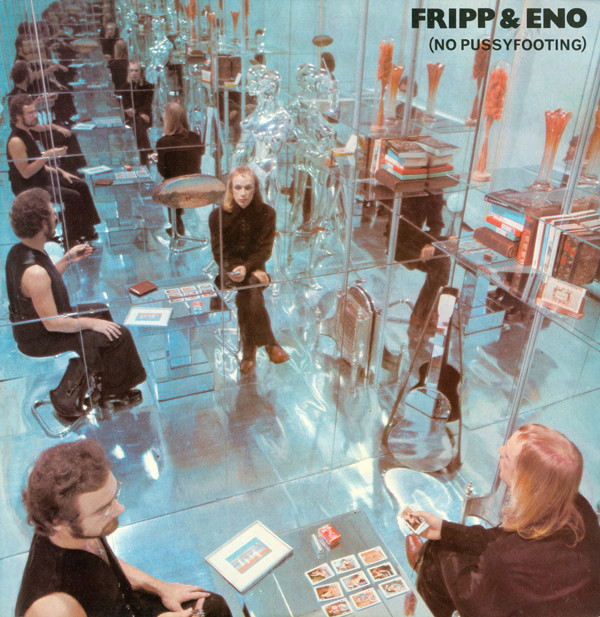
Fripp & Eno - "(No Pussyfooting)" Vinyl, LP, Album, 1973 (Editions EG)


The Roxy Music empire just kept on giving in 1973.  Two brilliant Roxy albums, a fascinating Bryan Ferry solo, and then a Phil Manzanera solo, and then the Eno explosion.  Being a consumer that year was very expensive and incredibly fun.  I remember the feeling that everything was possible, and music will go to explore new avenues and landscapes.  But of course, with make-up!

Robert Fripp, the guitarist, and the brains behind King Crimson, and Eno (before Brian) made the ultimate bedroom music album.  A tape recorder (or two) and guitar with effects.  The music drew the listener into an abstract world of aural pleasure.  No vocals, but a sound that had no beginning or no end.  "The Heavenly Music Corporation" was not a shocking piece of music, because I suspected that Eno will eventually come to this point with his music.  What is fascinating is that the music is not made by spiritualists (well, not Eno) but with the physical world of pleasure and desire.  Eno's later recordings deal with the ambient landscape, but this is more of music that transform your world and to be engaged with it as well. 

At the same time, it's the ultimate guitar album.  Just as important as Jimi Hendrix or surf music.  Also of great interest to me is the album cover and packaging.  The mirrored room is not one of meditation but to follow your glaze to one's inner world.  Which I suspect by the playing cards on the table is a lot of fun. 


Saturday, April 29, 2017

The Kinks - "Preservation Act 1 & 2" Two albums Vinyl (RCA) 1973/1974


The last great Kinks project.  Ever since "Village Green Preservation Society" Ray Davies has thought out conceptually for that and future albums.  He started out as being an excellent observational songwriter, who knew how to do musical profiles on individual figures of the London or UK world. "Dandy," "Lola," and others, and prop them up as figures in a specific class or social order.  Davies used each album as a particular subject matter - and not as in a mood piece, but more in a narrative story or novel.  

"Preservation Act 1" and "Preservation Act 2" are separate albums, but in actuality, one project. I'm sure there was a business issue of putting out a three-disc set at the time and a very ambitious project on top of that.    For me, and I think others, I see this as one big work.  So I'm going to treat this as one album here.  "Preservation" is very much a major Ray Davies work.

It' reminds me of Kurt Weill/Bertolt Brecht's "Three-Penny Opera, which takes place in London, and actuality is based on John Gays "Beggar's Opera" which was written in 1728.   What Ray did was bring the political satire back to British roots.  The music at times have a Weill touch, but with Ray, there is an additional British Music Hall presence as well.   The musical (and "Preservation" is a musical) takes place perhaps in the future, but the foundation is clearly post-war London or another industrial town.   Flash is the main villian here.  Corporate gangster.  Street thug.  He's all that and more.   Flash even has his own theme song that runs through both albums.  Not far from Weill/Brecht's Mack the Knife character.  The narrative structure hangs on the balance of the rise and fall of Flash.

The beauty of a classic Kinks song is that it's like a small movie in your presence.  There is nothing abstract in Davies' songs.  Most if not all are clearly films or theater pieces that is set in music.  "Preservation" is his first leap into the musical world, or at the very least imagining his songs set in a much bigger landscape.  

I remember seeing the Kinks doing a live version of this album at the Santa Monica Civic.   Ray at his theaterifal mode of entertainment.  It's interesting to read interviews with him now, where he comes off as being stand-offish, distant, and not comfortable in his own skin.   On stage he's the ultimate performer.  Music Hall tradition fits Ray Davies to a perfect 't.'   From 1963 to 1974, Ray Davies couldn't do anything wrong.   A brilliant songwriter and an incredible performer.  He fits in both the British band invasion and the glam era without any trouble.   "Preservation" has beautiful ballads and humorous songs.  Someone should present this as a new musical.  It's a shame that Davies is not more known as a writer for musicals. 


Saturday, April 15, 2017

Rod McKuen - "Rod McKuen Sings Jacques Brel" Album, Vinyl, 1973


My one and only Rod McKuen album in my collection of vinyl.  The only reason I purchase this record is because it's music by Jacques Brel, sung by McKuen, who also translated the lyrics from French to English.  Beyond that, the album is great. 

I never warmed to McKuen's boho image, which I find very showbusiness related.  It's not he's talentless, it is just he's the mainstream American versions of someone 'out there' and that he's ain't. 
On the other hand, he is one of the first English-speaking artist (besides Scott Walker) who has committed himself in doing Brel recordings, as well as translating his words.  The truth is, McKuen does an excellent job in performing Brel's works. His voice is not the typical showman type of vocalist, but he in his gravel way gives the material real grit and soul.   The orchestrations on the album are also great - in being true to the material, and backing McKuen's vocalization.  This album is the flip side to Scott Walker's recordings of Brel's music.  I would get both.