Total Pageviews

Showing posts with label Reprise Records. Show all posts

Sunday, March 3, 2019

Mort Shuman - "My Death" Vinyl, LP, Album, Stereo, 1969 (Reprise Records)


I have met people who liked a Mort Shuman song or two but never met a hardcore fan of his overall work.   He had a remarkable career.  Wrote classic Brill Building songs with partner-in-crime Doc Pomus such as "Save The Last Dance For Me," and Elvis' "Surrender," "Little Sister" and "(Marie's the Name) His Latest Flame," among other iconic pop tunes.  Shuman then moved to France, where he became a songwriter there during the height of the Yé-Yé decade, but more importantly, he discovered the songs of Jacques Brel.   One can make a strong argument without Shuman's translations of Brel songs into English, there would be no Scott Walker recordings of Brel songs, nor obtaining the interest from David Bowie, regarding the world of Brel.  Along with Eric Blau, Shuman wrote the book for the musical "Jacques Brel is Alive and Well and Living in Paris" which is greatly responsible for the Brel presence in the English speaking world.  And on top of that, he co-wrote one of my all-time favorite songs - "Little Children" recorded by Billy  J. Kramer. 

In 1969, Shuman recorded a very odd solo album "My Death," which is a combination of old school pop songwriting, but with strong traces of Bertolt Brecht, Charles Baudelaire, and of course, Jacques Brel.   Perhaps a concept album about birth to death, but nevertheless, a very eccentric pop album, which of course makes it a masterpiece in my ears and brain. 

My favorite songs on the album are the title cut, which is a Brel classic, and was recorded by Bowie, Scott, and even Rod McKuen.  Shuman gives it a pop flair due to its arrangements, but it's a fantastic version of "My Death."  The other fave on the album is "She's Gonna Give Me a Baby" which is a six-minute epic that ends tragically, but a beautiful melody does remain in the listeners' consciousness. 


Tuesday, October 9, 2018

The Kinks - "The Kink Kronikles" 2 x Vinyl, Compilation, 1972 (Reprise)


I have always loved The Kinks since I first heard their music in 1964, but it was in the late 60s and early 1970s where I became a fanatic fan.  Their album from 1968 "The Village Green Preservation Society" opened me up in an emotional manner that to this day was a unique experience for me.  I have heard people taking a walk and finding God in their lives, and correspondingly, this is what happened to me with respect to The Kinks.   Throughout the early 1970s, I went to see the band play at the Santa Monica Civic numerous times.  As a teenager, I was liberated at the thought of Ray Davies acting 'camp' in front of an audience, but also his sharp lyrical writing skills of telling a story, or observing a life that's quiet, yet full of emotional meaning.  "The Kink Kronikles" was heaven sent for the American fan because it added Kinks songs that were not available to the U.S. market at the time of its release (1972).

For the first time, I heard songs "Deadend Street," "Autumn Almanac," and "Did You See His Name?"   I don't know how I missed these songs in the first place, but by late 1966 and early '67, the Kinks sort of disappeared in the U.S. marketplace.  "The Kinks Kronikles" is an excellent compilation of those years, and it shows the genius of Ray Davies but also the sound and vision of the band, as they focus on the little things in life that are significant in one's life.  "Lola" a song about gender confusion on the dance floor has enough detail in its story to be a novella.

More important this is an album for the Kink fanatic, and usually, this double-record was passed among other fans, in a secret society of lovers of this type of music.  John Mendelsohn's liner notes describe precisely what made the Kinks a fantastic force in one's life.  For those who are not familiar with the magic that is The Kinks, this is a magnificent collection that will wet your hunger for more.

Tuesday, August 28, 2018

Fleetwood Mac - "The Green Manalishi with The Two Prong Crown" b/w "World in Harmony" 7" 45rpm Single, 1970 (Reprise Records)


In many ways, this is a perfect single.   As far as I know, these two songs are not on any official Fleetwood Mac albums, and to discover this disc is finding perfection as practiced.  The beauty of Fleetwood Mac during the height of the Peter Green years is the interaction of three guitars that one can listen to separately, but more likely admire the way they build a wall of sound.   The interplay of the guitars is one of the many joys, and it all comes together on this single. 

"The Green Manalishi" is classic Green/Kirwan/Spencer on guitars and the great rhythm section of Mick Fleetwood and John McVie.  The beauty of their arrangements and how they work out their guitar parts, with individual players is remarkable.  The awesome aspect is that each guitarist has its own sound and identity, and in that sense, they remind me a bit of the band Television, with respect to the dialogue between Tom Verlaine and Richard Lloyd.   Why "The Green Manalishi" never made it on their "Then Play On" album is a mystery to me.  

The b-side, "World in Harmony" is an instrumental that is highly melodic, and again its the beauty of the guitars working toward each other, yet remarkably distinctive styles at work.  Exceptional record. 


Sunday, March 18, 2018

T. Rex -"T. Rex" Vinyl, LP, Album, Reissue, Remastered, 1970/2016 (Reprise Records)


Where have I been for the last 40 or so years? I purchased "Electric Warrior" and "The Slider" numerous times over the years, yet, I somehow missed "T. Rex."   I just recently purchased it, and this album is incredible.   At the moment it's my favorite T. Rex album, and to hear something new from a band that I thought I knew... And to be honest I don't know the recordings Bolan made with Steve Took - so that's another avenue I need to explore.  But now...  What impresses me about the album is the songwriting is superb, as well as the performance.  The minimal sound of Bolan's guitar work, but with the added textures from Tony Visconti's production, is a great combination.   In fact, I think this may be Visconti's best work in the studio, sound wise.  Sun Records is surely the model to study from, and Bolan, Mickey Finn, and Visconti studied very well under the beauty of that Memphis label.   Also noted the king of the big sound (for Queen among others) Roy Thomas Baker was the engineer.  

Also, as far as I know, I don't think there are any drums on this album, just percussion work from Finn.   Yet, the sound is full, and Visconti's tasteful use of strings here and there is a loving campanion to Bolan's croon.   If like me, and you overlooked this album, get it now.  Bolan is the real deal. 

Thursday, October 26, 2017

Jack Nitzsche - "The Lonely Surfer" LP, Album, Stereo, 1961 (Reprise)


More likely if one has Jack Nitzsche even in the studio while one is making a recording, there is a good chance that the record will be a masterpiece. Nitzsche was a brilliant arranger, producer, and on the classic Phil Spector recordings, the producer's right-handed man. It was his arrangements of "He's A Rebel," and "Da Doo Ron Ron" that gave it such magnificent power. "The Lonely Surfer" was Jack's first solo album, of his arrangments of various songs of that time. One can imagine "The Lonely Surfer" as a surf album, but it's surf as if it was arranged by a 19-century Russian composer. The fact is, I never heard such a sad sounding instrumental album before this one. Even an up-tempo "Baja" or "Puerto Vallarta" has a depressing aspect of exotica island music. The depth of feeling is Nitzsche's genius.

His version of "Da Doo Ron Ron," and as mentioned, he made the original arrangement, but here he slows it down that it's almost not identifiable. A sharp-suited man on the album cover, yet his eyes expose a certain hesitation or maybe even fear. There is a lot to read on this album, and it is one of my favorite records in my collection. I love all of Nitzsche's solo albums (three all together, then the soundtrack recordings, and of course production/arrangement works) and he gives any work that he's involved in a broad sense of feeling, which is unusual for a pop record of the 1960s. It's almost like he's giving the record a foot-note, giving it more depth or layer of emotion that is not yet settled. A classic Wrecking Crew era record album, but also one that I think is the best of the lot - including the Phil Spector recordings. Nitzsche was the real deal.


Wednesday, October 4, 2017

Morrissey - "Southpaw Grammar" CD, Album, 1995 (Reprise Records)


The opening 10-minute track "The Teachers Are Afraid of the Pupils" is Morrissey's (at least music-wise) a tribute to Roxy Music's great "In Every Dream Home a Heartache."  It builds similarly, and even the orchestration of all the instruments sound familiar.  This also clearly states that "Southpaw Grammar" is a much different album by Morrissey than his other solo works at the time. I like it because it's a big introduction and very much of a different type of work from Morrissey.  On the other hand, I think the song could have been edited down by a minute or so less.   But things are back to Morrissey-land by the next track "Reader Meet Author," about the delicate relationship between one who confronts a work of art, and how it can or can't add something to one's life. "Boy Racer" is the classic Morrissey portrait but done through the singer's eyes, as an object of desire and wonder.

"The Operation" starts off with a very long drum solo, which seems to be the most un-Morrissey like presence ever on an album.   The solo is cool; it reminds me of Gene Krupa.  It's a song of sadness, which is a put-down, but on the other hand, it may be a person who has naturally changed and causing stress on the community around the subject matter.   Morrissey is a very tricky writer to me, because one, you can never be sure if he is the narrator, or he's going through another character.  The intimate manner of his singing expresses a feeling that you're getting the singer's character, and there's truth in that, but at the same time it may be a technique of his as a writer to get into someone else's head.

"Dagenham Dave" is a song that I like very much, and I can see it as a weakness.  Compared to "Reader Meet Author" it sounds like a wonderful b-side of a single. It's a song about a figure who has a swagger, a ladies man, which is interesting coming from Morrissey's perspective.  It's Morrissey's appreciation for a ruffian that again, he puts up on a statue stand, to admire greatly.

"Do Your Best and Don't Worry" is regarding a fellow who looks high to the skies, but tends to fail. Morrissey's way of tribute to those who fall greatly due to their high inspirations.  "Best Friend on the Payroll" is his version of Joseph Losey/Harold Pinter's "The Servant."   Not a very good song.  The idea is there, but it's not fully realized.  "Southpaw" is another 10-minute song, and again, it's the narrator that is fascinating due to his commentary on someone else's life.   Morrissey to me is not about truth or reporting, but always a reflection of his personality or character.  Never a good journalist, but an artist whose thoughts are still in his head and his ability to express doubts about the person he's singing about, but alas, it may be more of his concerns for his ability to connect with this person.

The unusual "Southpaw Grammar" is the textures put into the songs.  As mentioned, there are references to Roxy Music's "For Your Pleasure" album.  There are Phil Manzanera moments and in parts, sounds very Roxy like especially when the song is stretched out.  Steve Lillywhite, the producer, is very much part of the package.  I think he was encouraged to add textures here and there, and it works well.  It's interesting that years later Morrissey releases another version of "Southpaw Grammar."   Perhaps taking advantage of the CD technology of adding songs, but he didn't only do that, but he also re-arrange the song order as well.   I heard both, and I prefer the original edition of "Southpaw Grammar."  By no means is it one of Morrissey better releases, but an interesting route to a side-street musically speaking.

Thursday, August 31, 2017

Sandie Shaw - "Sandie Shaw" Vinyl, LP, Album, 1965 (Reprise)


The greatest British Yé-Yè singer ever.   A pop vocalist who had/has a look that shook the United Kingdom.  Wearing no shoes on stage, or in her publicity photos, she is no hippie, but a Juliette Gréco for the teenage set, and of course, in a British sense.   Her main creative partner is Chris Andrews, a man I know little about, except that he made recordings under his name, which is pretty fantastic.  Yet, his work with Sandie Shaw is remarkable.  His "I'll Stop at Nothing," "Talk About Love," "Girl Don't Come" (great song title), and others made Sandie a classic artist, along with her distinctive vocal style.   And Robert Wyatt recorded a version of his "Yesterday Man."

Back to Sandie Shaw, the pure pop here is not sugar coated, but it is full of emotion.  She's classic 'girl-pop' with a vengeance.  "Girl Don't Come" has menace.   One of my favorite pop records to come out of the British Invasion.   Now, reading the title, it has sexual overtures, but in fact is about a woman who won't show up. Still, unusual phrase.  And perhaps it's a duality, but not sure how songwriters thought out their song titles in the 1960s.  Still, this is Sandie Shaw's first American release, and it's classic British girl pop.   Sassy, sexual, tender, and for those who love The Pretenders, a must-have.   

Thursday, July 13, 2017

Fleetwood Mac - "Then Play On" Vinyl, LP, Album, 1969 (Reprise)


I discovered this album late in my life.   Fleetwood Mac when under the control or influence of Peter Green was something magical.  The beauty of the lineup of Green, Kirwan, Spencer, and the dynamic rhythm section, Fleetwood and McVie made an impressive amount of noise.  This album is the perfect blend of blues, pop rock, a touch of surf, and impressive songwriting.  What's pleasing to me is to hear three separate guitars with their individual style, and all blending into the mix.  The dynamics of this particular line-up, when together, is bigger than any person in the band.  In other words, "Then Play On" is a work by a band.  

Kirwan I feel is an underrated songwriter at this time.  There is a sweetness but tinted with sadness that really gives his songs a real soul.  Green I feel was exploring the blues to find a new angle in approaching that category.   The combination of all gives this album a majestic sound.  To my ears, it reminds me a bit of Television -especially with the difference between Tom Verlaine and Richard Lloyd on their instruments.  This Fleetwood Mac album leaves a great aftertaste, but alas it was the last of this particular lineup.  By listening to this album, I would think for sure there would have been more.  Unfortunately, that wasn't meant to happen. 

Wednesday, June 14, 2017

Frank Sinatra - "September of my Years" Vinyl, LP, Album, 1965 (Reprise)


No way in heaven or hell would I have purchased this album in 1965, at the age of 11 or so.  In fact, this album didn't make sense to me till I was in my mid-40s.  I slowly started to buy Sinatra albums when I was in my 30s, which was in the 80s.  I totally ignore Sinatra as an artist in my youth.  The fact that this album came out during the 'youth' explosion of the pop rock world is funny enough.  An album about aging in the era of youth! 

The truth is, this is a major album by a middle-aged singer.   Sinatra grasps the issues of being a Romeo at a later age, and also the ability to look back and reflect on one's life.  That is a hard thing to do for someone who's a teenager or a young adult. On the other hand, one would think this album had a huge impact on Sinatra's generation at this specific 60's era.   Life is often a blur or a Futurist painting, so a work of art that reflects on the passing of time is a profound medium, whatever it's in the literature (Marcel Proust comes to mind) or on the vinyl, this album for instance. 

The visual image of I have of this album, and all Sinatra 1950s to 1960s recordings come with a mental picture of some sort, is of one listening to "September of My Years" around 11:15 in the evening and with one's choice of alcohol.  The orchestration by the great Gordon Jenkins is Wagner like in the textures of the feelings in these set of songs.  All, very much looking back as an older person and commenting on life then and of course, what happened to that life now.   This album is like a book.  Not a beginning, middle, and end type of narrative, but nevertheless it does tell a story of emotions spent and the after-effects of one's attention at the time.  It's a very moving piece of work. My favorite cuts are "It Was a Very Good Year," "The Man in the Looking Glass," and the fave of all faves is "September Song."  In fact, I think this is the best recording or version of this song.  Sinatra as a singer was at the peak of his talent.  I think some of his recordings of the 1960s are very so-so, but this album reads to me like a very personal statement from Sinatra. 


Tuesday, May 2, 2017

Crazy Horse - "Crazy Horse" Vinyl, LP, Album, 1971 (Reprise Records)


I can't stand the majority of Neil Young's music.  I pretty much liked everything by him through the Buffalo Springfield years - the first solo album not that much, and the second album a lot.  "After The Gold Rush"  a very good album.  Then the overrated years came upon us and still is, with respect to Young's albums.  On the other hand, his quasi-backing band Crazy Horse is great.   At least the first album. 

Once Jack Nitzsche left and the very talented Danny Whitten passed away, Crazy Horse lost their purpose.  Neil Young is very talented in surrounding himself with people who are better than him.  Nietzsche was a brilliant arranger who worked with The Rolling Stones and Phil Spector - both at their most iconic state of excellence.  Nitzsche also wrote and made superb soundtracks, for instance, "Performance."   What he added to the Crazy Horse landscape is a sense of professionalism intensity and mystique.  Every Nitzsche recording session seems to bring on a sense of urgency and energy.  Danny Whitten was the Johnny Thunders of his time/day.  Narcotics played its ugly hand against him, but a wonderful guitarist and a great songwriter, who was just getting himself started but died way too young. 

"Gone Dead Train" the opening cut on "Crazy Horse" was known to me on the "Performance" soundtrack, with Randy Newman on vocals, but here it's Danny Whitten on vocals and it sounds like bullets fired from a pistol, with respect to their rhythm section of Billy Talbot (bass) and Ralph Molina.   Young's "Dance Dance Dance" is great, but Whitten is the star here, with Nitzsche's, I think, guidance. 

There are a lot of guest players on this album:  Ry Cooder, Nils Lofgren, and I suspect Young as well (although not credited).   Probably the classic off this album is Whitten's "I Don't Want To Talk About It" which is a great song.  "Look At All The Things is totally fab as well.  The Nitzsche songs have a special magic for me.  I'm very fond of "Crow Jane Lady" which shows off the arranger's art.  A magnificent record and sadily this band didn't stay to make another album.  "Crazy Horse" is a way better album than any of Neil Young's solo efforts.  

Thursday, April 27, 2017

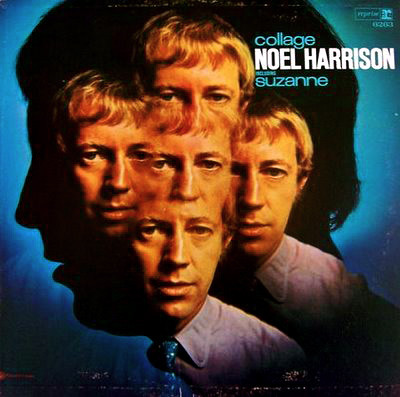
Noel Harrison - "Collage" Vinyl, LP, Album, 1967 (Reprise Records)


Noel Harrison is known for his role in "The Girl From U.N.C.L.E., as well as being the son of Rex.  But he also made a series of albums, and had a huge hit with Michel Legrand's "The Windmills of Your Mind."   And he had been making recordings since the late 1950s.  A recording artist of good taste and his very last album was a recording of Jacques Brel songs - which makes perfect sense with what one thinks of Harrison's music career.  "Collage" is the ultimate 1967 folk/pop album from Harrison.  It's interesting to note that the songwriter/singer was in full bloom at this time, but Harrison is mostly a singer who covered songs.  But his taste was exquisite, and this is one of my favorite albums from that period of time.  Mostly due to his liking, but also he had that British/French attitude towards the craftsmanship of a good song, and '67 produced a lot of great music in that category.   

He covers Dylan's "Just Like A Woman" but also "Suzanne" by Leonard Cohen.  He also had the wisdom to do "Museum" by Donovan, which is a fantastic underappreciated piece of work.   A Bob Lind song (another underrated figure) and a great version of "A Whiter Shade of Pale" by Procol Harum.   And of course, it ends with "Strawberry Fields Forever."   The beauty of the album is how Harrison approaches the material.  It doesn't feel like he's just singing the hits of the day, but for sure he had an individual and real connection to these songs. 

Monday, April 24, 2017

Jack Nitzsche and his Orchestra - "Chopin '66" Vinyl LP (Reprise)


One of my favorite all - time albums.  Jack Nitzsche's arrangements for Chopin.  This on the surface sounds very kitsch, but the fact is this is a very moving album.   The Nitzsche touch is a golden one, and whoever he does arrangments for or production for that matter, is always the right touch.  Here he takes on the great piano music by Chopin and transforms these music pieces into an epic orchestration that is more pop orientated than classical.   

There is no written history of this album being made, so I'm not even sure why it exists.  "The modern sounds" that is stated on the cover, is the full-blown Nitzsche talent in making the perfect orchestration that is neither overblown or downtrodden the original score.   Yet it is very 1966 in that pop mode of perfection that came out of that year. Think of The Beach Boys "Pet Sounds" and perhaps the last puff of the great Spector recordings.   Nitzsche takes Chopin on the route of pop but turns these beautiful melodies into a magnificent soundscape.   I love this album.  


Sunday, February 16, 2014

Bryan Ferry - "Let's Stick Together" CD Album


Bryan Ferry - Let’s Stick Together
CD, Album, U.S.,  1990 (Released 1976)
Reprise Records

A very odd record.  In the same year, at least in the U.K. Bryan Ferry released an EP that was sort of perfection in format and music.  Let’s Stick Together is a full album including that EP, but still, the album feels like a b-side to various singles.   In fact, I believe that most of this material were b-sides.   On this album he does or re-do’s five Roxy Music songs.   All decent covers, but not as good as the Roxy originals.   So one wonders,  perhaps he re-recorded them for financial reasons? 


The one thing that Ferry never fails to do is do a great version of an American Songbook classic.  Here he does “You Go To My Head” which is superb.   The voice, the image, and his stance backs the greatness of this song.  It’s a natural fit.  Also his take on “Let’s Stick Together” works because he has that sheen of the surface and when it is attached to a gritty R&B song, it adds a new dimension to the work.   So yeah, enjoyable package, but what is the thought behind it?