Total Pageviews

Tuesday, July 4, 2017

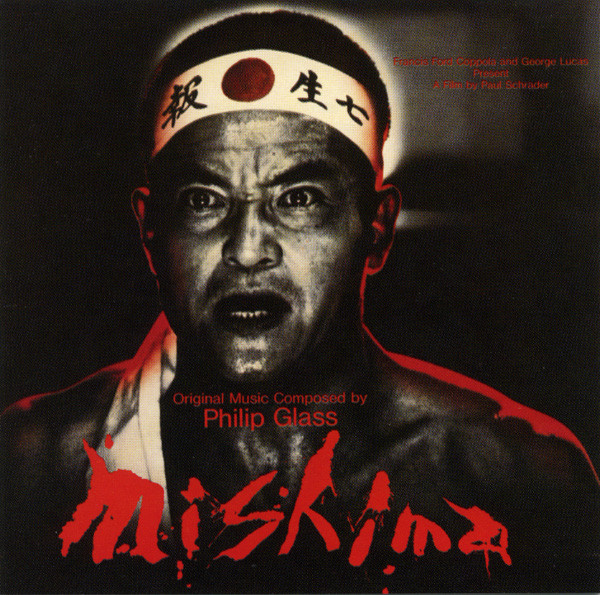
Philip Glass - "Mishima" CD, Album, 1985 (Nonsuch)


Now, this is a very nice cocktail.  The subject matter of Yukio Mishima, filmmaker Paul Schrader, and music by Philip Glass all in one package.  Well, the music is here.  This is one of my favorite soundtrack albums, because it serves the purpose of the narrative and images of the film, and stands on its own as an album.   Also, I have heard the melodies on this album on other works by Glass, so I suspect that this is music that he comes back to time-to-time.  

Consistently beautiful, but the dynamic is a subject that is very Japanese (Eastern) made by an American filmmaker and sounds by an American composer.  They didn't exotic it up.  As someone who writes, "Mishima" the film is one of the great movies of a writer's  life.  Usually, cinema fails in the writer biography due that we get scenes of the author behind the typewriter and sweating and drinking in despair.  Due to restrictions made by Mishima's wife, she didn't allow any mention of his homosexuality, his politics, and his suicide.   Which all Mishima fans know those three subject matters are what makes Yukio Mishima a fascinating figure and artist.   At times, he was a performance artist as well as a prose writer. Mishima did make films, both as a filmmaker and an actor.  He was the king of media when alive.   Schrader did a fantastic thing.  Instead of shooting the author's life, he had to go somewhere he wasn't restricted, and that is his books.  Schrader had the film rights so he could mine the material on Mishima through his writing.  This can be dangerous ground, but Schrader picked and chose the right pieces to tell the Mishima narrative.   

The exquisite music is delicate as well as coming like a powerful wave to the listener.   On one cut it sounds like a surf melody with an electric guitar.   So, there are surprises here and there.  A masterful soundtrack for an excellent film on a remarkable writer. 

John Cage & Lejaren Hiller/Ben Johnson - "HPSCHD" / "String Quartet No. 2" Vinyl, LP, Album, 1969 (Nonesuch)


Of all the compositions of John Cage, this has to be the most intense or insane piece in his catalog of goodies.   Co-made and written with Lejaren Hiller, this is Cage's first adventure in the computer world that existed in 1969.   First of all the title, HPSCHD (1967-1969) is the word harpsichord reduced to the computer's six-word limit at the time.  It consists of 51 electronic sound tapes and seven solo compositions for harpsichord, all played at once.  If you have the means, you can hear the album on the left channel or the right channel, or in this case both.  This is not only the weirdest stereo/hi-fi adventure but one that is a challenging listening experience.  The irony is that the music is written for an old keyboard concept, but done in the most advanced manner in 1969.   What I get here is clearly what sounds like four or five harpsichords with various sheets of electric sounds, that at times sound like a generator or bits and pieces of melody, but very faint.  It's a noisy, full volume lease breaker of a record.  I think with respect to Cage's works, HPSCHD is the most extreme in its attack, noise, concept, and in general, Nonesuch was a brave label of its time.  The total opposite of Cage's famous 4:33.  Silence and noise.   It's 21 minutes of a relentless attack, yet, listening to it the time goes quickly.  I love it. 

Flip to the second side, and we have Ben Johnson's "String Quartet No. 2"(1962) and performed by The Composer's Quartet.  It's a work that reminds me of Schoenberg.  It's a moody work and emotional compared to Cage and Hiller's concept of making music.  It's work that is dissonant in tone, yet the sound is very sculptural to me.  I hear, but I can see it as well. It's interesting to note that Johnson was a friend of Harry Partch, and helped him build his instruments.  And he also studied with Cage as well as Darius Milhaud.  Johnson was (or still is) working on the foundation or perhaps storm, where the contemporary composition and practices took place.  "String Quartet 2" is demanding but pays off well, especially in its ending which is very serene and quiet.  Unlike the other side!

Monday, July 3, 2017

Sex Pistols - "Never Mind The Bollocks Here's The Sex Pistols" Vinyl, LP, Album, Reissue, 2008/1977 (Warner Brothers Records)


My first impression of when I first heard of the Sex Pistols is ho-hum.   At the time I was totally in love with the New York City Punk/No Wave scene.  The British side of the Punk world seemed to be more fashion orientated (which is laughable on my part, because clearly, NYC had that as well) and more bullshit media attention than anything else.   It wasn't till I bought the original single of "Anarchy in the U.K." that I went "oh my god."   For the reasons above I suspected that this song or recording would be so-so.  I didn't expect it to be a sonic masterpiece on a higher level.  Lyrically, theme wise, melody and just the production of this song became a huge wow for me.  Clearly up there with "My Generation,"  "Psychotic Breakdown" and "Talk Talk" of the 1960s.  Yet though the roots of the song were in those recordings, "Anarchy" is very much the sound of that moment or time.  There are a few records for me that yell out a moment and becomes a snapshot of life then.  

It's fun to know the story behind this album, and the relationship between band members and their manager. As well as the entire British music scene of the time - but I will also like to distance this album from that world, and listen to it as music.  Is that possible?  In my opinion, no.  It's very much of a product/artwork from 1977. 

Johnny Rotten's lyrics are like journalism.  He's reporting the world through his eyes, and his work is very unpoetic and straight forward.   In that sense, it is very much part of the social world of Punk, but not only is he making art here, but also reporting it at the same time.   Sex Pistols could have wrapped this album around a British newsprint, which would have made great sense.  It is also a work where you don't need a second album or further thought.  The band did all their work on that one disc, and there is no reason why there should be another album.   Them breaking up makes perfect sense in the Pistols world.  In my opinion Rotten's next adventure, Public Image Ltd. is a much better band (with Wobble and Levene) and vision.   Still, "Never Mind The Bollocks" is a great rock album.  A classic like the first Doors album.  And like that album, it fits perfectly in that year or decade, but the power doesn't last.  The music still sounds good, but it's not an essential sound in my life anymore.  Like a flower that blossoms, we love the instant second that happens.  A lovely memory of that flower, but once gone, it's gone. 

Sunday, July 2, 2017

Lewis Furey - "The Humours of :" CD, Album, Reissue, Japan, 1976/1990 (A&M)


This French Canadian (now living in Paris) is an amazing talent and songwriter.  I had the vinyl back in 1976 but lost it through the ages.  This is his second album and although the material is basically the same, the production by Roy Thomas Baker is huge.  Huge as in over-production, and treating the songs here as Broadway tunes.  The first album by Lewis Furey is quieter, yet theatrical, but in an off-Broadway manner or in a small theater.   

Furey reminds me a bit of John Cale's solo recordings with a mixture of early Lou Reed.  Furey's songs tend to have street life tattooed on his aesthetic, but with a Bertolt Brecht distance and one gets the feeling he's writing a narrative than saying something out of his personal life.  It's interesting that I found the first and second album in Tokyo in the 1990s  At the time it seems that A&M released all their 1970s titles into the CD format for the first time.  It was like going to Tower Records in the 70s.  

I love Furey's music.  Although I do have a problem with the production, it still is a fantastic album.   The way "Cop's Ballet" emerges into   "Rubber Gun Show" is a great opening for an album/CD.  The songs are all catchy, and again, I suspect Furey is writing a musical, although I don't feel there is a running narration, it still feels like a Broadway or big budget show.   CD is very difficult to find, but the vinyl comes up once in every little while.  Get it. 

Pierre Bachelet & Hervé Roy - "Emmanuelle: The Original Sound Track" CD, Album, Reissue, Japan, 1974 (Warner Brothers)


At the age of 62, I'm the ripe customer for Emmanuelle and that whole European soft-porn era of the 1970s.  Even as a teenager I found Emmanuelle sexy.  The combination of exotic locale with a white European woman being surrounded by danger and various men, including an older gentleman - it seemed so perfect to me.  Is it correct to feel this way?  I don't know.  I keep this pretty much in my head and rarely share this information, till now, of course.

Also "Emmanuelle" is the most absurd film track album ever.  It's basically the one theme done in various music styles over and over again.   Come to think of it, "Emmanuelle" the film is just as absurd.  I want to say it's fun, but it brings up too many issues.  Racism, sexism, and probably even more "ism" then that I am aware of.  On the other hand, I love it.  I don't say this with great pride, but with a tad amount of embarrassment. 

Oddly enough I was introduced to the soundtrack by a beautiful blonde girl that I went to Junior High School with.  This was in the early 1970s, and her main music interest was in Donovan (she owned and played the Live Donovan album all the time) and Joni Mitchell's "Blue" album.  She had sophisticated taste, and on top of that, she was a beauty.   She was a strange girl in that she kept her own company pretty much all of the time.  We shared another friend of hers, and that is why we became friends.  Beyond the Joni and Donovan record, she also had the Emmanuelle soundtrack.  She played it for me, and it was at that time, the weirdest album I have ever heard, but beyond that, I was sexually attracted to my blonde friend, and her playing this album for me was almost a sexual act.  We never connected on a physical level, but many years later I found this album in Tokyo, with additional songs.   Like one needs additional songs on this album!  It's the same song over and over again - but of course, different arrangements each time. 

The other great discovery is that there is an English version of the theme song on the CD, and the lyrics were written by Howard / Blaikley, who wrote all the classic Honeycombs album as well as Dave Dee Dozy Beaky Mick & Tich's material.  What a strange discovery that was!

Saturday, July 1, 2017

The Doors - "The Doors" Vinyl, LP, Album, Mono, 1967 (Elektra)


I first saw The Doors at the Whiskey sometime in late 1966.  They opened up for Van Morrison's era Them.  I went there with my dad to see Them because I couldn't get enough of "Gloria," or "Mystic Eyes."  I must have been eleven years old at the time.   The Doors made a huge impression on me, due to the songs, but also the unusual instrumentation of the band.  No bass player!  I found it psychologically disturbing at the time.  Guitar, Electric Organ/Piano, drums, and voice.  Morrison was the voice. A great voice by the way.  What I remember from that set was Morrison wearing the iconic leather pants, but not moving a muscle while singing.  He held the mike close to his mouth and was hypnotizing me and the audience.   I bought their album when it came out, or perhaps my dad did.  I played that album to death and beyond.  I actually loved every Doors albums except "L.A. Woman."  At that point, I got tired of the band, and I felt the band itself was exhausted as well.  

Pretty much throughout my late teens and adulthood, I pretty much ignored listening to The Doors, even on the AM Radio.   I was turned off on the whole "Lizard King" motif, as well as his official poetry, which was not as good as his lyric writing.   I found other bands to feed my urgency for sound and words, for instance, David Bowie, The Kinks, and the whole Punk explosion of the 1970s. 

Recently I found a Mono version of the first Doors album at Mono Records (no pun intended) and bought it.  I was curious what my adult ears will hear compared to my childhood's listening experience.  In ways, the album holds up.  The songs are still terrific and the performances are faultless.  What is missing is the essence of the band, the mystery.  When I first saw them and purchased their albums when they were originally released, it was still a mysterious process.  Once they hit the huge mainstream and became iconic, I feel the mystery was diluted into the pop world and culture.  In no fashion or way can they match up with The Velvet Underground, who to this day captures the essence of poetry/horror/beauty.    They never date, but The Doors do have an expiration date - at least for my ears and sensibility. 

Still, this is a ROCK classic.  A great album.  But it's an album that has no real importance for me anymore.  

Halfnelson (Sparks) - "Halfnelson" Vinyl, LP, Album, 1971 (Bearsville)


The first time I heard Sparks' music was in 1974, and the album "Kimono My House."  It was like someone shot me in the heart, and I survived the bullet wound.  One of the few albums that had such a strong effect/influence over me, that to this day, is hard to shake off.  Once I bought this album, I immediately tracked down the first two Sparks' albums.  Both (all) are excellent.  

"Halfnelson" is Sparks, but before they changed their name due to Albert Grossman's request to do so.   A good record company/manager type of decision.   Halfnelson (Sparks) from the very beginning showed an off-beat vision of pop.  The genius level of Ron Mael's songwriting was apparent from their first album.   "Wonder Girl" "Fletcher Honorama," and others show a sophistication that's a mixture of wit and the perfect melody.  Russell Mael's songs were a total winner as well.   Also when we think of Sparks, we mostly focus on Ron and Russell Mael, but in the early days, before they hit the U.K. (Kimono and afterward) they were a functioning five-man band. One can't ignore the importance of Earl and Jim Mankey, as well as the drummer Harvey Feinstein.  A perfect unit at the time who found the perfect producer Todd Rundgren.  As the producer, he kept the Sparks/Halfnelson eccentricity in place and allowed a sense of exploration within the band's arrangements and sound.  The album to me is very tight as if it was recorded in a room with no windows, and therefore perhaps they were stranded in the studio, with nothing to do, but to make this fantastic album.  

Listening to this album in 1974, (and recorded/released in 1971) it struck me as a work of originality, and it was like getting music from Mars from actual Martians.  I always felt Sparks were outside artists, in the sense that they didn't belong to any scene or music moment.   One can think of them as the Los Angeles band or glam (Kimono), but the truth is they went beyond those categories.  Love the band, is Los Angeles.  The Beach Boys are Los Angeles.  Sparks live in Los Angeles, but the music they made came from another world or culture.  European perhaps?   They could easily be a band from France, Germany or Sweden.  Ziggy Stardust came from Mars, but Sparks/Halfnelson actually do sound they came from another galaxy.  

It is now 2017, and they are still that band from 'somewhere' else and are releasing provocative and excellent music.   

On a side note, I did write a book "Sparks-Tastic" (Rarebird Books) about my experiences of seeing this band play 21 concerts in London, each show devoted to one of their albums.  It was a life-changing experience for me, and, hopefully, my book expressed that sentiment as well as the adventure.