Total Pageviews

Friday, June 16, 2017

Various - Jean-Pierre Melville - "Le Circle Noir" CD, Compilation, 2008 (Universal Music)


As far as I know, this is the only compilation of soundtrack music to Jean-Pierre Melville's cinema.  I can't think of anything more pleasurable than being in a theater in front of a Melville image/narration.    The word "perfection" comes to mind.  Not only for the mind but the physical pleasure of being glued to one's seat and watching the world of French gangsters do what they do best: drink, rob, and existential dialogue.  

"Le Cercle Noir" is a CD that came out in 2008 that pretty much covers all of Melville's film work.  We have the great theme by Jo Boyer doing "Bob Le Flambeur" as well as the haunted score for Le Samouraï."  For a CD, the packaging is great with a wonderful essay both in French and in English.  Not the easiest CD to find, but very much worth the hunt.  I think I got mine in Paris, which is odd because usually, I have a hard time locating French New Wave soundtracks in that city, even though the CD is made in France.  Japan tends to be the capital of French New Wave albums/CDs. 

ist Hide Credits

Bob Le Flambeur (1956)
1Jo BoyerThème De Bob
Composed By, Trumpet – Jo BoyerPerformer – L'Orchestre D'Eddie Barclay*
2:32
Deux Hommes Dans Manhattan (1959)
2Christian ChevallierDeux Hommes Dans Manhattan (Générique)1:51
3Christian ChevallierDéambulation Nocturne2:07
4Christian ChevallierFilature2:00
5Christian ChevallierStreet In Manhattan
Lyrics By – Jo WarfieldVocals – Glenda Leigh
3:52
Léon Morin, Prêtre (1961)
6Martial SolalLéon Morin
Composed By – Martial SolalHarmonica – Albert Raisner
1:54
Le Doulos (1962)
7Paul MisrakiLe Doulos (Générique)3:22
8Paul MisrakiJazz Rapide3:17
9Paul MisrakiFinal2:16
L'Aîné Des Ferchaux (1963)
10Georges DelerueLes Appalaches
Composed By – Georges Delerue
4:36
Le Samouraï (1967)
11François De RoubaixLe Samouraï
Orchestrated By, Directed By – Eric Demarsan
2:03
12François De RoubaixFatalité / La Blessure
Orchestrated By, Directed By – Eric Demarsan
3:09
L'Armée Des Ombres (1969)
13Eric DemarsanThème De Gerbier3:13
14Eric DemarsanLe 20 Octobre 19421:38
15Eric DemarsanMathilde / Les Barraquements3:05
Le Cercle Rouge (1970)
16Eric DemarsanLe Cercle Rouge1:50
17Eric DemarsanQuand Les Hommes Ont Rendez-vous1:08
18Eric DemarsanFinal Inédit4:03
Un Flic (1972)
19Michel ColombierUn Monsieur Distingué3:20
20Michel ColombierUn Casse2:57
21Michel ColombierC'est Ainsi Que Les Choses Arrivent
Lyrics By – Charles AznavourVocals – Isabelle Aubret
3:58
Musique Inédite Pour Le Cercle Rouge (1970)
22Michel LegrandChassés-Croisés2:43
23Michel LegrandVisions2:49
24Michel LegrandEngrenages (Final)2:21


Thursday, June 15, 2017

Various - Jean-Luc Godard "Histoire(s) de Musique" CD, Compilation, 2007 (Universal Music)


I have a habit of picking up any collection of music that was used in Jean-Luc Godard's films.  There are lots of collections or compilations out there and it's impossible for me to choose the best one.  All are great!   So, reader, you have to take that in, that I'm just a super-fan with no critical judgment whatsoever on the subject matter of Godard's various soundtracks.  There is a Japanese CD compilation that is excellent and I wrote about it here:  http://toshberman.blogspot.com/2017/04/va-bandes-originales-des-films-de-jean.html

I bought "Histoire(s) de Musique" in Tokyo about ten years ago.  For some odd reason, it's not difficult to find French New Wave soundtracks on CD in Japan.  This collection put together by Universal Music is excellent.  The one unique cut that the other's don't have is the song "Mao Mao" sung by Claude Channes and from the film "La Chinoise."   This album covers all the Godard films from À bout de souffle ("Breathless") to Sauve Qui Peut (La Vie).  So the time frame is from 1959 to 1980.  The classic Godard years and the music are excellent.  Martial Solal, Michel Legrand, the great Georges Delerue score for "Contempt" as well as Paul Misraki, Antoine Duhamel and Gabriel Yared. All wonderful soundtrack composers doing their best iconic work. 

Also the CD has great text with nice photographs.  Do get it!


The Ventures - "Golden Pops" / "Pops in Japan" CD, Compilation, 1999 (See for Miles Records)


Not an easy CD to find, or the two original albums "Golden Pops" (1970) and "Pops in Japan" (1971). These two oddities or albums was a fascinating find for me when I lived in Japan, and I think I originally rent the original albums to listen to them around 1989.  Nevertheless, The Ventures were (and still are) an important band in Japan.  One of the first, if not THE first, bands to tour Japan with electric guitars.  Once can't undermine the importance of The Ventures for Japanese pop culture.  Due to the commercial marketplace or just something that they wanted to do, The Ventures made two albums focusing on Japanese Enka music.   Enka is an entirely unique pop music that is a big part of the Showa era in Japan.  Theme wise not that far from weepy country and western, but also is a version of the Japanese blues.  The ultimate bar music of loss, regret, and sadness. 

Weirdly enough, this is the only Ventures collection I have. I was never a fan of their music because it seemed water-down compared to the other great surf/instrumental bands of the early 1960s.  But "Golden Pops" and "Pops in Japan" are really unique albums, with some fantastic music within the disc.  I recommend this CD package for those who have a yen for Japanese pop culture or have an interest in the Showa era.  On one level it's totally marketing for The Ventures in a country that still brings them currency, due to their yearly tours of that country, but also eccentric listening experience as well.  American musicians interpreting Japanese pop music.  The hybrid is fantastic. 


Wednesday, June 14, 2017

Thunderclap Newman - "Hollywood Dream" Vinyl, LP, Album, 1970 (Track Records)


Thunderclap Newman is a band put together by Pete Townshend and his manager Kit Lambert.   The band was a trio consisting of Pete's driver Speedy Keen, who I gather is the normal guy in the group, Andy Newman, who is the eccentric and maybe slightly older piano/sax player, and their teenage wonder guitar player Jimmy McCulloch, who ended up in Paul McCartney's Wings, when they were huge.  Why Townshend felt a need to put this band together, I think was to give Keen some attention as a songwriter.   Townshend produced and played bass on this album "Hollywood Dream." 

First of all, it's a brilliant record that probably wasn't meant to become a classic.  The scope of Keen's songs go from Hollywood myth town to getting your head together and make this album via Traffic's aesthetic of going to the country.  Thunderclap Newman didn't go to the country but instead went to Townshend's home studio in London which I suspect was a tiny hole-in-the-wall.  Each member has a distinctive sound and role in the band.  Speedy sings lead and drums, and Andy Newman and Jimmy to me are the stars of the group.  Jimmy because he was 15 or so, doing amazing guitar work, but Andy like the other Andy in the future Roxy Music, adds textures and layers of ambient sax sounds which are essential to the Thunderclap sound - and of course is amazing piano playing which sometimes reminds me of Monk meeting some turn-of-the-century whore house pianist.  It's an amazing group of sounds that fits into Keen's songwriting vision.  "Something in the Air" is the great classic hit off this album, and pretty much shows why they are great, but "Accidents" is the track that goes beyond that even by its length of nine minutes as well as an off-color joke that goes well with its length as well as it's great music.  Especially the Andy Newman freak-out sequence in the middle of the piece.  A classic. 


Frank Sinatra - "September of my Years" Vinyl, LP, Album, 1965 (Reprise)


No way in heaven or hell would I have purchased this album in 1965, at the age of 11 or so.  In fact, this album didn't make sense to me till I was in my mid-40s.  I slowly started to buy Sinatra albums when I was in my 30s, which was in the 80s.  I totally ignore Sinatra as an artist in my youth.  The fact that this album came out during the 'youth' explosion of the pop rock world is funny enough.  An album about aging in the era of youth! 

The truth is, this is a major album by a middle-aged singer.   Sinatra grasps the issues of being a Romeo at a later age, and also the ability to look back and reflect on one's life.  That is a hard thing to do for someone who's a teenager or a young adult. On the other hand, one would think this album had a huge impact on Sinatra's generation at this specific 60's era.   Life is often a blur or a Futurist painting, so a work of art that reflects on the passing of time is a profound medium, whatever it's in the literature (Marcel Proust comes to mind) or on the vinyl, this album for instance. 

The visual image of I have of this album, and all Sinatra 1950s to 1960s recordings come with a mental picture of some sort, is of one listening to "September of My Years" around 11:15 in the evening and with one's choice of alcohol.  The orchestration by the great Gordon Jenkins is Wagner like in the textures of the feelings in these set of songs.  All, very much looking back as an older person and commenting on life then and of course, what happened to that life now.   This album is like a book.  Not a beginning, middle, and end type of narrative, but nevertheless it does tell a story of emotions spent and the after-effects of one's attention at the time.  It's a very moving piece of work. My favorite cuts are "It Was a Very Good Year," "The Man in the Looking Glass," and the fave of all faves is "September Song."  In fact, I think this is the best recording or version of this song.  Sinatra as a singer was at the peak of his talent.  I think some of his recordings of the 1960s are very so-so, but this album reads to me like a very personal statement from Sinatra. 


Erik Satie/Michel Legrand - "Piano Works" CD, Album, 1997 (Erato)


Some years ago I found this collection of music by Erik Satie in the budget bin at Tower Records. What surprised me when I found it, was that Michel Legrand is the pianist.  Why this surprised me is a foolish response on my behalf.  For one, most pianists who do Satie's piano music are usually from the classical world.  Legrand is well-known for his compositions in the soundtrack and pop world.  And is a noted jazz player, who made recordings with Miles Davis and others in the 1950s.  Still, it makes perfect sense that Legrand would do an album of Satie's piano music.  They do share a common ground besides that they are both French of course.  What the bridge is between the two composers is a love of melody that is full of air and a certain amount of lightness.  I also suspect that they share a sense of humor as well.

And even beyond that, both Satie and Legrand have collaborated with other artists.  Legrand with his soundtrack work, specifically with Jacques Demy, and Satie's work with Picasso, Rene Clair, and Picabia.  Legrand's playing of Satie's music is actually a perfect fit.  For those who don't know Satie's work, this album in a pretty good introduction.  Although through my past, it's the Aldo Ciccolini recordings for Angel Records that I think are the essential recordings. 

Tracklist 

1Gymnopédies - 1. Lent Et Douloureux
Sonatine Bureaucratique
21. Allegro
32. Andante
43. Vivace
-
5Gymnopédies - 2. Lent Et Triste
Sports Et Divertissements
6Choral Inappétissant
7La Balancoire
8La Chasse
9La Comedie Italienne
10Le Reveil De La Mariée
11Colin-Maillard
12La Peche
13Le Yachting
14Le Bain De Mer
15Le Carnaval
16Le Golf
17La Pieuvre
18Les Courses
19Les Quatre-Coins
20Le Pique-Nique
21Le Water-Chute
22Le Tango
23Le Traineau
24Le Flirt
25Le Feu D'Artifice
26Le Tennis
-
27Gymnopédies - 3. Lent Et Grave
4 Préludes Flasques (Pour Un Chien)
281. Voix D'Interieur
292. Idylle Cynique
303. Chanson Canine
314. Avec Camaraderie
6 Pièces De La Période 1906-1913
321. Désespoir Agréable
332. Effronterie
343. Poésie
354. Prélude Canin
365. Profondeur
376. Songe Creux
2 Rêveries Nocturnes
381. Pas Vite
392. Très Modérément
Chapitres Tournés En Tous Sens
401. Celle Qui Parle Trop
412. Le Porteur De Grosses Pierres
423. Regrets Des Enfermes
-
43Caresse
Avant-Dernières Pensées
441. Idylle: Modere, Je Vous Prie, à Debussy
452. Aubade, à Paul Dukas
463. Meditation, à Albert Roussel
Jack In The Box, Pantomime For Piano
471. Prélude
482. Entr'Acte
493. Finale

Tuesday, June 13, 2017

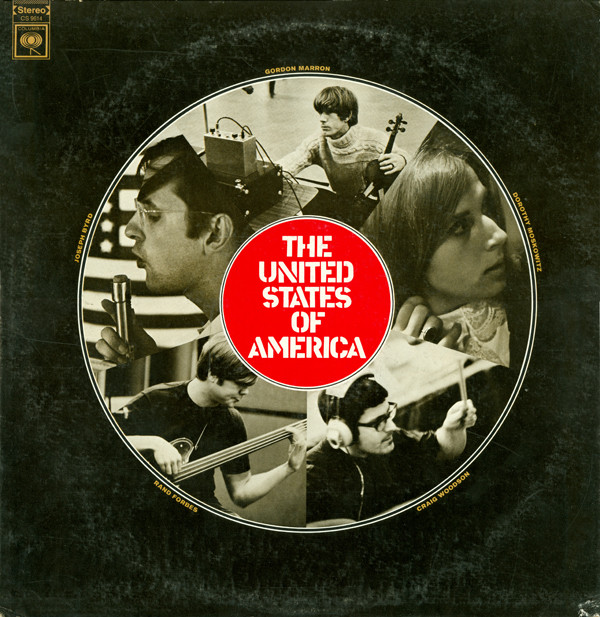
The United States of America - "The United States of America" Vinyl, LP, Album, 1968 (Columbia_


It took me 49 years to really appreciate the album "United States of America" by the same name as this L.P.  There are certain artists that take years for me to feel comfortable with.  The other artist is Van Dyke Parks.  Both Parks and the United States of America gave me nothing but confusion.  The thing about this band is that they were one of the first electronic bands.  Not in the sense of Kraftwerk electronics, but their acoustic instruments being filtered through electronics or stuff like an electric violin, electric drums (whatever that means in 1968) and so forth.   I was a young teenager when I first heard this album, and it's clearly not meant for the teenies.  This is adult pop, but one with an edge. 

Joseph Byrd and band brings a cynical and bad mood that yells out New York City of that era.   I'm not sure if the band was from that part of the world or the West Coast, but for me, at least on vinyl, I hear NYC.  The music is sophisticated with a capital "S."   Dixie land meets small town brass meets something in a very dark part of the mind.  I suspect the entire band is college educated professionals or drop-outs.  Nevertheless, a smart bunch.  

Dorothy Moskowitz is the man singer and kind of have that 1960's folk-era voice but clearly trained.  There is something very academic in their approach to their music.  Not in a stuffy with jacket leather patch elbow type of music, but smart.   On the other hand, there is something disturbing about their overall aesthetic.  I can't really place my finger on it. Which explains why I keep coming back to this album for four decades.  The United States of America can remind one of Parks or the more experimental aspect of The Beach Boys or The Beatles - but the truth is, they're original.