One of my favorite figures from the French cinema world, who also happens to be a great singer. To make a comparison, he reminds me of Bryan Ferry. Not his identity or characteristics, but his voice. Ferry singing other people songs naturally make it is own, due to the limitations and tone of his voice. Serge Reggiani is exactly the same. Reggiani doesn't do the American songbook but instead tackles the poetry of Jacques Prévert, Victor Hugo, Charles Baudelaire, and Louis Bessières. On "Poètes 1" it's bare music with a focus on the words. My inability to understand French may limit me the enjoyment of this album, but that's not fully the case here. Reggiani brings a sense of cool, but passion at the same time. There is a long tradition of making songs out of poetry in France, and Reggiani is one of the greats to take on this medium. There is "Chanson De Maglia" with music by Serge Gainsbourg. How great is it to hear music with credit: written by Victor Hugo and Serge Gainsbourg. I have three other albums by Serge Reggiani that features more Gainsbourg, but also Boris Vian material. Reggiani is one of my favorite vocalists. And not a bad actor!
Total Pageviews
Showing posts with label French Poetry. Show all posts
Monday, April 17, 2017
Tuesday, November 22, 2016
Gil J Wolman - "Wolman et son double" Vinyl LP, (Alga Marghen)
![]() |
| "Wolman et son double" |
Gil J Wolman is one of those figures that is almost ghost-like in the 20th century avant-garde. Painter, poet, fllm-maker, and member of both The Letterist movement as well as Letterist International, which eventually turned into the Situationist International. Works by him are sparse in the States, but one that is here for sure is his album “Wolman et son Double.” Influenced by Anton Artaud’s lecture/performance in Paris in 1947, Wolman takes the sound poetics of Artuad and is applied to his own sensibility, which serves him of course, but clearly a tribute to Artaud as well.
![]() |
| Gil J Wolman |
Letterism came from the post-war years of World War II, mostly organized by poet/filmmaker Isidore Isou. The principal mediums for this group are poetry, film, painting and political theory. Sort of a little brother to DADA and Surrealism, but Isou and company looked up to DADA poet Tristan Tzara, but not much of the other artists in those two movements. The other medium they had an interest in is performances and recodings using the voice as an instrument, but not necessary with the actual words, but sounds. Like his fellow Letterist and “vocalist” Maurice Lemaître, Wolman made sound art, and did a recording sometime in the 1970s of his performance work. “Wolman et son Double” is that work.
![]() |
| The Letterist International |
Multi-tracked, and often very intense, there is a heaviness compared to Lemaître’s work, which is quite funny and very sexual. Wolman clearly takes his influence of Artaud, but to another level. The album is very much a musique concrete recording, but all from his vocal abilities. Screams, hiccups, coughing, breathing, yelping -all adds a sense of tension. It’s a brilliant piece of work (the recording) and the ideal state of hearing it is in a room, playing this album very loud, and in total darkness. A limited edition of 350 copies.
![]() |
| Gil J Wolman |
Friday, November 18, 2016
Maurice Lemaitre -Poémes et Musiques Lettristes et Hyperphonie"
This album is a limited edition release, and therefore an important purchase for one who wanders into the world of European Avant-Garde and dwell into it's charm and seduction. Maurice Lemaitre is by all means, a Letterist. Letterism was a movement that started in Paris in 1946 that co-piloted by the great Isidore Isou. Also involved was Gabriel Pomerand, Gil J Wolman, and, of course our artist here, Maurice Lemaitre. With a theory of 'Kladology, ' which is a branch of knowledge that is somewhere between the figurative and the abstract. Letterism is the little brother to DADA. It eventually rolled into the realm of The Situationists, but that's another narrative.
"Poémes et Musiques Lettristes et Hyperhphonie" is a compilation of recordings made by Lemaitre from the 1950s to 1968. Every track is vocal orientated. Yet there are mixtures of sounds. For instance, Lemaitre uses French rock n' roll instrumentals as a background to his vocal gymnastics - and without a doubt, Lemaitre can project his voice across the room. When you look at the Discogs site for this album, it mentions the genre is "Non-Music." I do not share that insight, because these recordings are very musical, but maybe not in the way that one has experienced music.
Most if not all of the pieces here are in French, but some are clearly just sound works. I may be missing out some important aspect of the work not knowing Frnech, but on the other hand, the performances take the listener to a new landscape, and I like the new territory! This is a superb album on so many levels. As a document of Avant-Garde Paris in its early days of post-war, as well as a dynamic listening experience. It's all exceptional. For those who want to focus on the roots of The Situationists (Guy Debord world) and those who want jump into the eros/politics/drunkness of that period in the St Germain des Prés world - this is simply a must to have.
Sunday, January 19, 2014
Antonin Artaud - Pour en finir avec le Judgement du dieu" Internet recording
Antonin Artaud - Pour en finir avec le Judgement du dieu
Download
I have this incredible joy of listening to Poets reading their works in their native language, and the fact that I don’t understand that language is an additional plus for me. But I think people in my category would have no trouble listening to and enjoying the voice of Antonin Artaud reading his works. This piece was recorded for a radio broadcast, but was banned before it even got on the air. There are very few recordings of Artaud, so each one has to be treasured in the sense it is a voice lost with the noise out there. Nevertheless there have been numerous recordings of this piece floating on Earth as well as on the Internet.
This work is very musical, and keeps one on their toes, because you don’t know what is going to happen. There are percussion affects as well as ambient noise affects through out the work. Even though I don’t know the language it is pretty intense stuff.
Thursday, December 26, 2013
André Almuro - "Poésie de Cruauté"
André Almuro - Artaud, Genet, Lorca, Cocteau, Larronde, Almuro - Poésie de Cruauté
Vinyl LP (Download), 1962
Disques Mouloudji
A mysterious album that I downloaded from god knows where, but what a cool piece of vinyl. I’m on the hunt for it. The little I know is that André Almuro worked in radio, and was or is (he’s still alive at 82) a figure in the French Music Conncréte world. He met a 15 year old Pierre Clémenti and worked together making films, and recording Clémenti’s poetry. Eventually in the 40’s he hooked up with the legendary Pierre Schaeffer and joined his Radio Télévision Française.
Poésie de Cruauté is a fascinating piece of work. Here Almuro makes music behind the narration of various poems by Artaud, Lorca, Genet, Cocteau and Olivier Larronde, who I don’t know at all. The poems are read by Jean Bollery and Pierre Frilay, with a certain amount of vocal effects for their voices. A great album, and without a doubt I am going to look for Almuro’s films. Fascinating.
Also of great interest is that this album was released on the great Left-Bank (Vian pal) Mouloudji’s record label.
Tuesday, December 17, 2013
Brigitte Fontaine - "13 Chansons Décadentes et Fantasmagoriques" CD Album
Brigitte Fontaine - 13 Chansons Décadentes et Fantasmagoriques
CD, Album, France, 2002 (originally recorded 1966)
Disques Jacques Canetti
What planet is this woman from, and why am I not born on this same planet? Brigitte Fontaine, is a force that goes forward and rarely looks back. But for me who just discovered her maybe five years ago, I have a lot to catch up on. So I believe this may be her first album. Chansons Décadentes et Fantasmagoriques. Fontaine, who I know very little of, with respect to her background, but I have a strong suspicion that she is the bohemian’s bo-ho. A chanson singer by trade, but one who took that form into another world. Her singing style is very theatrical with a tinge of contemporary feeling or soul. What is interesting to me (among a lot of stuff regarding her) is that Jimmy Walter arranged this album, and also worked with Boris Vian. And she also did an album of recordings of Vian’s music as well. So that thread between Saint Germain des Prés culture is very much part of Fontaine’s world, yet different because it is being made for the May ’68 generation. This is an artist who didn’t stand still. I want to belong to her cult.
Sunday, November 10, 2013
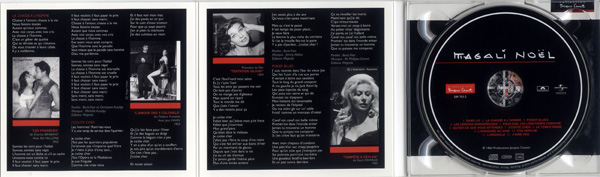
Magali Noel - "Magali Noel chante Boris Vian" CD Album Reissue
Magali Noel - Magali Noel Chante Boris Vian
CD, Album, Reissue, 2002 (originally recorded 1964), France
Jacques Canetti
Both films “La Dolce Vita” and “Rififi” benefited from the presence of Magall Noel, and like a shadow following another presence, Boris Vian had a wonderful singer to represent the pop side of his music. Jazz like, but more of a pop leaning, Noel tears into the Vian songbook for the second time. Her first album was “Rock n’ Roll” which was supervised by Vian as well as being all songs co-written by the master. This album was recorded in 1964, five years after Vian’s death. It is both a tribute to the man, but also the distance of years between his passing and the recording allows Noel to convey a fresh light to the magnificent Vian wit.
Finger-snapping rhythm, most of these songs are up-tempo and it does have a sense of energy due to Noel’s voice and presence in these recordings.
Saturday, November 9, 2013
Boris Vian by Claude Vence - "Je Voudrais pas crever"
Boris Vian by Claude Vence - Je Voudrais pas crever
CD Album, France, 2005
EPM Musique
In my typical fashion I am attracted to an album of Boris Vian’s poetry, in French, a language I don’t speak or understand but put to music by Claude Vence. It seems it is a class French move to add music to poetry. it is not uncommon to run upon music with Rimbaud, Baudelaire and of course Jacques Prevert - so why not Vian?
I found this CD at a bookshop in Saint-Germain-des-Prés, and I bought it without knowing what it was, except it had the words “Boris Vian” and that was reason enough to exchange some euros for this product. Nevertheless an enjoyable listen, and all the words are from Vian’s classic book of poetry Je Voudrais Pas Crever. I know nothing of Claude Vence, but his music is lively, tuneful and the arrangements are tasteful and very textured, which I imagine would mix well with Vian’s words.
Subscribe to:
Posts (Atom)