Total Pageviews

Friday, January 19, 2018

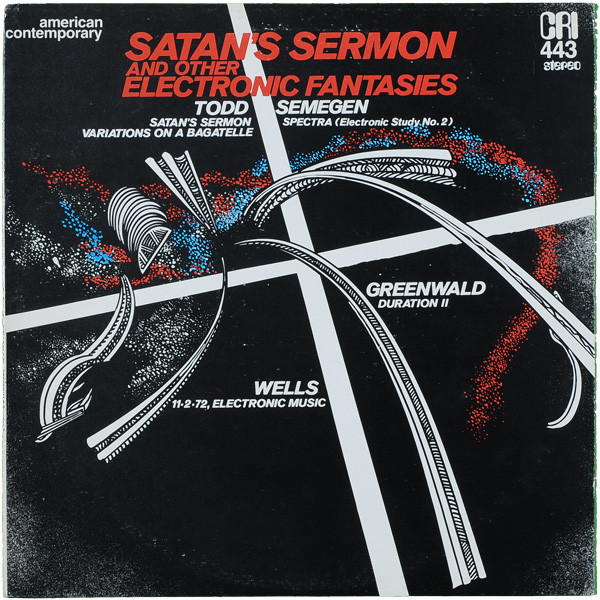
Various - "Satan's Sermon and Other Electronic Fantasies" Vinyl, LP, Album, 1980 (Composers Recording Inc)


I just did a Tosh Talks episode with my friend and translator Paul Knobloch, and he brought this album over to the house as a gift.  He knows that I'm crazy about electronic music from the 1950s to 1970s.    This is an album with music by four composers, who to this day, are unknown to me.  George Todd, Saria Semegen, Thomas Wells, and Jan Greenwald.  Looking up their names on Discogs website I don't find that many other recordings by these composers, which is a shame because the album is a delight. 

"Satan's Sermon" is a work by Todd that is mostly done on a synclavier, invented in 1977-1978.  A lot of bands in the 80s used the synclavier, especially in the recordings produced by Trevor Horn.  Here, its use is totally expansive and driven by an Able 40 computer.  It's digital meets analog.  The music is dark since it is called "Satan's Sermon."  

My favorite work on this compilation is Greenwald's "Duration 2" which was composed on the Nova 1200 Data General computer attached to Buchia 500 digital-to-analog synthesizer.  It's a very slow piece that's meditative but has textures that reflect sinister or even cinematic touches of an Alfred Hitchcock piece of work.  

Wednesday, January 17, 2018

Les Rita Mitsouko - "Variéty" Vinyl, LP, Album, 2016 (Because Music)


Les Rita Mitsouko is Catherine Ringer and the late (and great) Fred Chichin.  A remarkable French band from the 1980s to the 21st century.   "Variéty" their last album, due to Chichin's death, is an album of many pleasures.  Ringer is one of the great figures in rock/pop music period.   Her expressive attitude and voice and sense of wonder are way beyond other singers of her generation.  Why she is not an icon here in the United States or in the U.K. can only be that most of the songs are in French.   It is the English speaking world's loss if one cannot dwell on Ringer's (and Chichin's) world. 

"Variéty" after repeated listenings is a treasure to behold.  Joyful, witty, strong melodic moments, and superb performances.  Mark Plati is the (not so) secret presence on the album.   He worked with David Bowie for numerous years, and he brings a Bowie touch to the project that reminds me a bit of that singer's "Hours" album.  Very straightforward approach to the song, but hidden textures that unfold on repeated hearings.   In a healthy world, these songs would be played on the radio on a consistent basis.  Alas, that's not the world that we live in.  

Sunday, January 14, 2018

Egisto Macchi - "E.S.P. Vinyl, LP, Album, OST, Limited Edition, 1973/2016 (Cometa Edizioni Musicali)


For those who have read my previous posts as well as my talk on Egisto Macchi https://youtu.be/rqCI97HMQxY know that I'm a huge fan of his work. I'm very passionate about Macchi's music at the moment because it's a new discovery or a new love.  Macchi is known for the music he composed for library music companies.   He was very much a close associate of Ennio Morricone, and like that great composer, they do share a sense of aural adventure.  Morricone did a lot of big budget films, and Macchi did mostly work for grade-z film productions.  Nevertheless, he was a brilliant composer.  E.S.P. is a work of stunning beauty.  

E.S.P. was an Italian TV series, and the music on this album basically plays the one theme but in different arrangements.  When I first heard E.S.P., it reminded me of the soundtrack "Twin Peaks, " in that both pieces capture a wishfulness but a sense of sinister underpinning around the corner.  The main instrument on E.S.P. is the Theremin.  Played not like a science fiction soundtrack, but more of a melodic instrument that fits in the orchestration perfectly.  The score is haunting and it's the perfect late night sound to reflect on one's life.  A superb album. 


Monday, January 8, 2018

The Velvet Underground - "1969" 2 x Vinyl, LP, U.S., 2017 (Republic Records)


In the glory days of the music world, there would be releases from record companies that have nothing to do with time or space.  Just product.  I by chance found this album "1969" by The Velvet Underground, and I have to imagine that it's a combination of the 1980's release of "VU" and "Another View" which is basically putting everything out under the Velvet's recorded catalog of the time.   Now, Universal music has put together these two albums as a double-album set on vinyl.   Three-sides are the Velvets with Doug Yule in the line-up, and side four is when John Cale was in the band.  Probably somewhere between White Light/White Heat and the Third album.  There are no liner notes explaining the reason for this album, so it's very much of a rush-released piece of product. "1969" is also a great compilation of Velvet Underground tracks that never made it to the final works (albums).  

The truth is The Velvet Underground couldn't do anything wrong from the years 1966 to 1970.  Lou Reed was on the top of his songwriting powers, and even throwaway songs like "Foggy Notion" are magnificent.    When I listen to these set of songs decades later, it strikes me how original his approach to pop/rock songwriting was at the time of these recordings.  For one, (both line-ups) the band was fantastic, with Moe Tucker's dynamic primitive drumming, with the combination of Lou and Sterling Morrison's guitars going in and out of their arrangements.  Then you have someone like Yule with his backup vocals, or Cale's viola riding on the rhythm, and you have this tremendous noise that's The Velvet Underground. 

There are no weak cuts on this four-sided package. All of it is essential if you are a Lou or Velvets fan.   The cover/packaging is boring but the sounds inside the package are going to take one to other worlds. 

Thursday, January 4, 2018

Egisto Macchi - "ll Deserto" 2 x Vinyl, Album, LP, Limited Edition, Reissue 1974/2016 (Cinedelic Records)


Egisto Macchi's "ll Deserto" is a masterpiece.  The orchestration of all four sides is one of quiet, but mixed in with real instruments such as 'maybe' a french horn, oboe, various orchestrational string instruments as well as percussion over an electronic hum that comes in and out of the mix.  "ll Deserto" is very much a sonic portrait of a North African desert, or at the very least a desert in one's imagination.  One wonders if Brian Eno heard this album before he made his ambient classic "Discreet Music," because in parts the music is very similar, if not in style, in the mood that carries the landscape.  

The white album cover is so minimal that it makes The Beatles White Album a complex design.  Yet the cover conveys the vastness of Macchi's music within its vinyl grooves.  Nine pieces are on this double album, and each one flows into the other as natural as the wind blowing across the white sands of a desert.  The rhythm conveys an African feeling and clearly not a Southwestern Desert in the United States.    The original edition of the album came out in 1974 on a small record label based in Florance Italy called AYNA.   Macchi did a lot of music for Music Libraries, which means it is used by a film producer to pick and choose their music if they need something cheaply or quickly for a scene in their film.   Macchi is very much a soundtrack composer, but in Library Music one can make their own soundtracks to fit their own mood.  In other words, the compositions can be experimental or groovy dance tune - nevertheless, it's an area of great experimentation.   

As mentioned, "ll Deserto" can easily fit into the ambient music world, but again, one marvel at the real instrumentation of actual instruments that is a great deal of the final sound.   The music is relaxing, but it has its quiet sinister qualities as well.  A beautiful album to reflect on one's daydreams. 

Tuesday, January 2, 2018

Magazine "Secondhand Daylight" LP, Album, Vinyl, 1979 (Virgin)


Out of the furnace that's punk came Magazine.  More Roxy Music than Sex Pistols, but in truth, Magazine lives within its own world.  Howard Devoto is the foundation where the music serves his lyrical and vocal talent.  Not a classical singer in the Bowie mode, but more of the street urchin who's deformed and not quite ugly, but beautiful.  "Secondhand Daylight" is the second album by Magazine.  It's different from the first in that the sound or songs are most majestic and cinematic in its scope.  It has been said that the band wanted John Barry, the film composer, to produce this album.  That would have been a natural relationship between the icy professionalism and amoral aspect of Barry's work against the Magazine aesthetic of emotional loss and slightly unbalanced in a world of harsh realities.  

Magazine made great albums, but "Secondhand Daylight" has always been a favorite of mine, and I notice hardcore Devoto fans prefer this album the most, compared to the others.  The scope is larger and the talents of the band are pretty magnificent.  John McGeoch is an underrated guitarist with plenty of elegance and orchestrational sense in playing within the band's grooves.  Dave Formula is the keyboardist with the closest abilities to 'think'  soundtrack music in the Magazine texture, and drummer John Doyle and bassist Barry Adamson are dream players, within the context that's Magazine.   Elegance comes to mind when listening to this album.   Not by wealth, but education. This is smart music made by aware musicians.  "Permafrost" is perhaps the perfect Magazine/Devoto song. It builds and builds and the language was shocking when I first heard the song in 1979. I remember it being direct and to the point, and when I hear it now, it's like honesty being played out in a world of ill illusion. 

Devoto has the Dylan bite but I prefer his poetry to the American master songwriter.   He has Johnny Rotten's snare, but there's a great deal of tenderness in his anger.   The jazzy overtures that show up here and there is close to Bowie/Mike Garson's approach to throwing that additional texture into the mix.  I'm also haunted by the beautiful opening of side two's "The Thin Air" which may be McGeoch's greatest moment on vinyl/tape.  

The Beatles "Revolver" Vinyl, LP, Album, The Beatles in Mono Series, Reissue, Remastered (Parlophone)


I already have the original American Mono edition of this album, which has fewer songs than the British version.  I bought the new remastered / reissue mono "Revolver" mostly out of boredom while waiting for a bus in Pasadena, and I was nearby the great Canterbury Records store on Colorado Boulevard.   For new year's day, and in a quiet series of moments during the early evening, i put this album on the turntable with my headphones on my ears.  It wasn't like visiting an old friend, in fact, I haven't listened to this album for some years. More of a meditation on what seems so perfect, and marveling what must have been so new in 1966.

"Revolver" always struck me as a violent title for an album.  Especially considering how John Lennon died years later, yet for some reason, I now see the title in a new light or awareness.   I think of it more as "revolve" as in moving in a circle on a central axis.   As one grows older they change, in other words, they revolve as in a verb.  Yet, it's a clever title, because most of us will think of the title as a revolver gun.  I have to imagine it was John Lennon who thought up of the title as a pun of sorts. Then again it could have been Ringo!  Nevertheless, this is an album in motion.  Their next album "Sgt. Peppe"r strikes me as a beginning, middle, and end.  Revolver just keeps turning round and round, with no start or no stop.  

"Revolver" may be the first proper 'modern'  power-pop format album. The guitars, the aggressive but melodic bass playing (by Paul) is upfront and always driving the song.  Also, incredible piano playing throughout the entire album as well.  Not sure if it's Paul or George Martin handling the keyboards, but it's an essential part of the overall sound, and especially when you included Indian instrumentation here and there.  Their previous album "Rubber Soul" is the first Beatle album to sound grown-up, and "Revolver" is made by wise men who tasted life in their own time-frame.  It exposes the inner world of 1966 than say the news of the day or time.  "Taxman" by Harrison is a bitter song about of course, the rich man's number one hatred 'paying taxes.'   Harrison's songs are always odd because at one point it can deal with spirituality and then make a sharp turn about the bitterness of romance or being pissed off about taxes.  I suspect the average Beatle fan in 1966 could care less about the tax issues among the wealthy.  Still, Harrison was an amazing songwriter when he was good.  "Taxman" is a funk machine of sorts that is mechanical in format, but driven by it's seductive (not necessarily sexual) rhythm.  

The only song that makes me frown is "Yellow Submarine" not due that it's a bad song, because it's not horrible, but just tattoed on my brain from so many years ago.  I never need to hear that song again.  On the other hand "Here, There, and Everywhere" is like butter melting on a hot biscuit, it's a perfect melody word combination that is classic Lennon/McCartney.   "Tomorrow Never Knows" is the perfect ending or beginning of "Revolver."  As mentioned, the circle is completed but I feel it can go on until one has enough of the album.   I reviewed the American edition, writing that it's an old friend that one doesn't need to really revisit anymore.  Hearing the full British version (and in mono) the album is not new, but I realize the delights that come up on "Revolver" is consistently fresh (except for "Yellow Submarine") and one just marvels at the tightness of the playing and the brilliance of George Martin's production.