Total Pageviews

Tuesday, January 30, 2018

Walter Marchetti - "La Caccia (Da Aprocrate Seduto Sui Loto) LP, Vinyl, Album, 1974 (Cramps Records)


The late (he passed away in 2015) Walter Marchetti was a composer who wrote and played in the collective ZAJ, a Fluxus minded group of sound artists from the year 1964 until they officially disbanded in the 1990s.  I went to Rockaway to check out the Ronald Kane collection of LPs he sold to the record store before his untimely death.  This one stood out to me due to the cover as well as being on the label Cramps records - not to be confused with the great band called The Cramps.  Then again, there is no such thing as coincidence. 

"La Caccia" (the Hunt) is a landscape record.   Two sides of what sounds like being in nature and listening to either birds or instruments that sound like creatures in the wilderness.  Duck calls, and other devices to attract the attention to these creatures of nature are used, and on one level this is very much an environmental soundtrack album. For me, it has the touch of disgust, due that I hate the idea of one going hunting and killing an animal.   Still, since the liner notes are all in Italian (a language I don't understand) these are the tools of perhaps a hunter but used for aesthetic purposes.  This is very much a music score being played out, and although it is placed (in the aural sense) in the middle of a hunt, and more likely in a godlike freezing condition, it's a funny work of art.  Using something that is sound related for the sake of luring birds to be shot, or other animals, is instead used in a music composition.  There is something very Goon (Spike Milligan/Peter Sellers) like that crosses my mind as I listen to this album.   I now have the urge to collect all recordings from the Italian label Cramps Records.  

Sunday, January 28, 2018

Jun Togawa (戸川純) - 極東慰安唱歌 Vinyl, LP, Album, 45 rpm, Japan, 1985 (Yen Records)


I first discovered Jun Togawa in the small town of Moji-Ku on the big island of Kyushu in Japan.  I was living there for the entire four-seasons, and I came across her albums with the help of my wife Lun*na Menoh.   With a great deal of cultural guilt, I never took on the Japanese pop music scene in Japan in a big way.  I greatly admired Hosono Harumi and other members of YMO (Yellow Magic Orchestra) but a lot of it sounded flat to me due to the production standards of record production of the 1980s. Very digital, and it struck me that Japanese pop music was very much like Kabuki theater where everything is laid out on the stage in an equal manner.   My eyes didn't focus on one character or actor, but I look at the stage as if it was a giant poster.  My eyes kept moving around, and I feel the same with Japanese pop music of the 1980s.   Jun Togawa was different from the rest of the Showa era entertainers or artists.  Listening to her work I got a huge painting, but I can focus on parts of that aural painting due to its clarity and at the same time, it's eccentricity. 

 極東慰安唱歌 is a superb Togawa album or should say, The Jun Togawa Unit, which is the official artist listing for this project.   Here she makes music with Yoichiro Yoshikawa, Takago Higae,  and uses traditional Okinawa music as well as the composer Giacomo Puccini and the great Haruomi Hosono.  The first impression is that this is very much a techno-pop music but with touches of the old (Puccini and Okinawaian music), but the glue that holds all of this is Togawa's magnificent vocal talents.  She's a great singer.   

On one level she reminds me a bit of Kate Bush, but totally not British and very Japanese.  I once read or heard a Togawa quote that she knew nothing of Western music except for classical and Prince.  I believe her.   There are traces of psychedelic pop in her method and sound.  Listening and collecting Togawa is for sure falling into the rabbit's hole, and how one can crawl out of that space is very questionable.  Still, her recordings are consistently being reissued on the CD format, as well as in various compilations.  It's worth the adventure to check her music out.  She's great.   

Friday, January 26, 2018

Lou Reed & Metallica - "Lulu" 2 x Vinyl, LP, Album, 2011 (Warner Brothers)


Probably due that I'm a regular type of consumer, who follows a brand name, but eventually turn to other interests.  For sure that's within the category when it concerns the solo albums made by Lou Reed.   Like thousands, I have read the great disappointment or disapproval of Lou Reed hooking up with Metallica to make "Lulu."  Which is a work that is based on the German playwright Frank Wedekind's "Lulu" cycle: "Erdgeist" (Earth Spirit, 1895) and "Die Büchse der Pandora" (Pandora's Box, 1904).  The two works focused on the character Lulu, who a young dancer and sexually active in her social circle.  This work is considered to be the foundation for German decadence and expressionism in the early 20th century.  Visualize and captured on film by G. W. Pabst, starring the iconic, smart, and beautiful Louise Brooks.   Alban Berg also made and compose an opera on "Lulu" in 1937.   This is a no-brainer subject matter for Lou, but Metallica?  

"Lulu" had the worse reviews and comments from both Lou and especially from Metallica fans.  They say its vulgar, or over-long, or Lou just riding on his reputation.  The truth is "Lulu" by Lou and Metallica is a masterpiece.  Without a doubt, it is one of the great Lou Reed albums like "Berlin," Street Hassle," and "Transformer."  And that includes the Velvet Underground albums as well.  It's hard for me to analyze the sourness of the critics regarding this album, but I think they didn't really listen to the record; instead, they're just commenting on what they 'think' is a proper Lou album or not.  

"Lulu" is very much into your face with the sheer volume and intensity, as well as the length of all the songs on this double vinyl album.   The songs themselves are beautiful.  Metallica offers a wall of guitar riffing that's majestic as well as being close to a drone hypnotic sound.  The electronics that filters through the mix and layers of sound adds a dimension to the riffs that one can separate the textures, so for me, it's a recording that sounds different to me in each different listening experience. If one likes the riffing of "Sweet Jane" or "White Light White Heat," I can't imagine one not liking the exquisite "Iced Honey" or the intensity of "Dragon."  "Lulu" is very much an angry or aggressive aural experience.  In essence, it reminds me a bit of David Bowie's "Blackstar," or the later works of Scott Walker, where you get the impression of naked fury or acceptance of how things turned out.  The fact that this is Lou Reed's last album project is an interesting gift to the public before bowing out on this physical world.  "Lulu" is an emotional ride for me, and it may be due to my aging process, or just the nakedness of the anger that is so articulated in the mind and voice of Reed.  "Junior Dad" the last song on the album, is over 19 minutes long, and it is one of his best songs.  Reed is relentless in portraying the dad as a major disappointment.  One can see this as a personal statement about his relationship with his father, or a commentary on the role of the dad in our culture.  I suspect both.  If "Lulu" is a failure, I hope more artists will get to this level to deliver such 'disappointment," because I'm bored with the commercial music market these days.  "Lulu" is like a spring bath where one meditates on the evils of the world, and you get it out of one's system.   Art working at its best.  

* I also made commentary on Lou Reed and Metallica's "Lulu" on my "Tosh Talks" program.  You can see it here:  https://youtu.be/2-BqJGdjvVU

Friday, January 19, 2018

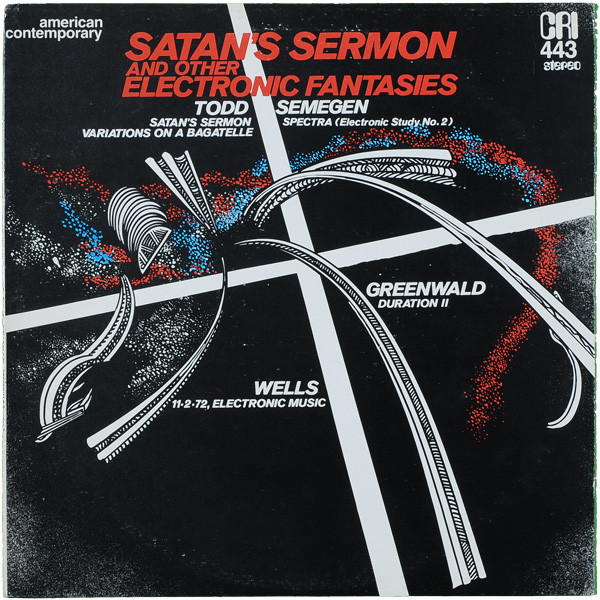
Various - "Satan's Sermon and Other Electronic Fantasies" Vinyl, LP, Album, 1980 (Composers Recording Inc)


I just did a Tosh Talks episode with my friend and translator Paul Knobloch, and he brought this album over to the house as a gift.  He knows that I'm crazy about electronic music from the 1950s to 1970s.    This is an album with music by four composers, who to this day, are unknown to me.  George Todd, Saria Semegen, Thomas Wells, and Jan Greenwald.  Looking up their names on Discogs website I don't find that many other recordings by these composers, which is a shame because the album is a delight. 

"Satan's Sermon" is a work by Todd that is mostly done on a synclavier, invented in 1977-1978.  A lot of bands in the 80s used the synclavier, especially in the recordings produced by Trevor Horn.  Here, its use is totally expansive and driven by an Able 40 computer.  It's digital meets analog.  The music is dark since it is called "Satan's Sermon."  

My favorite work on this compilation is Greenwald's "Duration 2" which was composed on the Nova 1200 Data General computer attached to Buchia 500 digital-to-analog synthesizer.  It's a very slow piece that's meditative but has textures that reflect sinister or even cinematic touches of an Alfred Hitchcock piece of work.  

Wednesday, January 17, 2018

Les Rita Mitsouko - "Variéty" Vinyl, LP, Album, 2016 (Because Music)


Les Rita Mitsouko is Catherine Ringer and the late (and great) Fred Chichin.  A remarkable French band from the 1980s to the 21st century.   "Variéty" their last album, due to Chichin's death, is an album of many pleasures.  Ringer is one of the great figures in rock/pop music period.   Her expressive attitude and voice and sense of wonder are way beyond other singers of her generation.  Why she is not an icon here in the United States or in the U.K. can only be that most of the songs are in French.   It is the English speaking world's loss if one cannot dwell on Ringer's (and Chichin's) world. 

"Variéty" after repeated listenings is a treasure to behold.  Joyful, witty, strong melodic moments, and superb performances.  Mark Plati is the (not so) secret presence on the album.   He worked with David Bowie for numerous years, and he brings a Bowie touch to the project that reminds me a bit of that singer's "Hours" album.  Very straightforward approach to the song, but hidden textures that unfold on repeated hearings.   In a healthy world, these songs would be played on the radio on a consistent basis.  Alas, that's not the world that we live in.  

Sunday, January 14, 2018

Egisto Macchi - "E.S.P. Vinyl, LP, Album, OST, Limited Edition, 1973/2016 (Cometa Edizioni Musicali)


For those who have read my previous posts as well as my talk on Egisto Macchi https://youtu.be/rqCI97HMQxY know that I'm a huge fan of his work. I'm very passionate about Macchi's music at the moment because it's a new discovery or a new love.  Macchi is known for the music he composed for library music companies.   He was very much a close associate of Ennio Morricone, and like that great composer, they do share a sense of aural adventure.  Morricone did a lot of big budget films, and Macchi did mostly work for grade-z film productions.  Nevertheless, he was a brilliant composer.  E.S.P. is a work of stunning beauty.  

E.S.P. was an Italian TV series, and the music on this album basically plays the one theme but in different arrangements.  When I first heard E.S.P., it reminded me of the soundtrack "Twin Peaks, " in that both pieces capture a wishfulness but a sense of sinister underpinning around the corner.  The main instrument on E.S.P. is the Theremin.  Played not like a science fiction soundtrack, but more of a melodic instrument that fits in the orchestration perfectly.  The score is haunting and it's the perfect late night sound to reflect on one's life.  A superb album. 


Monday, January 8, 2018

The Velvet Underground - "1969" 2 x Vinyl, LP, U.S., 2017 (Republic Records)


In the glory days of the music world, there would be releases from record companies that have nothing to do with time or space.  Just product.  I by chance found this album "1969" by The Velvet Underground, and I have to imagine that it's a combination of the 1980's release of "VU" and "Another View" which is basically putting everything out under the Velvet's recorded catalog of the time.   Now, Universal music has put together these two albums as a double-album set on vinyl.   Three-sides are the Velvets with Doug Yule in the line-up, and side four is when John Cale was in the band.  Probably somewhere between White Light/White Heat and the Third album.  There are no liner notes explaining the reason for this album, so it's very much of a rush-released piece of product. "1969" is also a great compilation of Velvet Underground tracks that never made it to the final works (albums).  

The truth is The Velvet Underground couldn't do anything wrong from the years 1966 to 1970.  Lou Reed was on the top of his songwriting powers, and even throwaway songs like "Foggy Notion" are magnificent.    When I listen to these set of songs decades later, it strikes me how original his approach to pop/rock songwriting was at the time of these recordings.  For one, (both line-ups) the band was fantastic, with Moe Tucker's dynamic primitive drumming, with the combination of Lou and Sterling Morrison's guitars going in and out of their arrangements.  Then you have someone like Yule with his backup vocals, or Cale's viola riding on the rhythm, and you have this tremendous noise that's The Velvet Underground. 

There are no weak cuts on this four-sided package. All of it is essential if you are a Lou or Velvets fan.   The cover/packaging is boring but the sounds inside the package are going to take one to other worlds.